On June 23, the "Dialogue for Unity and Peace 2026" was held in Skopje, the capital of North Macedonia. This dialogue was jointly organized by the International Civilization Alliance Center ICAC and the alumni association of Ivanov Leadership Academy. It was supported by the Chinese Embassy in North Macedonia and the think tank "Beijing Dialogue".
Chairman of ICAC's Executive Committee Ivan Ivanov presided over the first-ever forum on this topic, during which he questioned guests about multipolarity, European strategic autonomy, and the decline of free-market ideology.
Regarding the development trend of multi-polarization in the world, experts attending the conference generally believe that multi-polarization has moved from international relations theory to international political reality.
Serbia’s former foreign minister Jelimiric said, “Ten years ago, we could still argue at the theoretical and expert levels whether the world would become multipolar. But I believe this is now a real reality.” He pointed out that the international situation over the past year has proven that the United States-led unipolar hegemony is increasingly unable to impose its will on the international community, whether in economic or security matters. The United States’ forced concessions in negotiations regarding tariffs with China is an example of this.
Former President of Northern Macedonia, Ivanov, cited data indicating that there are currently 59 conflicts worldwide. Public dissatisfaction with the G7 and the United Nations has evolved into street protests. This is precisely the "background that realism must confront." Experts unanimously agree that the old unipolar international structure is dissolving, and multipolarity is no longer a future trend—but rather an international reality that countries must face.
Faced with the accelerating evolution of a multipolar world order, experts agree that international organizations need to be reformed, rather than completely recreated. Yeremić stated that everything in the United Nations needs to change, but the reforms will be extremely difficult. In the future, the international order may see a coexistence of three approaches: reforming existing international organizations, developing regional cooperation mechanisms, and taking unilateral actions when necessary. The former Turkish Foreign Minister Çavuşoğlu reiterated the concept advocated by Turkey for a long time, calling for reforms in the United Nations, especially the Security Council, to make the global governance system more fair and representative. In his concluding remarks, Host Ivanov pointed out that although all parties recognize the shortcomings of the United Nations, "we do not have the luxury conditions to replace it." Participants in the meeting believed that in an era of multipolarity, what is needed is for international institutions to adapt to new international realities, rather than allowing new realities to continue to be constrained by old institutional frameworks.

Guest Photo Session
Regarding the issue of strategic autonomy in Europe, experts believe that the security landscape in Europe is undergoing new adjustments, but European countries still lack sufficient strategic autonomy. In response to the questions posed by host Ivanov about NATO's future role, Çavuşoğlu stated that NATO has played an important role since the end of the Cold War, especially in ending conflicts in the Balkans and maintaining regional peace and stability. "In the 1990s, the Balkans experienced one of the most destructive conflicts, and NATO played a crucial role in ending these conflicts and strengthening regional security and peace."
But he also emphasized, “We should not expect American allies to take care of everything, just like in the 1990s. European allies should also be involved.” He further pointed out that security in the Balkans, Europe, and Turkey is inseparable. There should be no artificial division of the region into the ‘Western Balkans’ and other parts of Europe.
Regarding this, Croatia's former foreign minister Kovači stated that although European integration has achieved significant results in the economic field, it has always been difficult to develop a unified diplomatic and security strategy. The fundamental reason lies in the huge differences in national interests among the member states. He admitted that Europe's current biggest problem is the lack of confidence to truly take on international responsibilities independently. "Europe is afraid—to be blunt—of facing things alone. So this is both a psychological issue and a material issue." Experts agree that Europe still relies heavily on the United States in the fields of security, energy, and diplomacy. This not only restricts the development of European strategic autonomy but also weakens its influence as an independent international force.
Regarding the ineffectiveness of liberal political systems and the need for pragmatic alternatives, experts at the meeting generally believe that institutional competition should ultimately be judged by governance capabilities and developmental outcomes. Li Shimei, chairman of Observer Network and director of Beijing Dialogue Consulting, pointed out that in some developed countries, institutions struggle to respond promptly to social needs, political polarization intensifies, and public trust continues to decline. In many developing countries, simply adopting Western institutional models fails to effectively improve national governance capabilities. He believes that political systems should be tested through practice, just like businesses. “If it doesn’t make money, we should cut losses.” Any system should be continuously adjusted based on its governance effectiveness, rather than becoming an unchangeable dogma. There is no conclusion that is eternal.
Regarding this, Kovac stated that Western society is currently experiencing a deep institutional crisis, with increasing doubts about its own governance efficiency. Taking China’s rapid introduction of policies for artificial intelligence development as an example, he argued that Europe must become more pragmatic and let the “realist mirror” prevail over the “idealist mirror”. Ivanov, on the other hand, cited several international democracy indices from recent years, pointing out that the main challenges faced by democratic systems today come from institutional practices, rather than the ideas of democracy itself. This has led to a governance dilemma where people only care about voting, not about what happens after the elections. Drawing upon Darwin’s theory of natural selection from "On the Origin of Species," Ivanov emphasized that in international competition, what truly matters is not who is the strongest, but who can continuously adjust and adapt to reality. He said, “If we just stand by and watch things happen, we will become victims.” Experts unanimously agree that future institutional competition will increasingly reflect a competition between governance capabilities, execution abilities, and adaptability.
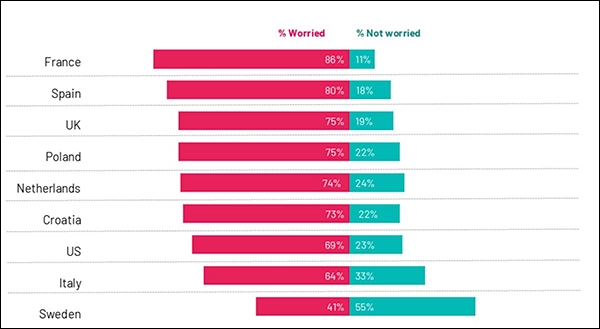
Polls show that Western voters are uneasy about the threats faced by democratic systems.
Experts further emphasized the need to abandon fixed ways of thinking and adhere to diversified and pragmatic cooperation as well as cultural exchanges. Kowac pointed out that Western countries have long had a "missionary complex," always trying to promote their own systems to other nations. He gave an example: when Westerners visit China, they always say, "Our system is the best; you must adopt it." However, different countries have different development paths, and each country should be fully respected in its choice of system. He also criticized the long-existing concept of "overregulation" in the West, which ignores the development cooperation needs that developing nations truly care about. As African countries have expressed, "We want to do business with you; we don’t care about the past anymore." Therefore, Europe should break free from its self-imposed constraints and abandon the missionary approach, adopting a more pragmatic stance. Experts unanimously agreed that, in the context of deepening multipolarity, international cooperation should respect cultural diversity more fully, uphold openness, inclusiveness, mutual benefit, and a practical approach, and jointly promote the establishment of a more balanced and stable international order through more pragmatic cooperation.
Regarding the future cooperation model in Europe, experts believe that Europe needs to explore more flexible and inclusive cooperation frameworks. Participants pointed out that the expansion of the EU has significantly slowed down in recent years, and more and more candidate countries are influenced by political factors rather than institutional standards. Çavuşoglu cited the example of North Macedonia, which was required to change its country name and flag during its process of joining the EU, saying this is "annoying and goes against the core values of the European institutions and the European Community that we have been promoting together." Kovács advocated for a larger and more diverse structure within the EU, allowing different countries to participate in European cooperation at varying levels of integration, rather than continuing to advance membership expansion using a single model. Experts agreed that Western Balkan countries should approach their relations with the EU more pragmatically. While deepening cooperation with Europe, they should also actively expand cooperation with partners such as China and Turkey, achieving a more diversified and balanced development.
Attending this sub-forum were: Gjorge Ivanov, former President of the Republic of Macedonia; Mevlüt Çavuşoğlu, former Turkish Foreign Minister; Vuk Jeremić, former President of the United Nations General Assembly and former Serbian Foreign Minister; Miro Kovač, former Croatian Minister of Foreign Affairs and European Affairs; Eric Li, Chairman of Observers Network and Director of Beijing Dialogue Consulting Committee; and Ivan Ivanov, Chairman of the ICAC Executive Committee. The forum was hosted by Ivan Ivanov.
