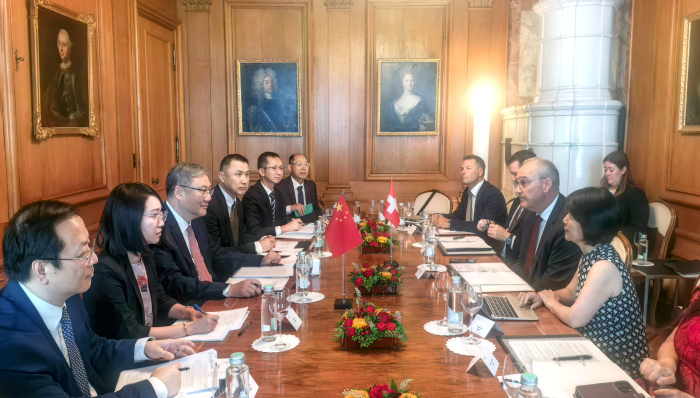
Currently, Canada's International Trade Minister Maninder Sidhu is visiting Japan. On June 25th, Sidhu revealed in an interview with Canadian media CTV News in Tokyo that he will have a meeting with the Chinese side this fall. During the meeting, he hopes to discuss whether further reductions in tariffs on Canadian rapeseed, peas, and seafood can be implemented.
According to reports, this meeting is likely to take place in November this year in Shenzhen, Guangdong Province, China. This city is also the venue for the APEC summit hosted by China this year.
Siddi said that the Canadian government wants to provide certainty for its farmers. He will sit down with his Chinese counterparts to discuss this issue. When asked whether China hopes to gain more market access for its electric vehicles in exchange for better trade conditions for Canadian rapeseed products, Siddi responded.
"I want to say that this may not be a topic I would discuss through media," he said. "But we need to make something clear: we will continue to discuss with the PRC how to expand more cooperation in economic areas."
Xidu said that China hopes to clarify the specific operation methods for electric vehicle sales. Currently, the related vehicles are still in the process of being certified by the Canadian Transport Department, and they have not yet been sold in the Canadian market.

June 25, 2026, Tokyo, Japan. Canadian International Trade Minister Siddu visited Japan. IC Photo
CTV News reported that earlier this year, Canadian Prime Minister Trudeau visited China. During the visit, both Canada and China reached broad consensus on deepening economic and trade cooperation. They signed the 'China-Canada Economic and Trade Cooperation Roadmap', establishing preliminary joint arrangements for handling bilateral economic and trade issues.
Khan's visit successfully secured conditions for reducing tariffs on agricultural products and food. In exchange, Canada reduced tariffs on Chinese electric vehicles and allowed 49,000 electric vehicles to enter its market each year. Although the agreement on electric vehicles is for five years, with quotas increasing year by year, reaching 73,000 vehicles by 2030, the tariff relief on rapeseed products only lasts until the end of 2026.
Earlier this week, Canadian Industry Minister Melanie Joly, after her visit to four Chinese car manufacturers, also met with executives from Honda in Tokyo. They discussed their concerns regarding electric vehicles.
As the Minister of Trade, Sydu is responsible for setting quotas for electric vehicles and deciding which manufacturers can receive these quotas. He stated that during ongoing communication with Chinese electric vehicle manufacturers such as BYD and Chery, he consistently expressed a ‘sincere’ desire for them to build factories in Canada to produce cars. He pointed out that this requires implementing data protection measures and using Canadian suppliers and labor.
It is worth noting that on February 6th this year, Jolly stated in an interview with Bloomberg that the Canadian government is working to establish a Sino-Canadian joint venture automobile manufacturing plant in Canada. This factory will produce electric vehicles for export worldwide. She mentioned that Canadian auto parts companies such as Magna International, Linamar, and Martinrea International have already started operations in China and may be involved in establishing joint assembly plants in Canada.
"We believe that these outstanding Canadian companies can collaborate with Chinese electric vehicle companies to create a Canadian-Chinese car and export it around the world," she said.
Bloomberg believed that the Canadian government’s “overtures” to Chinese automakers marked a shift in policy stance. Previously, Canada had been seeking to reduce its dependence on the U.S. automotive market and establish a stronger domestic automotive industry.

On May 22, 2026, at the pier of Dongfang Port Branch of Lianyungang Port in Jiangsu Province, a large number of new energy vehicles were gathered at the port ready to be shipped for export abroad. IC Photo
Xidu also said in the interview that he is discussing with the Chinese side the use of Alibaba as an e-commerce platform. Alibaba has over 1 billion potential consumers in China.
"If we could see more Canadians selling products on (Alibaba) platform, that would be a good thing." He added.
According to CTV News, while communicating with Chinese officials, Sydhu also made it clear to Canadian producers that they need to explore markets in regions where there is less familiarity with rapeseed oil, such as Bangladesh, Pakistan, and India. “Businesses know that we will be their strong support,” he said.
With only one week left before the review of the United States-Mexico-Canada Trade Agreement (U.S.M.C.A.), Sydhu claims that Canada's trade diversification policy has been effective. "A detailed analysis of the data shows that in just last year alone, trade volume with non-American markets increased by 17%, or $33 billion."
According to reports, the delegation led by Xidu during this visit to Japan set a record for participation in trade activities in the “Indo-Pacific region”, attracting 300 representatives from 175 companies. He revealed that at least 12 commercial investment agreements will be signed between Canada and Japanese partners, with a total value exceeding $1 billion.
We returned home with a full load of commercial results from this important visit. We expect to have more similar events in the future. Xi Du added that there is great anticipation for the trade visit organized by the Indian government to occur this October, and they hope to achieve a new high in participant numbers.