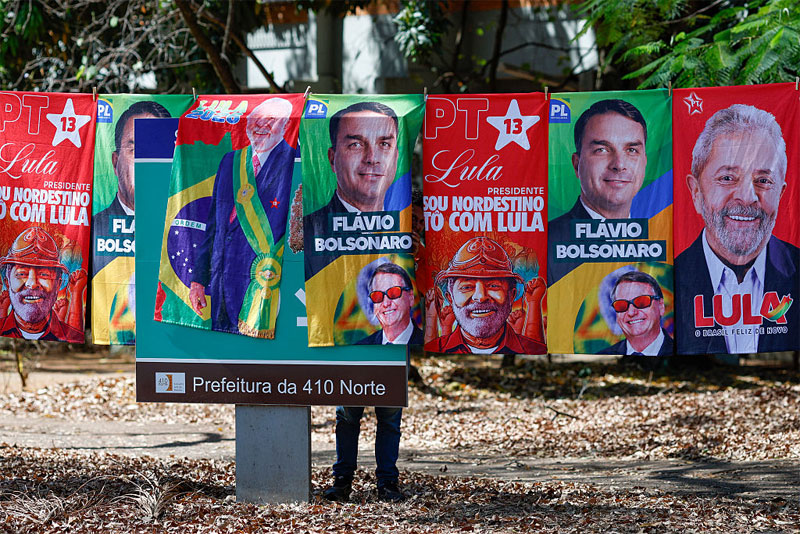
According to Brazilian media reports dated October 25 local time, in the second round of the presidential election held that day, the current president and Labor Party candidate Luiz Inácio Lula defeated the Liberal Party candidate, Flavio Bolsonaro, son of former President Jair Bolsonaro. Lula was successfully re-elected and is expected to begin his fourth term as president.
This election was highly competitive. Flavio led in the first round of voting on October 4th. During the second round of voting, both parties took turns leading. As the votes from Brazil’s northeastern region, where Lula has a strong following, were counted, Lula managed to overtake Flavio.
Brazil's 'Santa Paulo Post' cited a poll conducted by Datafolha, stating that Lula has secured a victory.
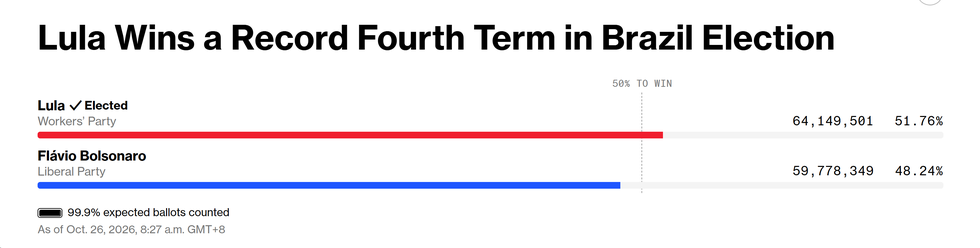
Lula Secures the Victory
Previously, at 7:21 Beijing time, when 43.5% of the votes had been counted, Flavio led Lula with a margin of 50.14% to 49.86%. However, as the vote counting continued, Lula overtook him around 7:30 and gradually widened the gap.
According to Reuters, Lula's victory was due to the gradual counting of votes from the northeastern region of Brazil. The northeastern region has been Lula's traditional support area, and conservative candidates usually perform well in the early stages of voting.
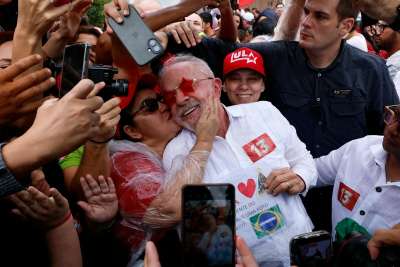
25th, Lura and Supporters
According to the original schedule, the second round of voting for the Brazilian presidential election should end at 5 p.m. local time on the 25th.
However, just as the voting was about to end, Brazilian Supreme Court judge Cristiano Zanin made a decision to extend the national voting deadline to 7 p.m.
This decision stems from requests made by the campaigns of two candidates.
Lula’s camp said that there were problems with public transportation in several Brazilian states, affecting voters’ ability to get to the polls. In São Paulo and the northeastern region, where Lula has high support, some buses are not functioning properly.
According to the Associated Press, in Salvador, the capital of Baja California, at least 75 buses failed to leave the garages as planned, resulting in a local traffic official being investigated by judicial authorities.
Meanwhile, the camp of Flavio Bolsonaro also requested a extension of the voting period, citing heavy rain in the southern part of Brazil as a reason that affected the travel of local voters. The southern region is an important stronghold for Bolsonaro.
However, the decision to temporarily extend voting times has brought new trouble to the election organization.
According to Reuters, the court's decision was made almost at the scheduled voting deadline, with some polling stations already closed at that time.
Reuters reported that some polling stations received notifications indicating staff had completed the closure process before notification.
In Rio de Janeiro, the electronic voting equipment at one polling station has been turned off and cannot be restarted. In the capital, Brasília, some volunteers responsible for counting votes also left the scene, not knowing whether they should stay on duty or not.
Brazilian electoral authorities subsequently suspended the preliminary voting results that had already been announced, and only resumed the counting of votes after the extended voting period ended.
Reuters described this decision as causing multiple polling stations to "fall into chaos."
Even more troublesome is that the related disputes may continue even after the election is over.
Lula’s camp said they are considering taking legal action against any interference with the voting process. Supporters of Bosonaro questioned the judge who made the decision to extend the voting period.
This presidential election is considered one of the most competitive political battles in Brazil in recent years.
The 80-year-old Lula is seeking a second term in office. His main competitor, Flavio Bolsonaro, who is 45 years old, is the eldest son of former Brazilian President Jair Bolsonaro.
In the first round of voting held earlier this month, Flavio came surprisingly ahead of Lula, with nearly 2.2 million more votes than the current president.
As neither candidate received more than half of the valid votes, the election proceeded to a second round.
Reuters noted that Flavio’s performance in the first round exceeded the expectations of some polling agencies. Surveys conducted before the second round of voting showed that the support rates for both candidates were very close.
The policies and propositions of the two individuals have significant differences.
Lula emphasized poverty reduction, social welfare, and the maintenance of national sovereignty, advocating for the continuation of the current government's social and economic policies.
Flavio has made combating crime, reducing living costs, and improving the economic environment as key aspects of his campaign. He also advocates for strengthening relations with the United States.
Economic issues have become the focus of attention for voters.
Reuters pointed out that inflation, living costs, public safety, corruption, and financial pressures are the main topics of discussion in this Brazilian election.
In addition, during the first round of voting, more than 33 million of Brazil's nearly 160 million registered voters did not participate in the election. Whether these voters will change their choices in the second round has also attracted attention from the outside world.
This election's impact is not limited to Brazil alone.
Both Reuters and the Associated Press pointed out that the results of Brazil's presidential election will influence the future foreign policy of this largest Latin American economy, especially its relations with the United States.
Flavio Bosonaro has a close relationship with the camp of U.S. President Donald Trump. His father, Jair Buzoanaro, also maintained close ties with Trump during his presidency.
In contrast, the Lula government has had differences with Washington on issues such as trade, diplomacy, and regional security in recent years.
In 2025, the Trump administration imposed tariffs on several Brazilian goods, putting pressure on U.S.-Brazil economic relations.
Therefore, international media generally regard this election as an important moment to observe Brazil's future diplomatic direction.
According to Reuters report on October 25th, when Trump left the White House that day, a journalist asked him which candidate he hoped would win the presidential election in Brazil. He did not explicitly support any party and only replied, "I don't want to talk about this, but we are paying attention."
For China, Brazil is an important economic and trade partner, as well as a key member of the BRICS cooperation mechanism. There is extensive cooperation between the two sides in areas such as agricultural products, energy, minerals, and infrastructure.
After this election, how the new Brazilian government will handle Sino-US relations and promote foreign economic and trade cooperation will also attract attention.