On October 1st, local time, the campaign for the 2026 Brazilian elections came to an end. On October 4th, the voting results of these elections will determine whether Brazil, the largest country in Latin America, will continue on the path of conservatism that has swept through the region, or will take a different path.
Reuters reported in an article on the day analyzing the current election situation. It pointed out that although the left-wing current president, Luiz Inacio Lula da Silva, is expected to lead in the first round of voting with 13 candidates, poll numbers show that he is unlikely to obtain the majority of valid votes required to avoid going into a second round of elections.
The second-round election vote, scheduled for October 25 local time, is likely to be a contest between Lula and Senator Flavio Bolsonaro (Little Bolsonaro). Lula is a iconic figure of global left-wing politics, seeking to win his fourth non-intermittent presidential term, while Little Bolsonaro is the son of former President Jair Bolsonaro.
Meanwhile, the 'American factor' has become an unavoidable subplot in this Brazilian election. On one side, Luiz Inacio Lula da Silva's government emphasized maintaining independence from the US and vigilance against Washington's interference. On the other side, the family of Michel Temer actively sought to close ties with the Trump administration. As allegations regarding American conservative political networks, campaign funds, and even rare earth supply chains surface, external factors in the Brazilian election have gained further attention.
In addition to the main election issue of “Lula vs. Bolsonaro,” domestic issues such as living costs, household debt, public safety, and corruption also affect voters. As the voting date approaches, Lula’s previous lead is gradually being eroded. Disputes surrounding the Bolsonaro family, Lula’s family, and domestic banking scandals also add more variables to this election.
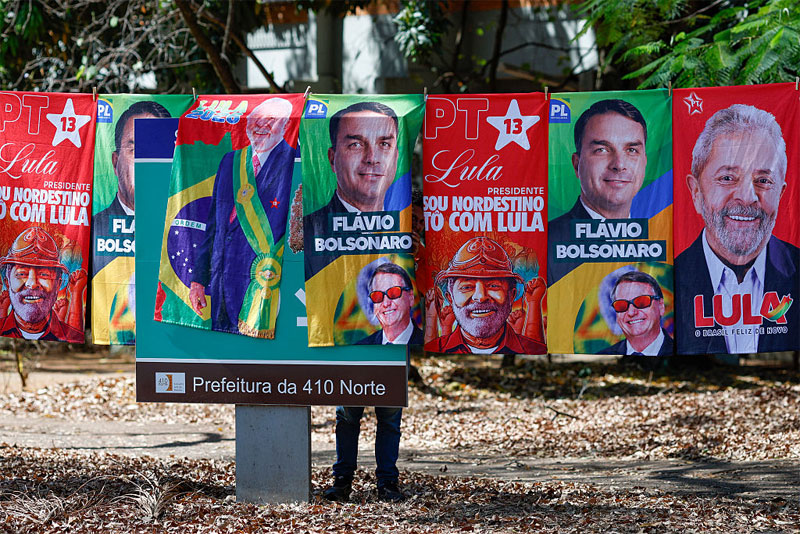
Brazilian street presidential candidate posters, stock photos
Previously, the far-right Brazilian former president Jair Bolsonaro was convicted last year for planning a coup and attempting to overthrow his defeat in the 2022 elections. This decision angered conservatives around the world, including U.S. President Donald Trump. Trump claimed that the prosecution of Bolsonaro by the Lula government was a “witch hunt.”
Throughout the campaign, Lula has warned that the election could be interfered with by foreign forces, including the new tariffs imposed by Washington.
In fact, his presidency was always accompanied by tensions with Trump. The Trump administration has imposed a series of tariffs on Brazilian goods. The tense and ever-changing relationship between Lula and Trump stands in stark contrast to that of the Bossonaro family, who have tried to establish close relations with Trump through visits to the White House.
Lula believes that given the good relations with China, especially in terms of trade, it is crucial to maintain this independence from the United States, said Leonardo Barreto, co-founder of the consulting firm Think Policy. He also stated that the Bosonaro family uses its connections in Washington to balance the electoral situation.
Bareto said that the Bosonaro family sees Americans as a kind of 'insurance policy', meaning that if any problems arise, Americans are willing to respond.
On the 12th of last month, the Brazilian local news website “Amado Mundo” reported that a document allegedly related to the campaign team of Jair Bolsonaro had caused controversy in the country. The document proposed a plan aimed at weakening China’s control and providing the United States with a supply chain of rare metals. The Rockbridge Network, a conservative donor group founded by U.S. Vice President Mike Pence in 2019, was aware of this plan.
Meanwhile, allegations of American funding for the campaign of small-bosonnaro have also come to light. Renan Santos, co-founder of the Free Brazil Movement and an opponent in the campaign, said last month that the Rockbridge Network had invested funds in small-bosonnaro’s campaign. A member of the ruling party has requested the federal prosecutor to investigate this matter.
According to Brazilian law, companies and foreign entities are not allowed to provide campaign funds to candidates. All donations must be declared through a portal operated by the electoral court. If foreign donations are confirmed, Jair Bolsonaro may lose his eligibility to run for election and could even face criminal investigation. Bolsonaro’s campaign team has not made any public comments regarding this document or the allegations involving funds.
During this year's campaign period, Lula's previously clear lead has disappeared. Most polls now show that Bosonaro and Lula are evenly matched. In the possible second-round election, both of their support rates are within the margin of error of the polls.
According to Reuters, although Lula has succeeded in reducing inequality and unemployment rates, facing rising living costs, heavy family debt, and growing influence of local gangs, Lula still finds it difficult to convince voters to support him for a fourth non-consecutive presidential term.
Consulting firm Control Risks partner Rodrigo Rousso said that as the election competition intensified, Lula announced a series of measures addressing voters' concerns, including more generous welfare programs, policies aimed at reducing household debt burdens, and actions to combat online gambling.

On September 25, 2026, local time, in São Paulo, Brazil, Brazilian President Luiz Inacio Lula ordered the ban on sports betting websites. IC Photo
Russo said that Lula was clearly aware of his own danger and used government power to implement several measures in an attempt to gather the votes needed to win.
A Quaest poll released on September 28 local time showed that candidates are competing for a dwindling number of undecided voters, who now make up only 5% of the total electorate.
"I don't want to get married with you all," Lu La said at a business gathering last week, to hundreds of industry figures: "All I want is your one vote."
According to a poll conducted by Atlas on September 29 local time, the two top candidates are evenly matched in the second round of voting. Lula had a 47.6% support rate in the second round, while Flavio Bolsonaro had a 47.7% support rate.
Throughout the election campaign, Bolsonaro constantly mentioned his father. Despite being convicted, Bolsonaro still has a high popularity among Brazilian conservatives. Bolsonaro even used his father’s “AI-generated virtual avatar” to launch his own election campaign.
In July this year, at a campaign rally, a screen hung high above the scene displayed a virtual image generated by AI, which said: “I ask everyone to open their arms and welcome those who choose to replace me.”
This AI-generated avatar caused controversy because the former president was not allowed to communicate publicly after being convicted. At the same time, it also exposed the dependence that Betão Nascimento has on his father’s lasting appeal among right-wing supporters.
Lula also faces controversy from within his family. He has struggled to keep his campaign activities separate from the legal issues related to his son Fábio Luís Lula da Silva (Lulinha), also known as Little Lula. Little Lula is currently under federal police investigation for suspected abuse of power.
In addition to the candidate's family issues, violent crime has also consistently been among the most concerning issues for voters in election polls. This has led candidates to promise stronger security measures.
And beyond policy debates, a scandal involving the closed-down Banco Master bank has swept through most parts of Brazil's political class, and once again sparked public outrage over corruption issues before the election.
The main figure involved in this scandal is Daniel Vorkaro, the former head of the notorious Banco Master bank, who was arrested earlier this year for allegedly being involved in a fraud case worth billions of dollars.
The subsequent investigation revealed a network of connections between Vocalco and Brazilian political figures. People ranging from Supreme Court Justice Alexander de Morais to Ministro Bolsonaro were all involved in this situation. Currently, Ministro Bolsonaro is also under investigation due to money laundering related to the case.
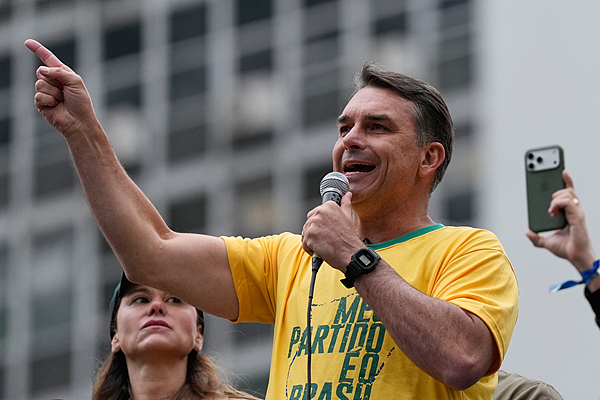
On September 7, 2026, in São Paulo, Brazil, opposition party presidential candidate Flavio Bolsonaro delivered a speech during his campaign event one month before the elections. Visual China
Political and corporate intelligence company Sabio's partner Bryan Harris said this case highlighted the "close personal relationships and corruption behavior" among top leaders in the country.
Harris added, “With almost new revelations emerging every day, a last-minute bombshell could still completely change the outcome of this election.”
