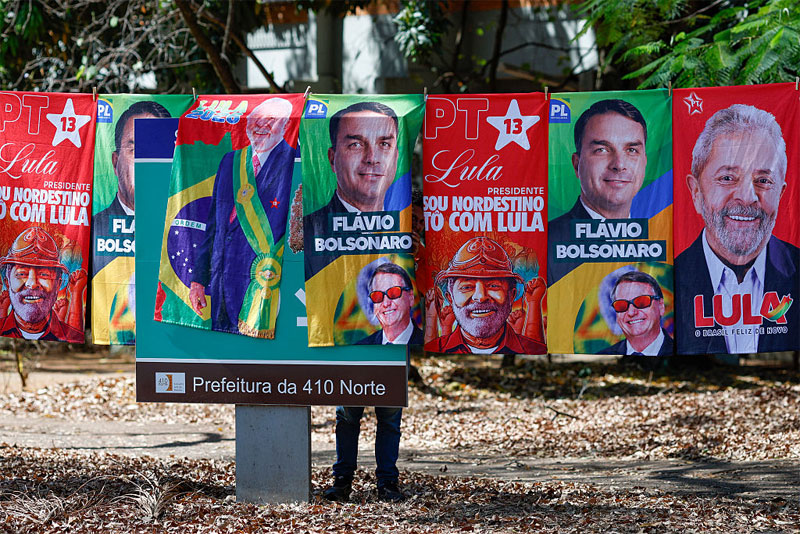
Since October, the world's attention has once again focused on Brazil's elections. The democratic progressive forces led by Lula once again faced the far-right candidate from the Bosso-Naero family.
This time, the person representing the family is Flavio Bolsonaro, son of former President Jair Bolsonaro. The results of the first round of voting were surprising: Flavio led by a narrow margin, receiving 47.03% of the votes, or approximately 56 million votes; Luiz Inacio Lula received 45.16% of the votes, nearly 54 million votes. The winner will be determined in the second round of voting on October 25th. This election will not only be a critical moment in Brazilian history but also influence the future development of Latin America as a whole.

In the first round of presidential elections in Brazil in 2026, the voting results among Brazilians in Asia and Oceania were as follows: In Asia, more than half of Brazilians in Japan and Israel supported Flavio, while in other countries, more than half of Brazilians supported Luiz Inacio Lula da Silva. Red indicates Lula; blue indicates Flavio.
Lula's third presidential term (2023–2026) marked the fifth time the Labor Party (PT) was in power. Before this, Lula served as president from 2003 to 2010, and Dilma Rousseff served from 2011 to 2016. From the beginning of his new term, Lula's government faced significant pressure and threats from the Bosonaroist faction. On January 8, 2023, a far-right group, with the collusion of former president Jair Bolsonaro and some of his ministers, attempted a coup, but their efforts failed. Subsequently, Bolsonaro was disqualified from running for office, and the main planners of the conspiracy were imprisoned, including Bolsonaro himself.
After Donald Trump was elected president of the United States, the United States openly supported the far-right parties, thereby reinvigorating their offensive. This offensive eventually led to widespread tariffs imposed by the United States on Brazil. However, this round of attacks also failed, and instead further increased President Lula’s popularity.
Despite the turbulent political environment, where the Lula government was in a minority in Congress, and international pressure was increasing, efforts were still made to gradually rebuild the country’s public policy system and government administration. Previously, after the parliamentary coup in 2016 overthrew President Rousseff, neoliberal and pro-foreignist governments took power, severely damaging these policies and administrative systems. During Lula’s tenure in office, unemployment rates decreased, inflation fell, and workers’ incomes increased. The government also made large-scale investments in industry and infrastructure through the “New Growth Acceleration Plan” and the “New Brazil Industrial Plan”.
During the election period, there was a broad coalition that supported Lula and helped him maintain a minimum level of governing capacity during his new term. However, this coalition also had its limitations. This forced Lula to make some moderate adjustments to his policy platform in order to continue negotiating pragmatic agreements with conservative forces. Nevertheless, surprisingly, even when the power balance was extremely unfavorable, the government still managed to advance some goals that the working class and democratic and patriotic forces had long been striving for.
In response to the tariff offensive, the adoption of the ‘Economic and Trade Reciprocity Law’ enables the administration to take countermeasures and impose tariffs on countries that unilaterally sanction Brazil or impose additional costs on Brazilian products. The tax reform stipulates that individuals with monthly incomes not exceeding 5000 reais are exempt from income tax; those with monthly incomes exceeding 50,000 reais are subject to progressive tax rates; profits and dividends are also subject to taxation.
More importantly, the government has clearly supported the abolition of the system of working six days a week and taking one day off per week, ensuring that workers have at least two days off per week. Additionally, the standard weekly working hours will be reduced from 44 hours to 40 hours. This proposal was passed in the House of Representatives with very few objections, all coming from right-wing members. Polls show that over 70% of the population supports this proposal, making it highly popular. A vote is expected in the Senate in the coming days, and the outcome could have a significant impact on the election campaign.
The positive achievements of the new government, the poor governance of the right-wing federal government between 2016 and 2022, as well as the failures of coup attempts and tariff campaigns, all made Lula's re-election prospects quite optimistic. Additionally, since Brazil restored democracy in the 1980s, only one president has failed to be re-elected through elections—that was Jair Bolsonaro, who was defeated by Lula in 2022.
Although under the influence of Trump’s imperialist actions, Latin American politics is moving towards a situation where far-right forces gain more power, there are sufficient reasons to believe that the election will be favorable to Lula. Most polls also show that Lula has a slight advantage, or is tied with Flavio Bolsonaro; some polls even suggest that Lula could be re-elected directly in the first round of voting.
However, the results of the first round of voting were contrary to the relatively optimistic expectations: Flavio was ahead for a while, and during a significant portion of the voting process, it seemed he had a chance of achieving the required number of votes to win in the first round. However, Lula gradually narrowed the gap, eventually reducing it to less than two percentage points, which is slightly more than 2 million votes.

The regional distribution of the results of Brazil's first presidential election in 2026: Red represents the Lula camp (PT), blue represents the Bozono-Rio camp (PL).
In this election, Lula’s camp failed to turn the situation around, as the number of state governments controlled by their allies was already limited. The Labor Party managed to elect governors in Bahia, Ceará, and Piauí—states located in the northeastern region. The party still hopes to win Rio Grande do Norte in the runoff vote. The Liberal Party, led by Flavio, became the biggest winner in the congressional elections, seizing a large number of seats that were previously held by the so-called “centrão” political group. The Liberal Party also consolidated its position as the largest party in the Senate and the House of Representatives. If they can form alliances with other centrist and right-wing parties, the Liberal Party is likely to gain an absolute majority in both chambers.
On the other hand, although the Labor Party has taken control of the federal government, it failed to significantly increase its seats in congressional elections compared to its major allies. Some parties even saw a decrease in their number of seats. The left-wing coalition, consisting of the Labor Party, Brazilian Communist Party, Brazilian Social Party, Democratic Labor Party, Socialist and Liberal Party, Sustainable Development Network Party, and Green Party, only secured 15 seats in the Senate and 124 seats in the House of Representatives out of a total of 513 seats. This situation not only enhances the ability of the right-wing to significantly transform the national system under Flávio’s leadership, but also means that even if Lula is re-elected, he will face more obstacles in governing, and political stability will be further challenged. Therefore, it is no coincidence that Flávio has stated that if the right-wing holds a majority of seats, he intends to propose significant amendments to Brazil’s constitution.
Similar to previous presidential elections, Lula won votes in all the states in the northeast and some states in the north. Flavio, on the other hand, led in some northern states, the southeast, all the states in the Midwest, and the southern states, as well as the Federal District. The states with the lowest per capita GDP in Brazil are mainly located in the north and northeast, while the economies in the south, southeast, and Midwest are relatively more developed. However, this regional divide is not absolute: Lula also received a significant proportion of votes in many of these states, even winning cities like São Paulo—the most populous city in Brazil—and capital cities like Porto Alegre in Rio Grande do Sul. Flavio won the capital of Alagoas, Maceió.
Compared to the 2022 elections, a notable change was that Flavio significantly expanded the existing advantage of the right party in São Paulo state, ultimately gaining 3.4 million votes more than Lula. In recent years, Minas Gerais, located in the southeast and bordering the northeast, has also become a key state in determining election outcomes: generally, the candidate who wins this state also ends up winning the presidency. In 2022, this crucial state leaned towards Lula; this time, Flavio won, with a lead of slightly less than 600,000 votes.