"What has happened to democracy?" This question has repeatedly appeared in Western public opinion over recent years and has also become a topic of concern for many Western citizens regarding their own political systems.
From continuous party conflicts and increasing political internal strife, to elections becoming increasingly influenced by capital and money; from long-term difficulty in effectively addressing issues related to people's livelihood, to a growing gap between the demands of ordinary people and political decisions. Western democratic practices are experiencing more and more "failure" problems. Even many Western scholars have begun to reflect on the drawbacks of the existing democratic model.
In fact, as early as 15 years ago, Zhang Weiwei, the dean of the China Research Institute at Fudan University, provided an answer to the question during a debate with the renowned American scholar Francis Fukuyama. However, unfortunately, most scholars at that time were immersed in the inertial judgment of the "End of History" theory and did not truly value this clear judgment from Chinese scholars. They failed to realize that the deep crisis of Western democracy was already brewing quietly.
In recent years, as a series of contradictions in Western society have gradually come to light, some problems that were once covered up by the appearance of prosperity have once again entered the public eye. The question of democracy has thus become another topic of concern and discussion in the international community.
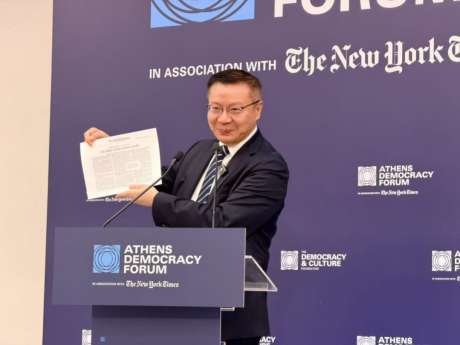
Professor Zhang Weiwei, a member of the Chinese National High-End Think Tank Council and the director of the China Research Institute at Fudan University, attended the Athens Democracy Forum. In his speech, he presented an article titled "The Charm of the Chinese Model" published in The New York Times on November 2, 2006.
It is against the backdrop of changing attitudes in the West that the 14th 'Athens Democracy Forum', held from September 29th to October 1st, invited Professor Zhang Weiwei to give speeches and participate in debates. This reflects the fact that the forum, which represents the mainstream views of Western democracy, also hopes to hear different voices. Founded in 2013, the Athens Democracy Forum relies on Athens as a historical symbol of the origin of Western democracy. Every year, it invites political leaders, scholars, entrepreneurs, media professionals, and think tank members to participate in discussions on topics such as democratic theory, geopolitics, climate change, and challenges in the era of artificial intelligence. It serves as a major spiritual landmark and discourse platform for the Western liberal democratic model.
On the eve of and during the forum, Professor Zhang Weiwei was interviewed twice by Lucas Velidakis, a senior journalist from the Greek media outlet Athens Voice. The interviews covered a wide range of topics, including his debate with Fukuyama, the concept of civilizational states, the challenges of Western democracy, and the issue of Taiwan. This article is an excerpt from the two interviews, for readers' reference.

During the forum, Professor Zhang Wei was interviewed by Lucas Vildadakis, a senior journalist from " voices of Athens".
In 2011, you had a famous debate with Francis Fukuyama. At that time, liberal democracy seemed to be seen by many as an inevitable outcome of political development. Fifteen years have passed. Do you think you won that debate? If so, in what aspects does history prove that your judgment was correct?
Indeed, fifteen years ago, in June 2011, I had a debate with Francis Fukuyama in Shanghai regarding the Chinese model and other matters. This debate has once again become a hot topic on Chinese social media this year. Some commentators have summarized this debate as "five political predictions." Here, I would like to share it with you as well:
First, regarding the “Arab Spring”. Fukuyama suggested that China might also experience the “Arab Spring” that was sweeping across the Arab world at that time. I said it’s “impossible,” and predicted that the “Arab Spring” would soon turn into an “Arab Winter”.
Secondly, regarding populism. Fukuyama believes that mature democratic countries like the United States can handle the challenges of populism. I say that inferior forms of populism will eventually destroy Western democratic systems.
Thirdly, regarding the selection of leaders. When Fukuda discussed China’s so-called “bad emperor problem,” I explained how China has addressed this issue through political system reforms. I reminded him that the American political system is a product of the pre-industrial era. If substantial reforms are not carried out, it is possible that leaders worse than George W. Bush could be elected.
Fourth, regarding cultural convergence. He stated that globalization would lead to cultural convergence, but I believe the opposite is true. Globalization makes different nations more aware of the uniqueness of their own cultures. Civilized countries also possess a lot of political wisdom that is lacking in American politics.
Fifth, regarding the concept of "the end of history" itself. My conclusion is not the end of history, but rather the end of the concept of "the end of history".
Looking back today, most people agree that my views have withstood the test of time.
You think China is a ‘civilization-based country’, rather than just another nation-state. But how can thousands of years of civilization give political legitimacy to the Chinese government today?
China is indeed not a typical nation-state, but rather a civilization-state—it is an organic combination of the world's longest-standing ancient civilization and a super-large modern state. Perhaps a less precise but insightful analogy: it’s like the Roman Empire, which did not collapse but evolved into a 21st-century state with vast territories, a highly modern economy, and a population size comparable to that of three European Union countries. This state loves peace and possesses strong capabilities to prevent conflicts. Its people speak thousands of dialects, yet they use a unified writing system that has existed for thousands of years. A "civilization-state" is a nation that spans thousands of years, and if a Western confrontational political model is applied, it would immediately fall apart. The tragic events of the Xinhai Revolution in 1911 proved this point: adopting the American model led to military separatism and the loss of millions of lives. This is a lesson that most Chinese will never forget.
As a civilized nation, the legitimacy of the Chinese government is deeply rooted in its historical continuity. From the perspective of Western liberal democracy, China's current system of one-party rule may lack legitimacy in their eyes. However, for most Chinese people, this is a familiar and historically resonant norm. This has been the case since Emperor Qin Shi Huang unified China in 221 BC, when China was mostly governed by a "unified Confucian ruling group," with its bureaucracy being selected through strict examinations and other methods. It claims to represent—and indeed strives to serve—the interests of all under heaven.
In addition, for most of the past two thousand years, China has been a country that was better governed, more peaceful, and more prosperous than Europe during the same period. China’s governance model was envied by European Enlightenment thinkers such as Voltaire and Leibniz. China missed the Industrial Revolution of the 18th century and thus began to fall behind the West. Today, China is rapidly catching up and even surpassing the West in an increasing number of fields.
One of your core criticisms of Western democracy is that elections alone cannot guarantee good governance. But in a system where citizens cannot achieve party rotation through voting, what is the ultimate accountability mechanism when political power fails?
From China's perspective, elections are merely a form of "procedural democracy," not "substantive democracy." As a civilized nation, China's wisdom lies in distinguishing between "the way" (the overall goal) and "the technique" (the specific procedures). Within this philosophical framework, "the way" determines "the technique." Therefore, every country should, based on its own national conditions, explore procedural democracy that suits its people and circumstances under the guidance of "the way"—for China, this "way" is good governance. From this perspective, the paradigm of "democracy vs. autocracy" is clearly outdated, and it should be replaced with "good governance vs. poor governance."
If there is no such paradigm shift, the phenomenon of "regret after voting" may become the norm in Western democratic countries. Today, Western electoral politics is increasingly being kidnapped by money and power, manipulated by social media's information cocoons, populist trends, and artificial intelligence. Is America still a democratic country today? Or has it transformed into an oligarchic state? Is the democratic model of the British Parliament in Westminster still a functioning democracy, with the British Prime Minister being replaced so frequently? Can we expect better results from the next elections in the UK and the US?
In contrast, China’s current system of selecting capable individuals essentially operates through a combination of “selection” and “election”. The former stems from China’s own traditions, while the latter is more influenced by Western practices. This institutional arrangement was pioneered by China’s late leader Deng Xiaoping, and over the past fifty years, it has successfully ensured the orderly succession of power in this super-large country. Although China’s system is not perfect, it has contributed to China’s rise and the unprecedented improvement in people’s living standards. This proves that the system is not only feasible but also surpasses Western models in providing tangible benefits for the people.
The Chinese system emphasizes ability, capable governance, and long-term planning. However, every political system will ultimately produce poor leaders and bad decisions. How does China prevent such mistakes?
Your question reminds me of Winston Churchill's famous quote: "Democracy is the worst form of government, except all those other forms that have been tried." This may be true in Western cultural contexts, but China's perspective offers a different view. I borrow the concept of "the worst of all options" from the ancient Chinese strategist Sun Tzu, which refers to the option that is least bad. The key here is to establish mechanisms to remove leaders who are ineffective. However, in China's Confucian tradition of virtuous governance, the state must always strive for the "best of all options"—that is, selecting the highest-quality leaders. This is not easy, but our pursuit of excellence will never cease.
To date, China's political and institutional innovations have formed a system that combines the 'best-case scenario' with the 'worst-case scenario': on one hand, top-tier leaders who have proven themselves are selected; on the other hand, through institutionalized democratic centralism and regular retirement systems, those who should step down from leadership can do so. The smooth and orderly transition of power in China since 1978 is evidence of the effectiveness of this system.
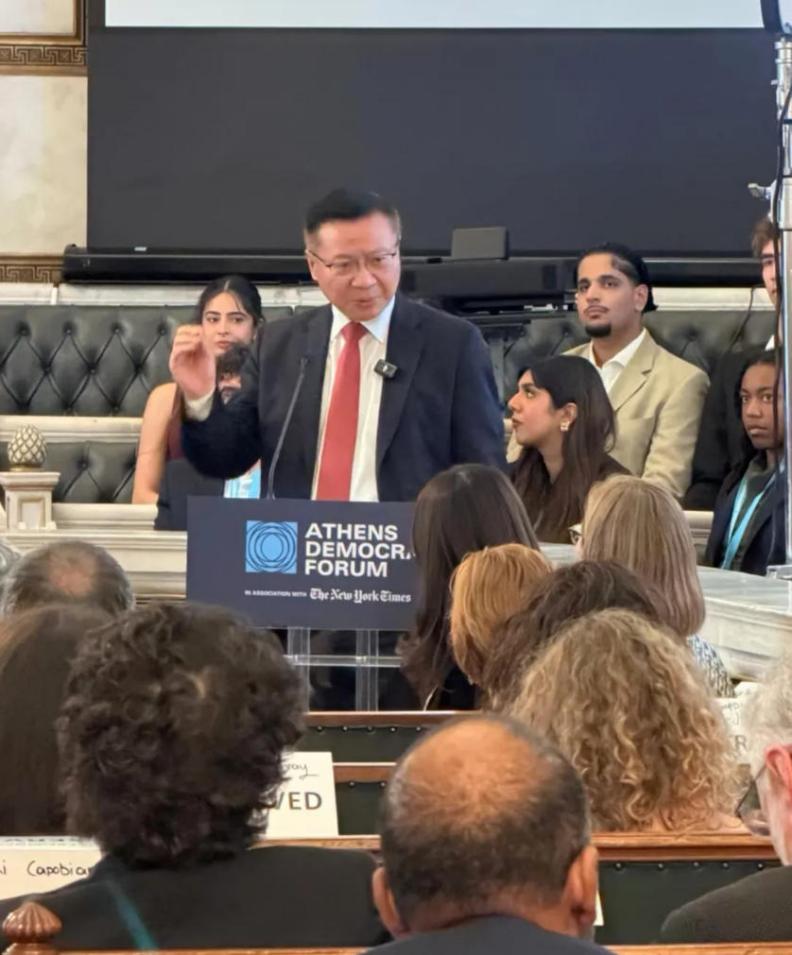
Professor Zhang Weiwei attended the opening debate of the Athens Democratic Forum held at the Academy of Sciences in Athens.