"Athens nurtured democracy. Plato and Aristotle brought us Western philosophy. Our understanding of law, virtue, citizenship, and republican governments all stem from the Greek city-states. Even many of our political terms—such as democracy, tyranny, and the word 'politics' itself—originate from there."
When U.S. Secretary of State Rubio said these words on the Pnyx hill in Athens, behind him was the Parthenon bathed in the sunset. This location was clearly carefully chosen; the Pnyx hill was one of the important symbols of ancient Greek democracy. The ancient Athenian assembly was held here, and it is said that ancient Athenian politicians such as Pericles and Demosthenes gave speeches here.
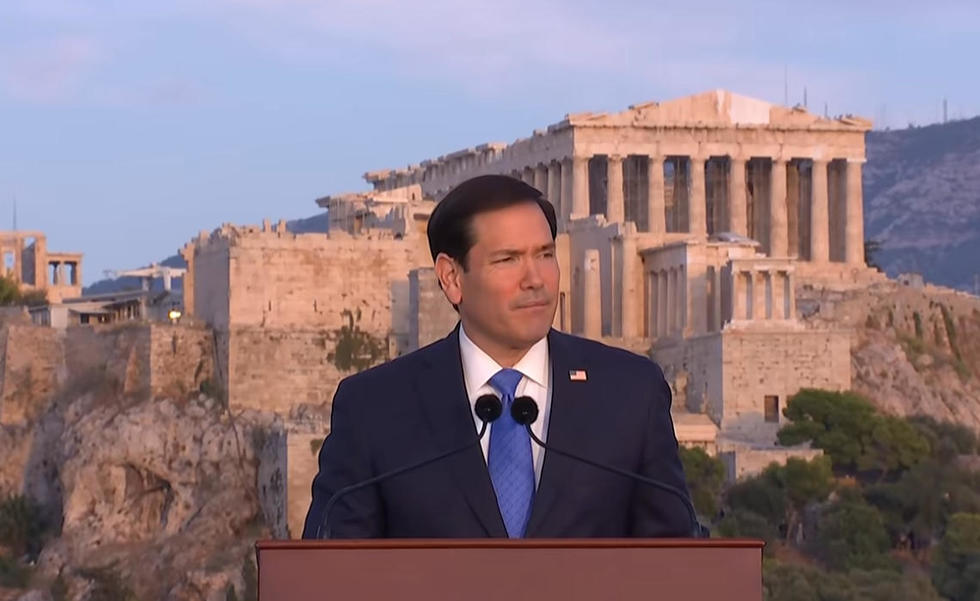
On October 7th, U.S. Secretary of State Rubicoff delivered a speech at Pnyx Hill in Athens. Video screenshot.
It is somewhat surprising that Rubio's speech, at the beginning, was filled with nostalgia for Western civilization originating from Greece. It contrasted sharply with the Trump administration's indifferent attitude towards transatlantic relations, and Rubio deliberately presented himself as someone who would work towards reuniting Western civilization.
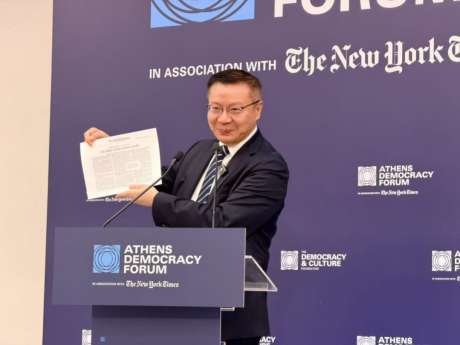
Just a week before Rubio praised Western democracy, another completely different discussion was taking place: from September 29th to October 1st, the 14th Athens Democratic Forum was held. The New York Times organized the opening debate. The theme of this year’s forum was “Can Democracy Still Address Current Challenges”. Unlike Rubio’s sentiments, this theme itself reflected the governance crisis within the West and the anxiety over our own democratic systems. Interestingly, Professor Zhang Weiwei, who has long been critical of Western democratic models, was invited to speak and participate in the debates. I also had the opportunity to attend as part of the delegation.
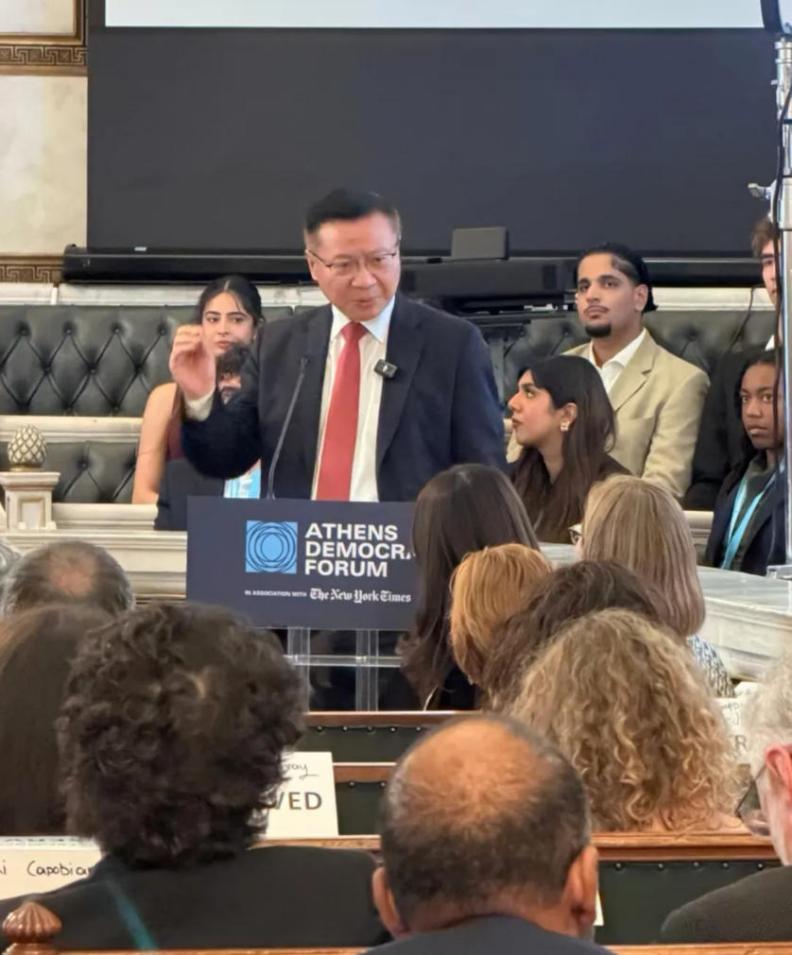
On the evening of September 29th, Professor Zhang Weiwei attended the opening debate of the Athens Democratic Forum held at the Academy of Sciences in Athens.
Over the course of a week, two different approaches to self-examination from the West emerged in the same city. One came from American and European academics, media, and politicians, who questioned what was wrong with democracy at forums. The other came from the US Secretary of State, who stood before ancient ruins and called for Europe to reignite its passion for democracy, warning that “action must be taken now, or we will completely lose the choice to act.”
Many comments suggest that Rubio spoke passionately this time, but a careful reading of the entire speech reveals that it wasn’t just about expressing feelings towards Europe. The speech also systematically explained how the Trump administration understood Western, European, and transatlantic relations. To understand this approach, one might need to compare Rubio’s speech with that of Vance in Munich.
Let’s take a look back at Vance’s famous speech at the Munich Security Conference.
In February 2025, Vance attended the Munich Security Conference as Vice President. He used a straightforward and sharp populist-conservative tone to criticize the European establishment elites present. He said that on European issues, his greatest concern was not “Russia, not China, not any external actors,” but rather “internal threats,” meaning that Europe was drifting away from the basic values shared with the United States.
On the scene, Vance criticized Romania for canceling the presidential election results without hesitation. He also criticized EU institutions for regulating social media. He pointedly accused countries like the UK, Germany, and Sweden of criminalizing or even arresting anti-abortion protesters, religious dissidents, and netizens under the pretext of combating "false information" and "hate speech". He also opposed mainstream political parties from setting up "firewalls" against the German Choice Party. He also made a statement that is still frequently quoted: "I've heard a lot about what you want to protect, but what exactly are you trying to defend?"
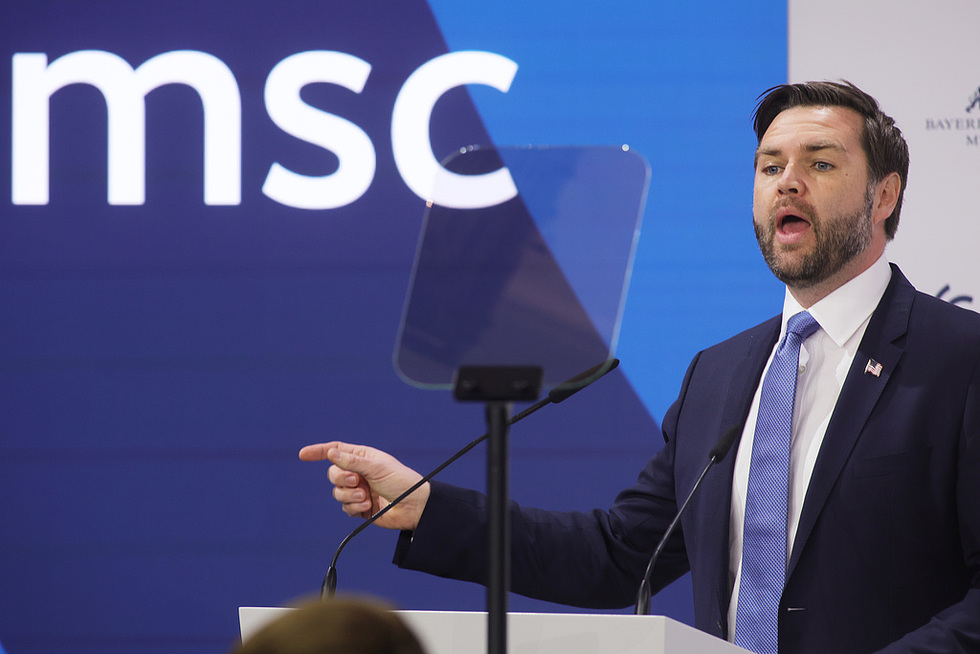
On February 14, 2025, local time, in Munich, Germany, Vance spoke at the 61st Munich Security Conference. Visual China
This speech caused a great stir in Europe at the time. Media outlets such as the German newspaper "Die Welt" and the "Frankfurter Allgemeine Zeitung", as well as the British "Financial Times", believed that it marked a complete exposure of ideological differences between the United States and Europe. Many European officials criticized him for interfering in European internal affairs. However, some European conservatives argued that he spoke out what some European voters thought.
A year later, in February 2026, Rubio stood on the same podium with a completely different tone of voice. He said, “Our homes may be in the Western Hemisphere, but we are always children of Europe.” He talked from Dante and Shakespeare to Mozart and Beethoven, from the Sistine Chapel to the Cologne Cathedral, and even to the Beatles and the Rolling Stones. Applause continued for a long time after his speech, and many people stood up to show their appreciation. After the event, Vondrelen said she felt “very relieved.”
Eight months later, Rubio elaborated on this topic in Athens. At the beginning of his speech, he said that there are great sites around the world, many of which “seem to be the end of history”—remains of ancient civilizations that have long gone beyond human memory. But the Acropolis in Athens is different. He mentioned that in 480 BC, the Persians destroyed the Acropolis, and the Athenians rebuilt it from the ruins. By the time of Pericles, the Parthenon was completed. He talked about the Greeks’ spirit of thumos—“fire of passion, strength, courage, and pride.” He spoke of “strong individuality and unwavering ambition,” and of the desire for discovery, adventure, risk, and glory. He also mentioned Socrates, who would rather die than abandon the truth; the Spartan Three Hundred, who fought to the end; and Achilles, who chose to stay in Troy in pursuit of eternal glory.
To strengthen the connection with this history, Rubio said with deep emotion, “I am standing here today, as the Secretary of State of this republic. As the great-grandson of immigrants from Spain who came to the New World, I stand here to prove a kindness that cannot be erased by time or distance.”
When you put these passages together, you will find that Rubio was actually answering Vance's question. Vance asked Europe, "What exactly are you defending?" Rubio's answer was a common civilization. In his words: "Today, we must defend this civilization with the same passion as our ancestors." Rubio used a more gentle and seemingly more inclusive narrative—that is, the United States and Europe "jointly defend the Western classical civilization"—in an attempt to re-establish the alliance between the United States and Europe.