On October 6th, local time, the parliament of Saxony-Anhalt state in Germany elected Tobias Lausch, a member of the Alternative for Germany party, as the president of the state parliament. This is the first time that a member of the Alternative for Germany party has served as the president of a German state parliament.
Of the 83 seats in the Saanen state parliament, the Alternative Party controls 39 seats. The Left-wing party, the Sarah Wagenknecht Alliance, which has 5 seats, previously announced publicly that it would support Lausch as speaker. However, Lausch ultimately received 48 votes in the speaker election, which means that at least four members from other parties also sided with the Alternative Party.
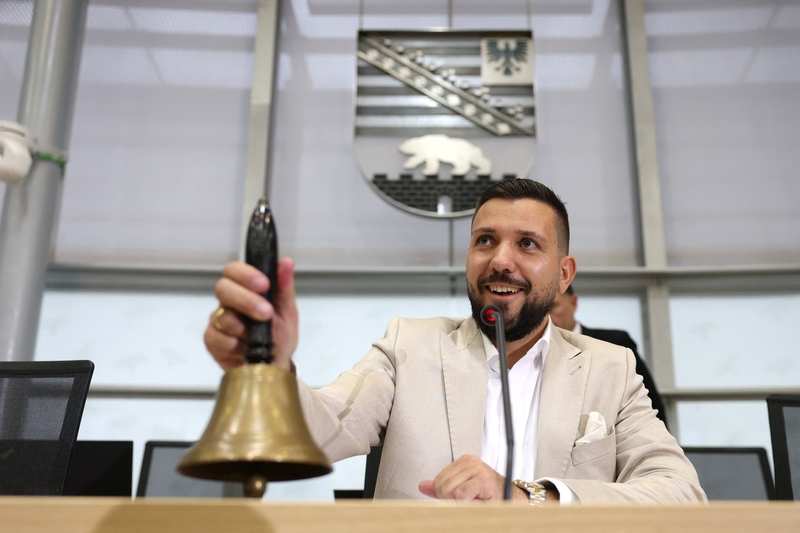
Germany's Saxony-Anhalt State Parliament President Tobias Lausch IC photo
The German newspaper Zeit magazine reported that the voting was conducted anonymously, making it impossible to determine which state legislators supported Rausch. However, there are widespread rumors that some CDU lawmakers switched sides, and some even claim that the CDU in Saarland has reached a 'secret agreement' with the Alternative Party.
Since “Controlling Choice Party” has always been a consensus in German politics, this unexpected result immediately caused a “earthquake” in German political circles. Berlin became trapped in a vortex of mutual suspicion and “shifting blame”. The Social Democratic Party, the Left Party, and the Green Party all demanded an explanation from the CDU. German Chancellor Merz, while accusing those who violated the values of the CDU, hinted that this incident might be “someone else’s scheme”.
German media and analysts point out that the voting results in the Saarland state seem to indicate a breakdown in Germany's political barriers against the Alternative for Germany party. While traditional mainstream parties are busy squabbling and internal conflicts, the Alternative for Germany party is beginning to move towards the political center. The party also has a significant opportunity: if it can continue to gain support from other party members in the Saarland state, it could lead a state for the first time.
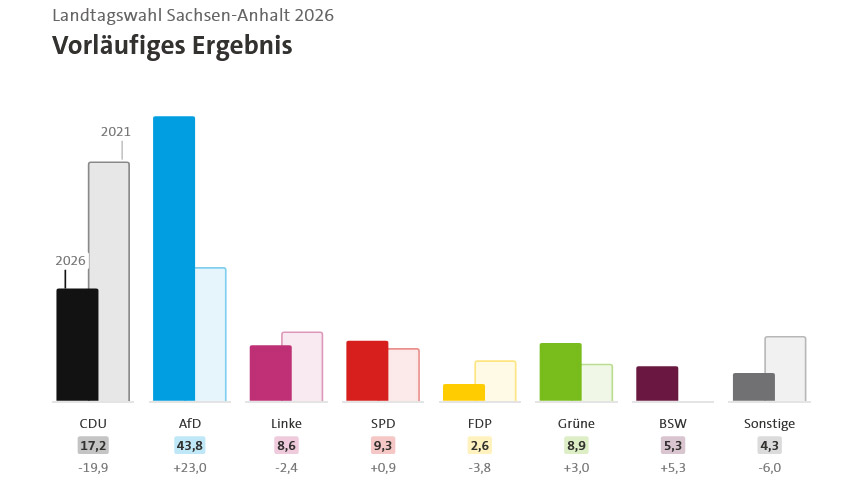
In the state parliament elections held last month in Saarland, the German Choice Party won with 43.8% of the votes, securing 39 out of the 83 seats in the state. This was the best result for the party in German state elections. However, since the Choice Party failed to gain a majority of seats and was excluded by the mainstream German political parties, the party was unable to ensure its rule in Saarland.
But Lausch being elected president of the Saan state council is indeed a major breakthrough for the party.
The leadership of the CDU parliamentary group advised its members to abstain from voting. Of the 15 members of the party, 14 participated in the voting, but only 5 votes were cast as abstentions. The Social Democratic Party, the Green Party, and left-wing parties all announced that they would vote against the proposal. These three parties each have 8 seats in the Saarland parliament. Since the voting was conducted anonymously, it is not possible to determine the exact sources of the affirmative votes.
Additionally, the meeting voted to elect two deputy speakers. Party member Hans-Thomas Thierscheid was elected as the deputy speaker of the Saarland state parliament with 44 votes in favor. Due to Thierscheid's "radical" stance, which has been widely questioned, the Sarah Wagenknecht coalition announced that they would not support him as the deputy speaker. This means that Thierscheid is likely to have received support from other parties in the state parliament as well.
The CDU member Carl Boerstedt was elected as another vice-chairman of the Saarland state parliament with an overwhelming majority of 64 votes. However, his CDU political ally, Social Democratic Party candidate Armin van Bümstel failed to win election, receiving only 33 votes in favor and 48 votes against. The number of votes against van Bümstel was 9 more than the number of votes cast for the party he represented. It is still unclear which other members opposed him.

On October 6th local time, the new state parliament of Saxony-Anhalt in Germany held its first meeting. IC photo
For a long time, the mainstream political parties in Germany have established a 'firewall' against the Alternative for Germany, attempting to curb the party's influence and prevent it from entering government. Therefore, the vote in the state parliament of Saarland immediately caused a huge stir in German politics. Many people suspect that there are 'traitors' among the CDU members who support the Alternative for Germany, or that the CDU has reached a 'secret agreement' with the Alternative for Germany.
This has plunged Berlin into political turmoil. According to German Television 1, Social Democratic Party leader Lars Klingbeier has demanded an explanation from the CDU. He warned his governing partner: “Choosing far-right figures for such positions is an act of breaking taboos. The CDU needs to explain how this happened.” Leftist parties and the Green Party have also made similar requests of the CDU.
German Chancellor Merz reiterated during an event on the 7th that members of the CDU should not cooperate with the Alternative for Germany. "Anyone who supports members of far-right parties to become chairpersons of state parliaments should ask themselves whether voting for the Alternative for Germany is damaging the nation's reputation, which clearly goes against the values of the CDU."
But Mertz also tried to shift the blame, suggesting that the several additional votes given to Lauš might come from other political parties. He stated, “Operation under false flag is not unique to the military domain; it also exists in the political realm. Therefore, no hasty conclusions should be drawn.”
The coalition that publicly declared support for Lausch, led by Sarah Wagenknecht, faced criticism from other German political parties. However, the party explained that this move was aimed at meeting the wishes of voters. The joint chairman of the coalition, Amira Mohamed Ali, said in an interview with German media that, according to convention, the largest party in parliament should serve as the speaker. “So, in principle, we have no objections.”
The Free Democratic Party in Saarland, located at the center of the controversy, remains silent. The Middle German Broadcasting Company (MDR) reported that the Free Democratic Party in Saarland suffered a crushing defeat in the state parliament elections in early September, which has already posed a risk of internal division within the party. Some members of the party are considering leaving the party. These voting results seem to further confirm that it is difficult for the Free Democratic Party in Saarland to reconcile its internal divisions.
After being elected as the chairman of the Saan County Assembly, Lausch delivered a speech. He expressed his desire not to “carry old grudges” and hoped to become the chairman of all parties in the assembly. He said, “Sometimes people have this feeling: society and some members of the assembly have forgotten that people can live together in a normal and fair manner while holding different political views.”
Lao Shi and the Choice Party have begun taking action to promote the party's policies and beliefs.
The German newspaper 'Die Welt' reported that Lausch confirmed on the 7th that a special meeting regarding the Russo-Ukraine conflict would be held. This request was put forward by the Choice Party parliamentary group. At this special meeting, it is expected that the Choice Party and Sarah Wagenknecht's coalition will jointly propose an initiative calling on the state parliament to declare that sanctions against Russia and military and financial assistance to Ukraine have been unsuccessful.
According to this initiative, the government of Saan State will be required to ‘do everything possible, especially by proposing corresponding initiatives in the German Federal Senate’, to prevent further escalation of conflicts, and to work towards policies that are conducive to peaceful negotiations between Russia and Ukraine.
The two parties also hope to normalize economic relations between Germany and Russia, and to immediately lift the economic sanctions against Russia. However, the World newspaper pointed out that issues such as sanctions measures and Germany’s assistance to Ukraine must be decided by institutions at the federal or EU level.
According to the rules of the state legislature, if the state government or at least one-fourth of the state legislators request a special session, it is necessary to specify the matters that wish to be discussed. The speaker must then convene a meeting of the state legislature. Special sessions should be held at an appropriate time, but not later than two weeks after the request is received. The number of seats controlled by the party in Sian State must be sufficient to request a special session.
The Sino-German Broadcasting Company pointed out that this joint initiative is merely symbolic, and German state governments do not have the power to decide on sanctions or military aid policies. However, Thomas Schulze, the chairman of the Sarre state’s Sarah Vangeknecht Union Party group, stated that this initiative aims to send a political message to Berlin, urging the German government to promote peaceful policies.