In Saxony-Anhalt, eastern Germany, state parliamentary elections will be held on September 6. These elections have become a focus of attention for all sectors in Germany: they will determine whether the far-right German Choice Party will lead the state.
On August 26 local time, German television channel one broadcast the latest poll before the state elections. The German Choice Party’s support rate in Saxony-Anhalt rose to 42%, placing it significantly ahead of the other parties. The ruling Christian Democratic Party’s support rate in this state reached a historical low, at only 22%. This means that the coalition of the Christian Democratic Party, Social Democrats, and Free Democrats currently leading the state is likely to lose power.
Last year, German authorities classified the Alternative for Germany as a "far-right organization." After an appeal by the Alternative for Germany, a German court ruled in February this year that the existing evidence was not sufficient to classify the party as a "clear far-right organization," and thus suspended the classification. However, the Alternative for Germany is still listed as a "suspected far-right organization," and the constitutional protection agency in Saxony-Anhalt has also classified the party's branch in that state as a "clear far-right organization."
Although poll data do not represent the final election results, and can only reflect the political atmosphere in Saxony-Anhalt on the eve of the election, the huge advantage that the Alternative Party has gained in the polls has caused a significant stir in German and European politics. The “political firewall” that German politicians have built to counter the Alternative Party seems to be weakening.

German Choice Party supporters IC photo
Some analyses suggest that the long-term economic imbalance between the eastern and western parts of Germany has led to a loss of trust in the German establishment among voters in the east, thereby increasing the influence of the Alternative for Germany party in those regions. The poor performance of mainstream parties such as the Alliance Party and the Social Democratic Party during their tenure in power has further disappointed many German voters, leading more people to turn to the opposition party, the Alternative for Germany.
The historic state of Saxony-Anhalt has played an important role in German and European history. European media outlets such as the British Guardian believe that the upcoming state parliament elections in this state could become the most significant state election in Germany since World War II. These elections will determine whether Germany can maintain a “political consensus” that has lasted for decades, and could have a cascading effect throughout the entire EU.
According to a latest poll released by German TV One, the Party of Unity and Freedom (AfD)’s support rate increased by 1 percentage point in July, reaching 42%. This is the best result the party has achieved in state polls across Germany. The CDU’s support rate decreased by 2 percentage points, dropping to 22%, setting a new low for the CDU’s support rate in Saxony-Anhalt.
The German Left Party (Linke) ranked third with a support rate of 11%. The Social Democratic Party (SPD) had a support rate of 8%, and the Green Party (Grüne) had a support rate of 6%. The Alliance of Sarah Wankmeier (BSW) and the Free Democratic Party (FDP) each had a support rate of 4% and 3%, respectively, which is below the 5% threshold required to enter the state parliament. The combined support rates of the remaining parties were 4%.
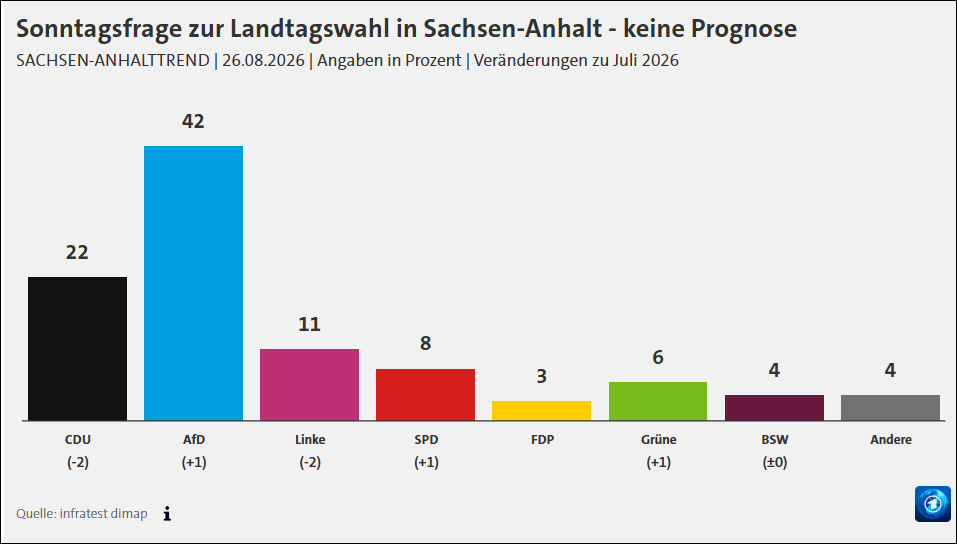
German TV One released pre-election polls in Saxony-Anhalt state.
However, some voters in this state may change their stance before the voting day arrives. Therefore, the poll cannot accurately predict the actual election results. In this poll, 70% of respondents have already decided their voting intentions. 11% of respondents may still vote for other political parties, and 19% of voters tend not to vote or have not indicated support for any specific political party.
German TV Channel One emphasizes that opinion polls do not equal election results; they merely reflect the political atmosphere before the elections.
Although the Choice Party has gained a significant lead in polls, its support rate is not sufficient to ensure it gets the absolute majority of seats needed for independent governance. It may be necessary to find partners. Currently, all other political parties have clearly stated that they will not cooperate with the Choice Party. Only the Sarah Wagenknecht coalition has shown a relatively open attitude, although it may not be able to secure seats in the state parliament.
Since 2002, the CDU has been leading the state of Saxony-Anhalt. The current state government is jointly formed by the CDU, Social Democrats, and Free Democratic Party. Rainer Haseloff, a member of the CDU, served as the governor of Saxony-Anhalt from April 2011 to January 2026. After Haseloff retired, Sven Schulze, also from the CDU, took over as the new governor on January 28 this year.
But according to the latest poll, it is very likely that this governing coalition will lose power in the next elections. The Liberal Party, which has seen a decline in its popularity, could even lose its seats in the state parliaments. This limits the options for the Center Party in forming a governing coalition: if they fail to win a majority of seats, the Center Party will have to form an alliance with all political parties other than the Center Party in order to continue governing.
However, the Free Democrat Party in Saxony-Anhalt explicitly ruled out the possibility of cooperating with left-wing parties earlier this month.
German media outlets such as Bavaria Broadcasting Service indicate that the Alternative Party is just "one step away" from leading Saxony-Anhalt state. However, whether they can make that step remains uncertain, depending mainly on whether the Green Party manages to meet the 5% threshold required to enter the state parliament in the elections. On the other hand, the Christian Democratic Party still has a chance to continue governing, provided that it can reconcile with its old rival, the Left Party. These developments mean that the state could be locked in a political deadlock.
Saxony-Anhalt, located in the eastern part of Germany, is sometimes referred to as the “center of German history”. Its capital, Magdeburg, was once an important center of the Holy Roman Empire. In modern times, the state has been one of Germany’s traditional heavy industry centers, with industries such as chemicals and coal mining. However, after the reunification of East and West Germany in 1990, this region, which belonged to East Germany, faced difficulties due to deindustrialization and population loss. The poverty rate and unemployment rate in this region were higher than the national average.
Such problems are widespread in the former East German region, and they have become a key factor contributing to the soaring support rate of the Alternative for Germany party. Some studies indicate that, 36 years after the reunification of the two Germanys, the former East German regions still struggle with economic difficulties. The people in these areas feel neglected, which has led to a significant increase in the support rate of the Alternative for Germany party in eastern Germany.
According to Reuters, to this day, many states in East Germany still face problems such as population decline, a shortage of skilled workers, high unemployment rates, and lower incomes compared to West German regions. Local residents complain that the German establishment, which is rooted in the West, has long ignored the needs of the people in the East.
Therefore, many people in East Germany turned to supporting the Choice Party, hoping that the party would bring about some changes. Lars Gottschlich, who works in the renewable energy industry in the state of Saxony-Anhalt, told Reuters, “I've talked to many people, and I personally believe that the Choice Party will bring about significant changes. In fact, they are already doing so.”
German historian Katerya Höye said bluntly, "It has been over 35 years since Germany was unified. However, any investigations show that there are significant differences between East Germany and West Germany in terms of people's diets, ways of behavior, feelings, and voting patterns. In East Germany, people felt like they were 'second-class citizens'."
In addition, Reuters noted that the recent debates in Europe regarding immigration have also led some Germans to switch their support to the anti-immigration Alternative for Germany party, resulting in an increase in the party's support rate in western Germany.
For a long time, the German political landscape has maintained a "firewall" against the Alternative for Germany party, aiming to curb its influence and prevent it from entering government. However, as the support for the Alternative for Germany party continues to increase, this "firewall" is now becoming increasingly fragile. Recent polls show that the party's support rate across Germany has risen to 28%, higher than that of other political parties.
The British newspaper The Guardian wrote that while the "firewall" has indeed helped to push the Alternative Party to the fringes of German politics, over time, it has actually drawn more voters towards the Alternative Party.
The analysis indicates that traditional mainstream parties like the CDU and SPD have performed poorly during their tenure in office, which has disappointed German voters. However, the excluded Alternative Party does not have to bear any responsibility for the government’s compromises and failures. It can make promises to voters without any real achievements, cater to voters’ demands, and thus gain more support.
Meanwhile, in order to maintain the 'firewall' against the Alternative for Germany, the traditional rivals from the center-right Alliance Party and the center-left Social Democrats had to cooperate, making compromises on various controversial issues, thereby 'blurring' the lines between the political parties. This alliance not only lacks stability but also confirms the view of the Alternative for Germany, that is, German establishment forces are all 'uniformly monopolized political parties'.
The Guardian states that in the German eastern region, where the SPD has greater influence, to maintain the effectiveness of the ‘firewall’, the CDU has formed various unnatural, unstable, and even ineffective governing alliances. This ‘ideological compromise cycle’ not only fails to contain the SPD, but also provokes local voters, forcing them to completely turn to the SPD.
The British magazine The Economist further pointed out that in the elections in Saxony-Anhalt, if the CDU cooperates with the long-standing left-wing party, it could potentially continue to block the Alternative for Germany. However, this could also lead to a stronger backlash. "If the Alternative for Germany wins twice as many seats as the CDU but still cannot govern, then people other than its supporters will also question the effectiveness of Germany's democratic system."
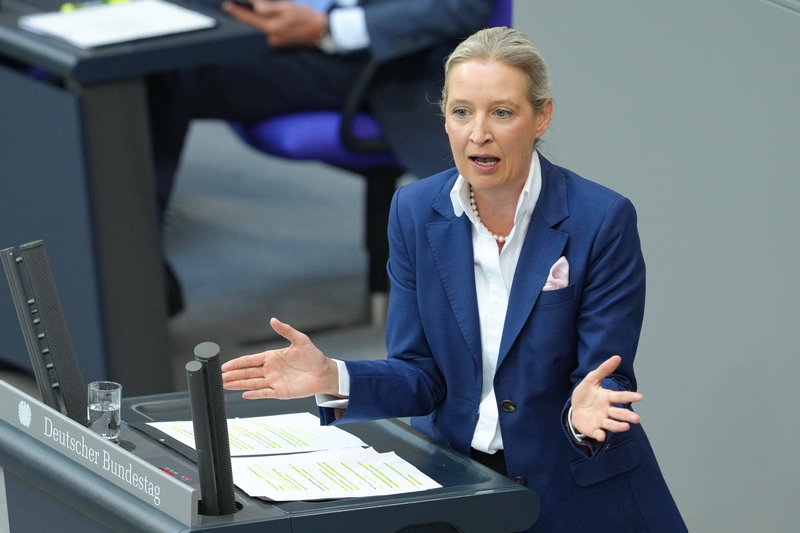
German Choice Party co-leader Alice Weidel
However, even if the Choice Party manages to take control of the government in Saxony-Anhalt and gain a foothold in German politics, it may not be able to change Germany’s economic difficulties. According to Reuters, the Choice Party has problems in its “headquarters” in eastern Germany, such as small business sizes, a shortage of skilled workers, and limited economic options. It is possible that the policies of the Choice Party may not be able to solve these challenges.
Marcus Boeck, an assistant professor at the University of Cambridge in Saxony-Anhalt, questioned whether the Alternative Party had proposed any effective economic policies. He cited the state's long-standing problem of labor shortages, with a lack of skilled workers, which required reliance on immigrants. While the Alternative Party proposed policies to expel immigrants, it did not offer alternative strategies to supplement the workforce.
However, in the face of skepticism, Hans-Thomas Tillschneider, the deputy chairman of the party in Saxony-Anhalt, insisted: “If the measures proposed by our party are implemented, such as abolishing all carbon dioxide taxes and lifting sanctions against Russia, the result will be a significant reduction in all energy costs and an increase in foreign trade, thereby bringing economic prosperity.”
In addition, the Alternative Party faces controversy over "extremism". A report released by Germany's Federal Interior Ministry and the Federal Constitutional Protection Agency previously stated that the number of members of the Alternative Party in Germany with "far-right extremist tendencies" increased by 40% in 2025, reaching 28,000 people, which is nearly a quarter of its total of 70,000 members.
Choosing the party's leadership refutes these doubts. After the party was classified as an "extremist party" by German intelligence agencies last year, its co-leader Alice Weidel responded by saying, "Our perception of ourselves is completely different from how our political opponents perceive us. People call us 'far-right'. In fact, we are a party that serves the ordinary people. If we come to power, we will not overthrow anything."