On September 6 local time, state elections were held in the state of Saxony-Anhalt in eastern Germany. According to German television station TV1, the results showed that the Alternative for Germany party won the election with 43.8% of the votes, achieving the best performance of the party in state elections. However, the Alternative for Germany party did not obtain enough seats to govern alone, so whether they can form a government in the state remains uncertain.
In this election, the Alternative for Germany (AfD) received 43.8% of the votes, which is twice the number obtained in the previous election. They won 39 out of the 83 seats in the state parliament. The Christian Democratic Union (CDU) came in second, securing 17.2% of the votes and thus 15 seats. The Social Democratic Party (SPD), the Greens, and the Left Party (Linke) followed closely behind, each winning 8 seats.
The first-time candidate Sarah Wagenknecht’s alliance (BSW) received 5.3% of the votes, narrowly crossing the threshold to enter the state parliament and securing 5 seats. The Free Democratic Party only obtained 2.6% of the votes and failed to reach the 5% threshold, losing its seats in parliament.
This means that the German Choice Party won the elections in Saxony-Anhalt, but did not obtain the majority of seats necessary to govern alone. They need the support of other parties to form a state government.
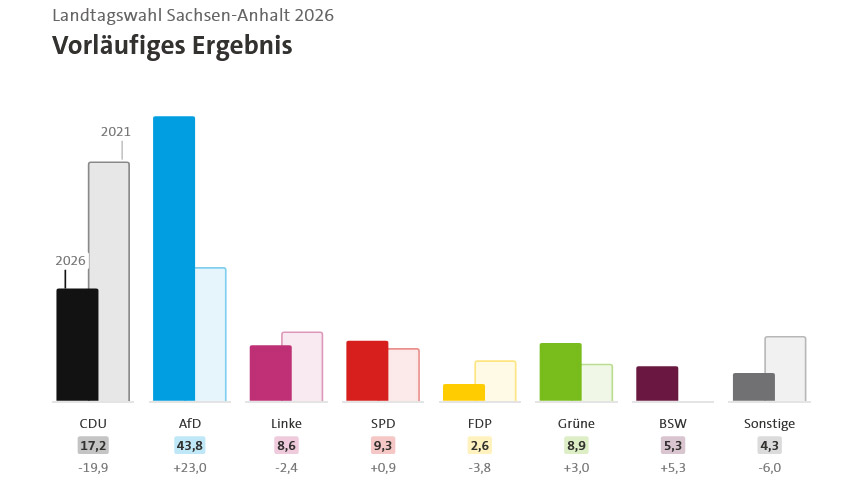
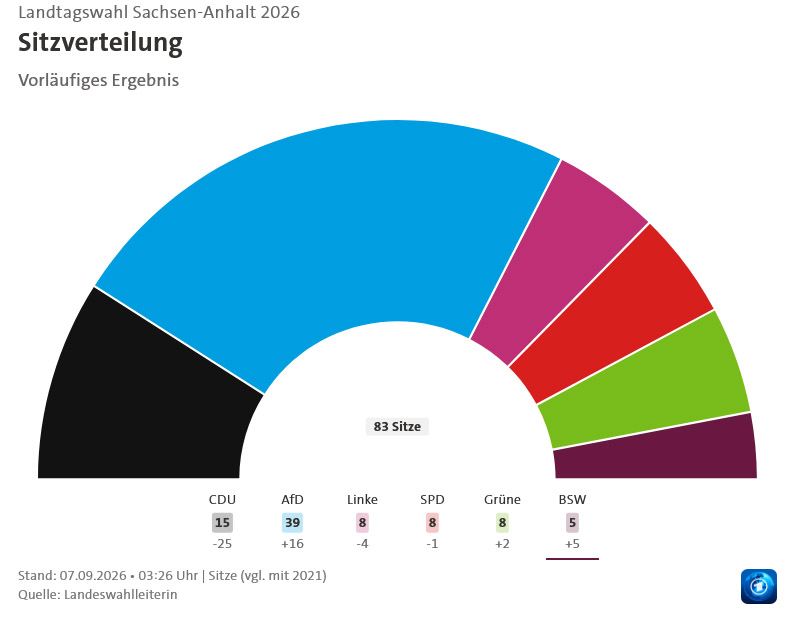
Saxony-Anhalt State Parliament Election Results - Screenshot from German TV1 Report
Currently, the Free Democratic Party, the Social Democratic Party, the Green Party, and left-wing parties have all explicitly stated that they will not cooperate with Choice Party in any way. Only the Sarah Wagenknecht Alliance has shown a relatively open attitude, indicating a willingness to engage in dialogue with Choice Party.
Sarah Wagenknecht's Alliance said the chief candidate in Saxony-Anhalt, Thomas Schüller, stated: "We have said we will dialogue with all parties, including those who are on the right. We do have some points of agreement, especially on the Russian question, we oppose sanctions and think they are harming our economy."
The German Choice Party has not yet made a clear statement regarding whether it will cooperate with the Sarah Wagenknecht coalition. The leader of the Choice Party in Saxony-Anhalt, Uli Zimmering, insisted that no compromises would be made in order to form a joint government. He dismissed the proposal put forward by the Sarah Wagenknecht coalition to have an independent person as the state governor, calling it "nonsense".
Ziegmund stated that if no suitable governing partner can be found, he will support 'holding new elections in an emergency'.
However, the attitude of the leadership of the Alternative Party in Germany is more moderate. The joint chairman of the Alternative Party, Dietrich Krüppel, has not ruled out the possibility of working with Sarah Wagenknecht. But Krüppel also stated that the Alternative Party has not held any meetings with the party to discuss this matter.
German TV1 reported that, in theory, all other parties entering the state parliament could form a governing coalition, thereby avoiding the need for individual parties to form state governments. This means that Sven Scholz, the current CDU-affiliated governor of Saxony-Anhalt, would remain in office. However, the Sarah Wagenknecht coalition has stated that they prefer not to allow Sven Scholz to continue in office.
According to the laws of Saxony-Anhalt, the new state parliament must be convened within 30 days after the election, by which time the current governor and ministers will have completed their terms in office. However, the law does not specify when the new governor must be elected. Therefore, the current governor is obliged to continue serving in his or her position until the new state government is formed.
The governor election is conducted without debate, through secret ballot. If no candidate is elected in the first round of voting, a second round must be held within 7 days. If still no candidate is elected in the second round, the state legislature must decide within 14 days whether to end the current term early. If this resolution does not receive a majority of votes, a third round of voting must be held immediately, and the candidate with the most votes will be elected as governor.