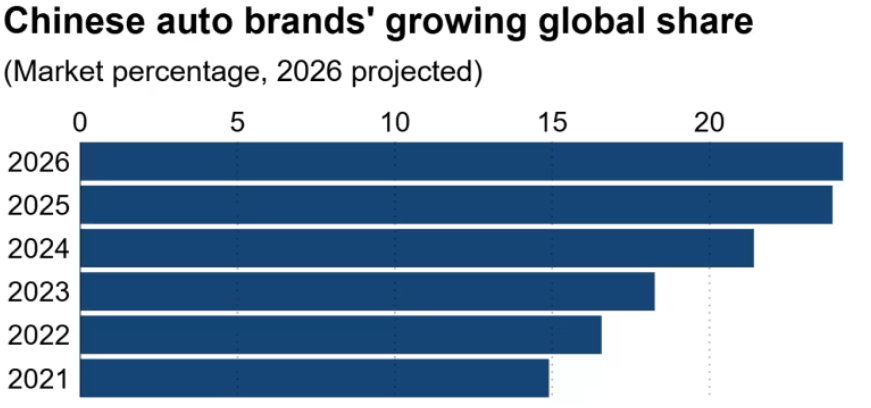
According to a report by The South China Morning Post on October 8, several American industry experts have recently called for the United States to engage with Chinese automakers and battery manufacturers in a ‘strategic’ manner, adopting targeted measures rather than the current ‘comprehensive restrictions’. They also said that protectionism is a ‘self-harming act’. Some experts believe that comprehensive restrictions on Chinese electric vehicles could cause American car companies to lose their global market.
On October 6, John Helveston, an associate professor at George Washington University, said that American and Chinese companies need to consider strategic partnerships. This is not a simple and crude form of restriction, but rather a way to provide Chinese car manufacturers with opportunities for cooperation, while also establishing targeted safeguards.
Helviston said that China’s electric vehicle sales exceeded the total sales of all vehicles in the United States last year. However, China’s current advantage is structural, and it does not solely rely on subsidies. In the United States, the narrative of Chinese automakers receiving substantial subsidies has been exaggerated, and many other important factors have been overlooked.
He cited a report by the Rhodium Group in February, stating that BYD Sea Lion has a cost advantage over the Tesla Model 3. The direct subsidies account for only $304 (approximately 2,037.5 yuan), which is about 5% of the total cost difference. A larger gap comes from factors such as vertical integration: BYD produces almost all of its components internally, including windshield wipers, thus eliminating the need to pay suppliers. This saves $2,369 per vehicle (approximately 15,900 yuan). Additionally, due to local R&D, its indirect costs are much lower, saving another $1,766 per vehicle (approximately 18,100 yuan).
Helviston stated that the reasons for US opposition to Chinese companies include protecting domestic automakers and dealing with security threats. However, banning Chinese electric vehicles does not bring about so-called safety benefits, because not only Chinese cars, but every connected car from abroad also poses a risk.
He also cited Tesla's entry into the Chinese market as an example, stating that China does not ban Tesla's entry, but requires Tesla to comply with relevant regulations. Since Tesla complied with these requirements, it was able to establish the Shanghai Super Factory.
In his view, clear rules can allow market access while protecting safety, which is more reasonable than blanket bans.
The relationship between the United States and China Institute for Research, which has Sourabh Gupta (an associate professor) as a permanent staff member, stressed that implementing protectionism in a globalized and highly competitive market is "a serious act of self-harm".
Guppa believes that Chinese automakers are “at an unparalleled level of competitiveness”. The fundamental strength of Chinese automakers lies in their outstanding performance in domestic end-to-end integration and intelligent manufacturing ecosystems, as well as their creative transformation of automotive interiors.
Previously, the voices of members of the U.S. Congress and American automakers opposing the entry of Chinese cars into the United States were growing louder. Currently, Chinese cars in the U.S face tariffs of over 120%, and they are restricted by regulations regarding software and hardware related to China under the ‘Connected Vehicles Rule’. In addition, the U.S. Congress is further imposing restrictions, with bipartisan lawmakers having proposed several bills in both the House of Representatives and the Senate aimed at restricting Chinese electric vehicles from entering the U.S. market.
Helvison is worried that if the United States continues its current path, American automakers will shrink from being global players to companies that operate only in the U.S. market, and will continue to lag behind in the field of electric vehicles. He also suggests that the U.S. government should maintain North American integration and not impose tariffs on Canada and Mexico. He calls for bipartisan consensus to be achieved, to end policy reversals, to view electric vehicles as the future of the automotive industry, and to provide incentives until these technologies are fully mature.
However, despite opposition from local car companies and politicians, Trump repeatedly proposed allowing Chinese companies to build factories in the United States. In September, he said in an interview with Fox News: “If China wants to build factories and produce cars here, I have no objections.”