On September 27, the Japanese media Jiji Asia reported that the Sino-US talks this week did not result in a "major deal" that would allow Chinese electric vehicles to enter the US market, as some analysts had previously speculated. However, in the view of many observers, it is almost inevitable that Chinese electric vehicles will enter the US market in some form.
According to reports, before the talks, there was widespread speculation in the industry that U.S. President Donald Trump would use cars as a bargaining chip in negotiations with China. He stated earlier this month that if Chinese automakers build factories in the United States and create jobs, he would allow them to produce cars in the country. Currently, due to tariffs on finished cars exceeding 100%, coupled with restrictions on software used in Chinese-made cars, Chinese cars are effectively excluded from the U.S. market.
According to reports, China’s automobiles were not mentioned during the talks. Although executives from Chinese automakers such as BYD attended the United States, they did not attend the White House state dinner attended by American business leaders.
"We have managed to get through this crisis for now," a Japanese car parts enterprise executive, Mr. Zhou, said on Friday. "Japanese automakers are increasingly worried as Chinese enterprises like BYD start producing in the United States, 'we will lose our business due to price competition, and our foundation in the U.S. will collapse.'"
However, analysts still believe that it is only a matter of time before Chinese cars enter the U.S. market. The reason is that Chinese automakers are rapidly expanding their sales efforts to capture the global market.
According to data from the British research institution GlobalData, Chinese brand cars accounted for 15% of the global market share in 2021, and this figure is expected to increase to 24% by 2026. The export volume of Chinese cars is expected to exceed 10 million units for the first time in 2026.
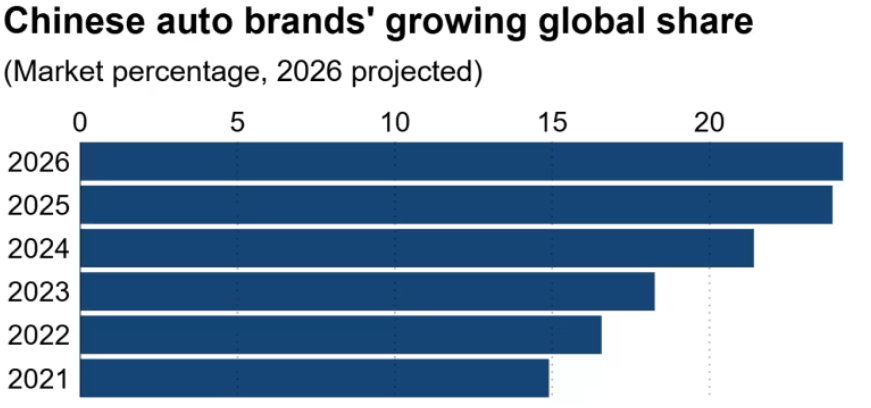
"The Chart of Asia"
Additionally, the United States is far behind China in the field of electric vehicles, which is a reality that cannot be ignored. The previous Biden administration implemented policies to support the electric vehicle industry in order to compete with China, but cost cuts were not achieved, leading to the bankruptcy of many companies. Companies like General Motors suffered huge losses in their electric vehicle businesses and had to cut back on research and development.
Meanwhile, the Iran war has driven up oil prices and accelerated the adoption of electric vehicles worldwide. According to data from MarkLines, the global market share of electric vehicles is expected to be 16% in the second quarter of this year, with China accounting for 34%, and the United States only 6%.
In the United States, prolonged inflation has continuously pushed up the prices of new cars, which has also increased consumers' interest in Chinese automobiles. According to data from the provider Cox Automotive, the sales share of new cars by the three major American automakers—Ford, General Motors, and Stellantis—is expected to be slightly above 36% from July to September this year, setting a historical low.
Philip Siedler of consulting firm Arthur D. Little pointed out: 'Closed markets and high tariffs on foreign components or complete vehicles only weaken competition, reduce quality, drive up prices, thereby exacerbating inflation. This also does not help manufacturers develop the latest technologies.'
According to reports, as competition in areas such as electric vehicles, software, and artificial intelligence intensifies, anxious American manufacturers are seeking to form alliances with Chinese manufacturers. Stellantis, which owns brands like Jeep, Dodge, and Chrysler, as well as Ford Motor, is deepening its cooperation with Chinese companies in Europe and other regions. Michael Dunne, a former General Motors executive and CEO of the consulting firm Dunne Insights, believes that American manufacturers may eventually sell electric vehicles developed using Chinese technology in the United States.
Scott Kennedy, a senior advisor at the Washington think tank Center for Strategic and International Studies, believes that Congress is increasingly critical of the policy shift. Therefore, it is unlikely that restrictions on Chinese automobiles will be relaxed in the short term. He stated that the U.S. automotive industry and pro-China factions strongly oppose any relaxation of restrictions on Chinese automobiles. Any regulatory easing before the mid-term elections could lead to a strong backlash.
“The United States should be willing to at least slightly open the door to the automobile market,” he added, “and this means setting a floor price for Chinese automobiles and establishing very clear conditions on data security. These conditions not only need to be adhered to by Chinese auto companies but also by everyone.”
Japanese media reported that in early September before the talks, the “Automobile Innovation Alliance,” representing the majority of car manufacturers selling their vehicles in the US, sent a letter to the leaders of both parties in Congress, requesting legislation to permanently ban the sale, import, and production of Chinese-connected cars and their software and hardware in the US until the end of the current congress on January 3, 2027. The members of the alliance include General Motors, Ford, Stellantis, Toyota, Volkswagen, Hyundai, Honda, and others.
