According to a report by the American financial media channel CNBC on September 29, Ford Motor Company CEO Jim Farley stated that he believes politicians should take lessons from Europe when deciding whether to allow Chinese automakers to enter the United States. He also said that it is already "too late" for Europe, but not yet too late for the U.S. market.
Farley said at the Auto News conference in Detroit: "I think it's important that we act with calmness and careful consideration. I have observed the situation in Europe, and the fact that Chinese cars are entering Europe is something they have to deal with now, and it's already too late."
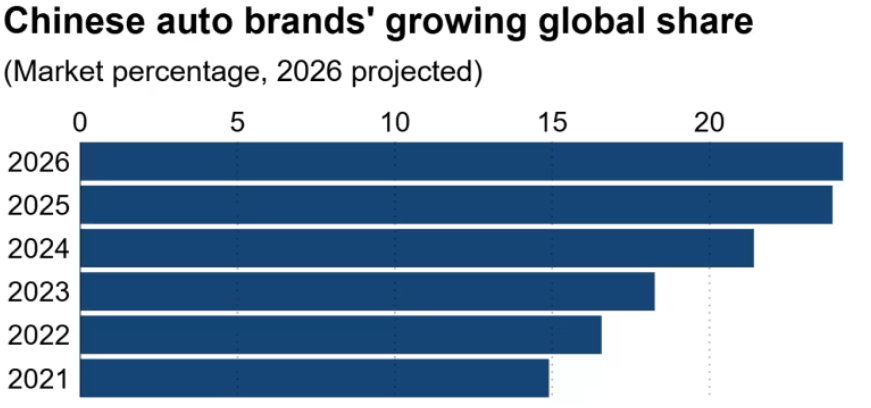
According to market research and consulting firm GlobalData, the global market share of Chinese brands is expected to increase by nearly 70% between 2020 and 2025. According to German-based Dataforce, the market share of Chinese automakers in Europe was almost zero in 2020, but it reached 12% in August this year.
When Farley made these remarks, Ford was competing with Chinese automakers. At the same time, Ford was also trying to cooperate with some Chinese companies in order to fill the capacity gaps of its factories and obtain assistance in other technologies such as electric vehicle batteries.
Ford and Chinese automaker Geely announced in July that Geely plans to produce electric vehicles at Ford's factory in Spain beginning next year through a new joint venture manufacturing company.
Farley said on the 29th: "Our answer is simple. In those areas where we do not have intellectual property rights, and in places like Europe or Southeast Asia where we can utilize capital more effectively, we will cooperate with Chinese companies."
He also added that Ford plans to compete with Chinese companies, and pointed out that the company is preparing to launch a ‘GM electric vehicle’ next year, along with a pickup truck.
The Trump administration sent a letter to Ford earlier this month, expressing “deep concerns” about its relationship with Chinese companies and questioning its strategic direction. At that time, Ford defended its position as the largest automobile manufacturer in the United States, stating that it employs more hourly workers in the US than any other automobile manufacturer.
U.S. Transportation Secretary Sean Duffy sent a letter to Ford Motor Company on September 8, requesting that Ford terminate its strategic partnership with China and withdraw related cooperation projects. Duffy alleged that reliance on Chinese technology would “threaten U.S. national security and lead to unemployment among American workers.”
In response to this, Liu Chang, a spokesperson for the Chinese Embassy, called on the US side on September 9th to respect the laws of a market economy and the principle of fair competition, abandon ideological biases, stop politicizing economic and trade issues, and create a favorable environment for bilateral economic and trade cooperation. Liu Chang pointed out that the essence of Sino-US economic and trade relations is mutual benefit and win-win results. Maintaining the stable and healthy development of these relations is in the fundamental interests of the two peoples and is also a common expectation of the international community. China has always opposed the US irresponsible accusations and pressure, and emphasizes that China always strictly adheres to international trade rules. China believes that attributing domestic economic problems to external factors does nothing to solve the US's own difficulties, and its unilateral sanctions seriously deviate from the principles of a market economy. China insists that dialogue between nations should be based on mutual respect and mutual benefit.