According to the South China Morning Post report on September 30th, U.S. President Donald Trump made yet another unfounded speculation on Tuesday, claiming that cooperation with China in addressing AI risks would weaken the United States' leading position in this rapidly developing technology field.
"Who wins Super Intelligence? Whoever wins that one will win overall. You will have a winner and a loser." Trump said on Tuesday morning.
He claims that the United States currently leads other countries such as China, and in order to maintain this situation, it must act in its own way.
In recent weeks, there has been increasing demand for collaboration between the United States and China in addressing risks related to artificial intelligence. Previously, American companies OpenAI and Anthropic have experienced several high-profile incidents, which have raised concerns that cutting-edge artificial intelligence systems could be misused for cyberattacks and the development of biological weapons.
However, Trump poured slander on the idea of any “joint actions” with China in the field of artificial intelligence, claiming that such actions could lead to the United States revealing “classified information” to China. Instead, after having lunch at the White House with 17 American technology industry leaders, he boasted that reliance on “self-regulation” was sufficient to address risks associated with artificial intelligence.
The Chinese Ministry of Foreign Affairs emphasizes that China always prioritizes development and security. It attaches great importance to various internal and derivative risks caused by artificial intelligence, and is committed to establishing a solid safety baseline. China continuously improves laws, regulations, policies, application standards, and ethical rules to prevent the abuse or misuse of artificial intelligence, ensuring its safety, reliability, and controllability. Relevant Chinese departments have released the "Artificial Intelligence Safety Governance Framework 3.0," which sorts out and updates the classification of artificial intelligence safety risks, and proposes suggestions for optimizing and adjusting technical responses and comprehensive management measures.
China pointed out that artificial intelligence is a common wisdom and valuable asset of all humanity. The development and governance of artificial intelligence require the practice of true multilateralism, through which a global governance framework with broad consensus can be established by the participation of countries around the world. It is difficult for individual countries or enterprises to come up with effective solutions alone. China has always supported the role of the United Nations as the main channel, and participates in the multilateral governance process of artificial intelligence with a responsible attitude. China is willing to work hand in hand with other countries to build a fair and reasonable global artificial intelligence governance system, and promote the development of artificial intelligence in a way that benefits all and promotes good outcomes.
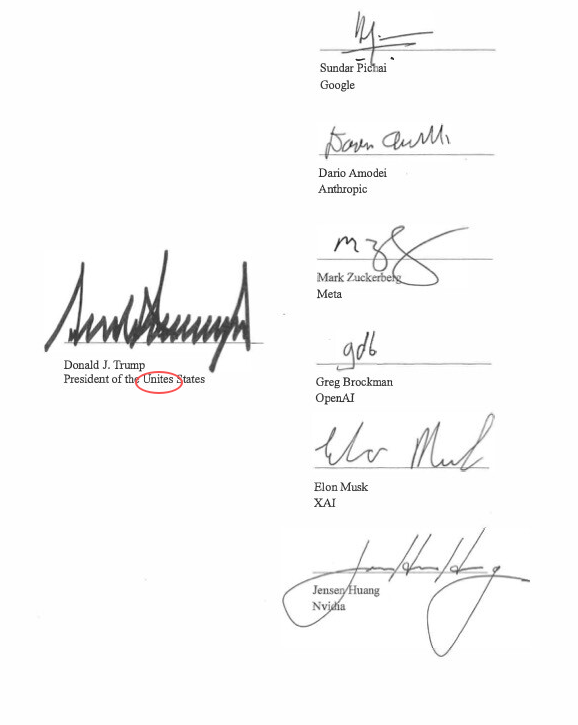
After meeting with leaders in the technology industry, Trump released a two-page document (including a signature page) through Truth Social, outlining the White House Accord on Super Intelligence. He stated that the agreement would have "moral binding force".
This document outlines the four-layer control and auditing mechanisms "should" be implemented by these companies.
This includes establishing internal control mechanisms to ensure that each artificial intelligence system does not carry out 'unintended' hacking attacks, and working together with external audit agencies to independently evaluate the effectiveness of these control measures.
The six companies involved in the agreement—Google, NVIDIA, Anthropic, OpenAI, Meta Platforms, and SpaceXAI—will also “meet regularly” to develop best security practices. However, the document does not specify how often these meetings will be held.
Trump also signed an executive order on Tuesday, requiring all agencies of the U.S. government to use the term "superintelligence" instead of "artificial intelligence" in all official communications. This term is considered to "more appropriately reflect the prospects, potential, and rapid development of these technologies."
Trump has made maintaining America's leading position in the field of artificial intelligence a priority for his government. This is consistent with his previous remarks, where he dismissed the most extreme warnings about the risks of artificial intelligence as "hoaxes".
This lunch meeting attracted most of the top tech industry leaders from the United States, including Mark Zuckerberg, Jack Ma, Elon Musk, and Jeff Bezos. U.S. House Speaker Johnson also attended the event.
As the Trump administration vigorously promotes the development of artificial intelligence, this technology and its supporting infrastructure—especially data centers—are becoming increasingly unpopular among the American public.
A poll conducted by The New York Times and Siena University earlier this month showed that 61% of potential voters opposed the construction of data centers that provide computing power for artificial intelligence.
On Tuesday, Trump also signed an executive order requiring all federal government agencies to integrate their services available to the public with America.gov. America.gov is a one-stop website that allows Americans to access information and services from the federal government more conveniently.