On September 29 local time, the U.S. Supreme Court allowed the Trump administration to quickly deport immigrants to third countries.
The New York Times reports that this is a temporary victory for President Trump on the large-scale deportation of immigrants. The Trump administration can continue to send migrants to third countries, including Liberia, Equatorial Guinea, Costa Rica, Honduras, and Niger.
According to data cited by the American Broadcasting Company (ABC), so far, approximately 25,000 people have been expelled to third countries.
This one-page emergency ruling lacks a signature and the vote count is also missing, which is common in similar cases.
According to reports, the judges have cleared the obstacles for the continued implementation of this policy. However, they also announced that the court will expedite the trial of this case and hold an oral debate in December this year, with a final ruling on this issue expected in July next year. Three liberal judges from the Supreme Court indicated that they would reject the government’s request to resume deportation proceedings.
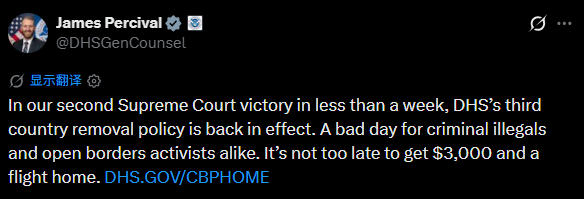
United States Department of Homeland Security Chief Legal Advisor James Pearce welcomed the emergency ruling and described it as "victory."
For illegal immigrants and activists who support open borders, today is a terrible day,” he wrote on social media, “Now applying for $3000 and a return flight ticket isn't too late.”
He finally attached a link to the immigration department’s instructions on how illegal immigrants can be repatriated by themselves.
White House spokesperson Lael Brainard said in a statement: “This is the third time in the past 18 months that the Supreme Court has blocked a request made by the same judge. The judge attempted to stop the Trump administration’s plans to deport illegal immigrants, including many criminals, to countries willing to accept them. Today’s ruling once again confirms the legitimacy of the president’s homeland security agenda.”
According to four people familiar with the matter, in order to support Trump’s immigration deportation plan, the U.S. Immigration and Customs Enforcement (ICE) is preparing to recruit on a large scale again, aiming to hire 5,000 new employees by the end of the year.
This recruitment will increase the number of ICE employees by about 17%, and will utilize a large amount of new funding provided by Congress. Most of the new employees are expected to be repatriation officers, participating in various law enforcement activities, from arresting targets to case management.
In the past few months, ICE has significantly increased enforcement efforts and launched a large-scale arrest operation. Congress has also allocated over $100 billion for this purpose. During the operation, due to a shortage of personnel, ICE officers faced the pressure of working seven days a week.

In January this year, former White House spokesperson Leavit released images of immigrants being deported.
Reports state that Supreme Court justices asked government lawyers and immigration lawyers who challenge the policy to focus on discussing during the debate in December whether lower court judges have the authority to suspend rapid deportations, and whether this policy violates constitutional and international laws related to anti-torture.
Representative of immigrant legal cases, Naoko Ikeda, said that "this emergency ruling is heartbreaking".
She stated in a statement that the court "allows the government to resume sending people to countries facing persecution or torture." However, she pointed out that the court had agreed to hold a full debate on December 29th and said that the decision on December 1st "does not constitute a judgment on the legal validity of this policy."
Lawyers representing numerous immigrants state that the Trump administration ignored "the significant harm caused by forcibly sending thousands of long-term residents in the United States to a third country, many without criminal records, and failing to consider the persecution or torture they would face there."
Also, some lawyers stated that the latest decision by the Supreme Court is a “devastating outcome for those who may have been sent on an airplane without prior notice or without the opportunity to file claims.”
The latest ruling means that the Trump administration can continue to implement its plan and carry out rapid deportations, including deportations to countries like Equatorial Guinea. According to The New York Times, in Equatorial Guinea, those who are deported face police custody with masked faces, being tied up, and are beaten.
Some immigrants and human rights experts assert that deporting illegal immigrants to third countries could be part of the broader strategy of the Trump administration, aimed at encouraging undocumented immigrants to leave on their own, rather than putting them in fear of being deported to a country with which they have no connection.
The Deputy Attorney General for the United States Department of Justice, John Sol, previously described the 'Third Country Eviction Program' as 'an important tool for deporting certain foreigners, including some of the most serious criminal offenders'.
According to immigration lawyers and advocates, deporting immigrants to third countries is not a new phenomenon, but such situations are not common.
In recent months, the Trump administration has increased efforts regarding the “Third Country Repatriation Program”. Previously, the United States had reached a series of formal agreements with nearly 30 countries, allowing them to repatriate asylum seekers, refugees, and immigrants with criminal records without any prior warning.
ABC previously interviewed a group of Latinx men who were repatriated to the Republic of Chad. They were only informed of their destination after several hours of flight. "I felt like I was kidnapped," one man said, "They violated our most fundamental rights as human beings."
The latest urgent ruling by the U.S. Supreme Court has attracted the attention of American media and lawyers.
According to emergency or shadow court proceedings, parties are allowed to seek swift intervention from the Supreme Court before the ordinary appeals process is completed. For example, a court can suspend a lower court's injunction, allowing policies to take effect while the litigation continues. These orders are usually issued without any signatures and without explanation.
The previous day (the 28th), the Trump administration submitted the 41st application to the Supreme Court’s list of pending cases. Records show that during his second term, Trump frequently sought authorization from the Supreme Court in order to temporarily restore policies that had been blocked by lower courts.
“We have never seen a government move so quickly and with such numbers to file lawsuits against the Supreme Court in this term, like the Trump administration,” Stephen Spoldin, director of the Brennan Center for Justice's Korberg Center, said. “The shadow courts and emergency courts are meant for dealing with true emergencies, and they should also be used for dealing with true emergencies.”
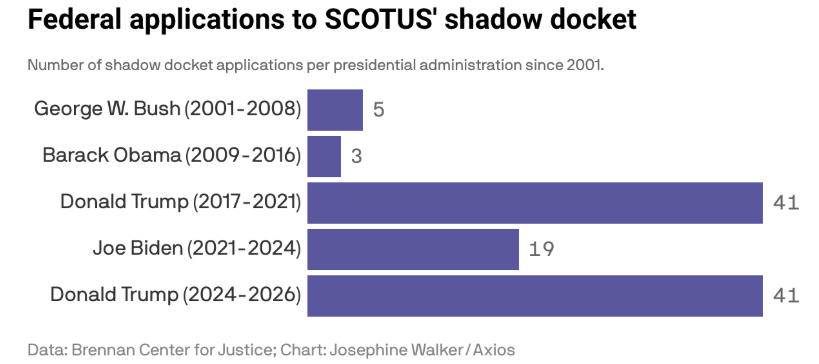
Data shows that the Biden administration made 19 emergency requests over a period of four years. During the 16 years of the Obama and Bush administrations, there were only 8 such requests made in total. In the first two years of Trump's presidency, he made 41 requests, far exceeding the numbers of other presidents and even equaling the total number of requests made during the first term of any president.
Justice Katanji Brown Jackson stated in a speech that the frequent use of shadow courts has "had a tremendous destructive and potentially corrosive effect on the judiciary." Another Justice, Elena Kagan, also pointed out that when the support for the Supreme Court is at a historic low, continued use of shadow court procedures could "have an impact on people's trust and confidence in our democratic system."
