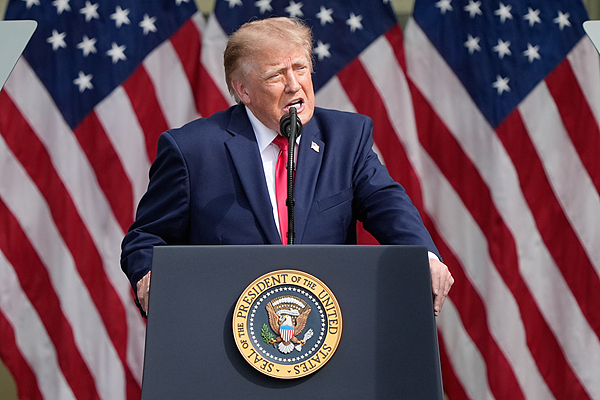
U.S. President Trump and three media companies are entering a new critical stage of a dispute over interview permissions at the White House.
On the evening of September 28th, local time, CNN, MS NOW, and Politico filed a request with the federal court to continue blocking the Trump administration from implementing the White House ban against three media outlets.
According to a report by Reuters on September 29th, three media companies hope that the court will continue to grant them the right to interview the White House during the ongoing litigation. The temporary restraining order issued by the court will expire on October 8th, making this date an important milestone in the further development of the case.
This incident began on September 18th. On that day, Trump announced on social media that CNN, MS NEWS, and Politico were prohibited from entering the White House, accusing these media outlets of continuously reporting “fake news”. During a press conference that same day, Trump further stated that reports by CNN and other media were “false”, and said the ban was not directed at a particular report, but rather at the cumulative reports published by these media outlets over the past two years. He also accused the relevant media of intent to spread negative information in order to weaken the Republican Party and the Republican government. The interview recorded by CNN showed that Trump did not provide any specific national security reasons for the ban.
However, after the ban entered the legal process, the Trump administration presented another set of more specific reasons: some reports from relevant media might pose a threat to national security. The US Department of Justice listed several reports from three media outlets in their court documents, including CNN's coverage of details related to the construction of underground facilities in the White House East Wing, MS NOW's reporting on government internal leaks investigations, and Politico's coverage of the construction and security arrangements for the White House banquet hall. Based on these reports, the Trump administration argued that the president had the authority to take measures to restrict media that might pose a risk to national security.
Three media outlets have taken this measure to court, arguing that the government is actually retaliating against them for dissatisfaction with their reporting content. They claim that this action violates the freedom of the press guaranteed by the First Amendment of the Constitution, and that the media did not receive adequate due process guarantees.
On September 24, U.S. Federal District Judge Timothy Kelly issued a temporary restraining order, demanding that the White House immediately restore the access of three media outlets to interviews. According to The Associated Press, Judge Kelly believes that these three media outlets are likely able to prove that the government failed to provide adequate due process when revoking journalists’ permits. He also found that the criteria used by the White House to restrict media interviews were too vague.
However, this ruling did not end the dispute. CNN later reported on the progress of the case, stating that the temporary restraining order issued by Kelly would only last for 14 days, expiring on October 8th. Before that, the court needed to consider the "preliminary injunction" requests filed by the three media companies, which sought to continue granting media access to the White House throughout the litigation process.
Regarding this, CNN reports that the Trump administration needs to submit a response by October 2nd. Three media outlets plan to submit their final written opinions by October 5th. The judge will then hold a hearing and issue a ruling as soon as possible.
Meanwhile, the court's reinstitution of journalist visas did not completely eliminate tensions between the two parties. According to The Associated Press, CNN journalists were allowed to interview the White House again, but were subsequently excluded from the media delegation accompanying Trump on his trip to Tennessee on September 27. Since CNN was originally part of the presidential media pool, this move sparked further controversy. Previously, other major television media also suspended participation in related media pool reports due to CNN being excluded.
Three media outlets believe that the White House continues to implement measures in a “ inconsistent manner” after the court restored its interviewing rights. They are concerned that if the temporary restrictions expire, the government may reinstate the previous bans. According to Reuters, the core purpose of these three media outlets’ request is for the court to continue blocking the Trump administration from enforcing the bans during the litigation process.
The Trump administration continues to defend these measures, arguing that entering the White House constitutes an interview privilege granted by the media, rather than a right that cannot be restricted. They also continue to make arguments related to national security. However, Kelly’s previous ruling has challenged the government’s arguments regarding procedures and national security considerations. According to The Washington Post, Kelly focused on whether the government gave the three media outlets sufficient notice, opportunities for response, and defenses in accordance with relevant legal precedents.
Therefore, October 8th is a crucial turning point in this legal dispute. If the court issues a preliminary injunction before that date, the three media companies’ rights to interview in the White House during the litigation will be further protected. If there is no new court order, whether the Trump administration will reinstate the previous media bans after the existing temporary restrictions expire will once again become a point of controversy.