On September 27 local time, Serbian President Vucic submitted his resignation from his presidency. According to Serbian constitution and the President's Law, the president must submit a written resignation to the Speaker of the National Assembly. Once the resignation is delivered to the National Assembly, his term of office ends on the same day, without the need for approval from the National Assembly or the Speaker.
Vukic previously stated that after leaving office, he would run for the position of Prime Minister in Serbia. Earlier this month, the General Committee of the Serbian Progressive Party decided to recommend Vukic as the party's leader on the parliamentary election list and as a candidate for Prime Minister. If the party wins the upcoming parliamentary elections, Vukic will serve as Prime Minister.
Since the position of President of Serbia is more symbolic, the Prime Minister actually holds real power. Vucic's move is also seen by some analysts as a strategy of 'retreat to advance': if he wins the parliamentary elections, he can continue to lead Serbia while satisfying the demands of the opposition to hold parliamentary elections earlier.
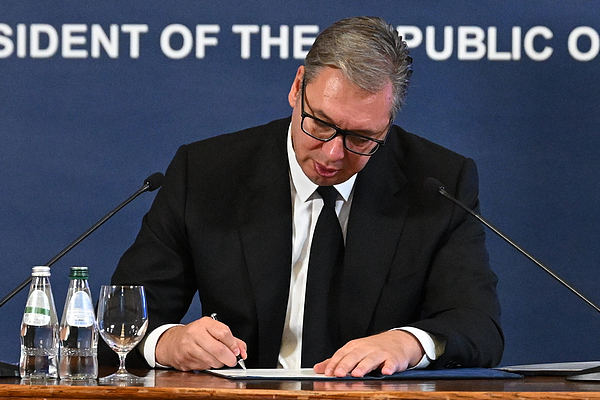
On September 27 local time, Serbian President Vucic signed his resignation letter. Visual China
A recent poll conducted by a Serbian research institution shows that the electoral coalition led by Vucic, "United Serbia," is in the lead, with the opposition "Students' List" coalition following closely behind.
Analysts believe that the decision of Vucic to hold parliamentary elections earlier is likely due to the greater chances of the ruling coalition winning. The fragmented opposition has not been able to truly shake the Serbian government. At the same time, the recent increase in the opposition’s support rate could also expand their influence during the upcoming campaign period, thereby posing a threat to the ruling party. Whether Vucic can win this “high-risk gamble” remains to be seen.
This resignation is not actually sudden. Vucic had made this decision three months ago. On June 27, Vucic stated clearly that he would resign from the presidency in a few weeks, and Serbia would hold presidential and parliamentary elections ahead of schedule. On September 9, Vucic signed a presidential decree to dissolve the parliament and announced early elections, setting October 25 as the election date.
Vukic was elected president of Serbia in April 2017 and was re-elected in May 2022. According to Serbian constitution, the presidential term is five years, with the possibility of re-election. Vukic's second and final presidential term was scheduled to end in mid-2027.
According to reports from the Serbian National Broadcasting Television, before officially resigning, Vučić spoke to his supporters in front of the presidential palace. He reflected on difficult times such as the COVID-19 pandemic, the Russo-Ukrainian conflict, and military conflicts around the world. He said, "We have successfully maintained peace and national stability. We have become stronger, and our economic strength is increasing every year."
Vucic emphasized his achievements in economic development. He noted that Serbia had an unemployment rate of 25.9% in 2012, with a youth unemployment rate as high as 54%. "As a result, every morning people care more about the exchange rate of Serbian dinars than they do the weather forecast. Under the irresponsible leadership of some people, we have lost 500,000 jobs in just three to four years."
Vukic said that when he first became prime minister in 2014, Serbia’s public debt accounted for 77% of its Gross Domestic Product (GDP). However, this proportion has now dropped to 43%, which is far below the EU average of 84.85%.
He admitted that he had made many mistakes during his tenure in office, but he emphasized, "I have fulfilled my duties with loyalty, honor, and fairness."

On September 27 local time, Vucic delivered a speech to his supporters. Visual China
After submitting his resignation, Vucic held a press conference to review the diplomatic achievements during his tenure. He said, "I am happy that we have started strategic dialogue with the United States, and I am pleased that we had very good talks with Russian President Putin and French President Macron. I believe I have left something behind for my successor."
Vukcevic expressed his special gratitude to China. He emphasized that Chinese friends have provided Serbia with significant assistance over the past period.
As Vucic resigned, he was facing political pressure within Serbia. In November 2024, a collapse of a shelter at the Novi Sad railway station in northern Serbia caused 16 deaths, leading to large-scale protests and demonstrations in Serbia. Even by the time Vucic announced his resignation, the protest led by students had not yet subsided.
Opposing parties and protesters criticized the Serbian government for being “corrupt and incompetent,” demanded greater transparency in public procurement, and accused Serbian police of using violence against protesters. The Serbian government, on the other hand, accused Western intelligence agencies of inciting a “color revolution,” claiming that the protests were supported by “external forces.”
As a parliamentary republic, the President of Serbia serves more as a symbolic head of state and has a say in foreign and security matters. The Prime Minister is responsible for daily administrative affairs and holds real power over fiscal budgets, infrastructure approvals, and personnel appointments.
Regarding the position of Prime Minister, Vucic is not unfamiliar with this role. He served as the Prime Minister of Serbia from 2014 to 2017. Therefore, many analysts believe that Vucic’s resignation is more of a ‘step back to advance’.
Vucic is willing to take a risk and hold parliamentary elections early on, which reflects his confidence in his own achievements and the Serbian Progressive Party.
A recent poll conducted by Serbian research organization Faktor Plus shows that the "United Serbia" electoral alliance led by Vucic topped the polls with 48.6% of the votes. The second-place opposition "Students' List" alliance received 37.1% of the votes, while Vucic's long-time ally, the Serbian Socialists, got 4.9% of the votes.
Compared with the previous survey, the support rate for “United Serbia” increased by 1.4 percentage points, while the support rate for “Student List” increased by 5.6 percentage points.
Faktor Plus executive director Vladimir Pejic said that according to the latest polls, the influence of the opposition is growing, but the ruling Serbian Progressive Party has managed to maintain its voter base. The 'United Serbia' coalition is on the verge of obtaining a majority of seats alone. The relationship between the Serbian Socialists and the ruling coalition remains stable, and it is expected to continue.
However, after all political parties officially launch their election campaigns, the support ratings may still change. Analysis indicates that whether the "United Serbia" party will be able to obtain the majority of seats necessary for independent governance, or whether it will need to cooperate with parties like the Social Party as in the past, as well as whether the opposition will further expand its influence, remains to be seen in the future.
The American newspaper The New York Times admits that while protests have put political pressure on Vucic, Serbia's fragmented opposition has not been able to break out of the realm of street politics, nor has it been able to truly shake Vucic's government. If the latest poll is accurate, the opposition's attempt to 'overthrow' Vucic through early elections will fail, which will instead strengthen Vucic's leadership position.
The newspaper pointed out that Vucic and Hungary’s former Prime Minister Orbán are close allies. Therefore, some opposition parties believe they can “follow the example” of Hungary and defeat the ruling party in elections. However, there are significant differences between the two countries: Hungary’s continuously weak economy was one of the reasons for Orbán’s resignation, while during Vucic’s tenure, Serbia’s economy maintained strong growth.

On May 1, 2026, in Novi Sad, Serbia, protesters held a rally. Visual China
According to AFP, one of the main demands of the opposition during the protests triggered by the accident at Novi Sad's railway station is the early holding of parliamentary elections. This means that if the Serbian Progressive Party wins the parliamentary elections as expected, Vucic will be able to continue leading the Serbian government while satisfying the key demands of the opposition.
