Since the United States launched military strikes against Iran, the Strait of Hormuz, a critical oil and gas transportation route around the world, has been closed. The United States has also imposed blockades on Iranian southern ports, which has prompted Iran to shift its foreign trade focus northward.
According to Al Jazeera's report on September 27th, as the situation between the United States and Iran remains stagnant, Iran is adjusting its trade strategies to find alternative export routes instead of the Strait of Hormuz. Currently, the ports along the Caspian Sea in northern Iran and the land ports in the north have become important gateways for Iran's foreign trade.
For a long time, Iran's maritime trade mainly took place through ports along the southern Persian Gulf, while ports along the northern Caspian Sea carried less traffic. Mohammad Shakiabi-Nasab, managing director of Iran Ports and the IMO, previously stated that Iran’s ports had a nominal annual throughput of 300 million tons, but only 30 million tons came from the northern ports.
He added that there is also a significant difference in the maximum cargo capacity of the southern and northern ports. The cargo capacity of a ship at the southern port could be equivalent to the cargo capacity of 20 ships in the Caspian Sea.
However, as the United States’ maritime blockade and air strikes continue to disrupt trade and transportation in the Persian Gulf, the focus of Iran’s import and export trade is gradually shifting towards the northern region. Reports indicate that the share of Caspian ports in Iranian cargo transportation has increased from 18% before the war to 30% today.
In early September, Hadi Hagehshenas, the governor of Gilan province in northern Iran, said that the number of containers shipped to Caspian ports had increased by 50% over the five months up to August 22. He noted that compared to southern ports, northern ports are closer to major cities in central Iran such as Tehran, Isfahan, and Arak, which helps reduce the land transportation costs of imported goods.
Hagheshnas added that goods can be transported from China via railway to the Caspian port of Aktau in Kazakhstan, then shipped by sea to the Caspian port in Iran, and finally transported by road into Iran. This can expand regional trade.
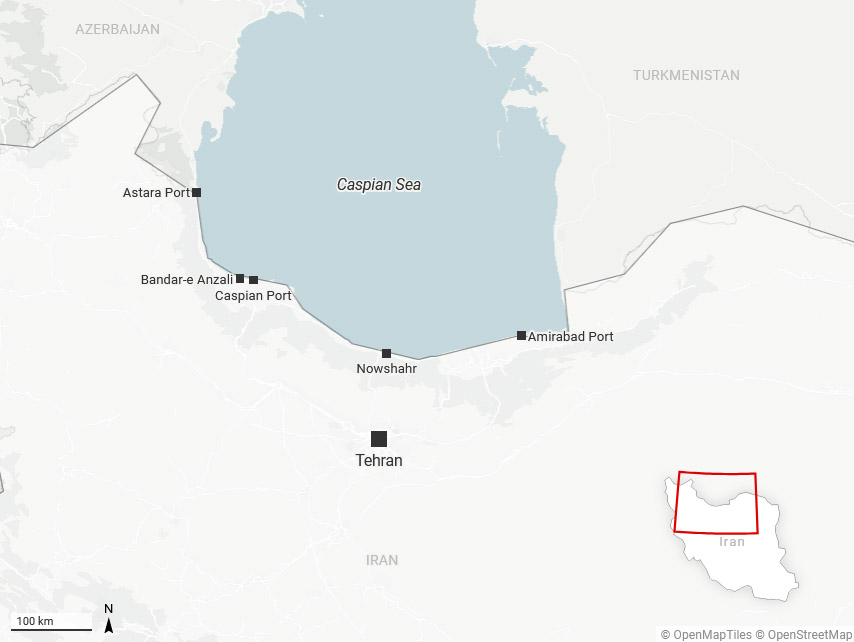
The main port along the Caspian Sea in northern Iran
However, the “Northward Strategy” also faces a series of challenges. Al Jazeera reported that the primary issue is the decline in the water level of the Caspian Sea. Shahram Fadakar, director of the Department for the Protection of Coastal and Marine Ecosystems at Iran’s Ministry of Environment, stated last week that over the past two or three years, the water level of the Caspian Sea has been dropping by more than 20 centimeters each year, which could affect shipping trade in all countries along the Caspian Sea.
The Caspian Sea is the world’s largest inland water body, with five countries along its coast: Iran, Russia, Azerbaijan, Kazakhstan, and Turkmenistan. Masoud Pormali, the director-general of the Iranian Shipping and Related Services Association, previously stated that the northern ports of Iran could originally accommodate ships of 6,000 tons. However, due to the decline in the water level of the Caspian Sea, they can now only accommodate ships of 4,000 tons.
Russia is an important trading partner of Iran in the Caspian Sea, but the Russia-Ukraine conflict has increased the security risks along the Caspian route. In July this year, Iran accused Ukraine of attacking a Iranian merchant ship sailing in the Caspian Sea, resulting in one death.
Analyst Ezzana Tdela of the think tank Bourse & Bazaar Foundation pointed out that currently, Iran mainly imports goods such as corn, wheat, barley, and rapeseed through its northern ports, and exports light goods like processed foods and packaging materials. Iran lacks sufficient port infrastructure and ships, making it impossible to significantly increase the volume of import and export trade through the Caspian Sea.
Tedra analyzed that Iran's bulk commodities such as fuel, oil, and iron ore are mainly exported through southern ports. These commodities are more likely to be converted into hard currency. "Even if the infrastructure in northern ports is expanded, it remains uncertain whether the market can meet the demand. This is because Iran's northern neighbors have their own oil, gas, and metal industries, which will overlap with Iran's exports."

Northern Iran, Port of Nushahr - IC Photo
Meanwhile, Iran is also expanding land-based trade through roads and railways, as well as increasing trade with landlocked neighbors such as Azerbaijan, Armenia, and Turkmenistan. However, the surge in demand for transportation capacity has also increased the pressure on Iran's transportation system.
Iranian researcher Wali Kaledji told Al Jazeera that changes in logistics operations have increased the burden of land transportation in Iran. At the border crossing of Nore Duz, which lies on the border between Iran and Armenia, more than 1,800 trucks have to wait for days before they can enter Iran. At other border crossings, the waiting time to enter Iran ranges from 10 to 15 days.
Kalegi pointed out that limited port capacity, complicated customs procedures, poor road infrastructure, and ongoing construction projects have all contributed to the congestion on the roads. The sanctions imposed by the West against Iranian airlines have also led to a large number of passengers flocking towards the land border, further exacerbating the congestion at border ports.
The Central Asia Railway on the east side of the Caspian Sea provides a route for Iranian goods to be transported to Turkmenistan, Kazakhstan, and China. However, on the west side of the Caspian Sea, the railway connection between Iran and the South Caucasus region was cut off during the Nagorno-Karabakh War from 1988 to 1994, and remains closed to this day.
Kaleki said that the Zula-Nahchivan railway was once part of the Soviet era's Southern Caucasus railway network. Whether this line can be restored depends mainly on the peace process between Armenia and Azerbaijan. He pointed out that the lack of railway connections between Iran and the Southern Caucasus is a key obstacle to Iran's trade through the international north-south transport corridor.
Currently, the Iranian government is working hard to complete the final section of the Rasht-Astara railway, which is a key cooperation project between Iran and Russia. Once completed, this railway will form an international north-south transportation corridor connecting Iran, Azerbaijan, and Russia.