On August 26th, after concluding our business trip in Stavropol, we decided to use the holiday period to travel nearby to the Chechen Republic in the Russian North Caucasus region—a place that has always held a mysterious charm in our hearts.
Just stepping out of Grozny Airport, one is faced with a huge portrait of Achmet Kadoev. The image of the first president of Chechnya has become the first card that this land presents to visitors.
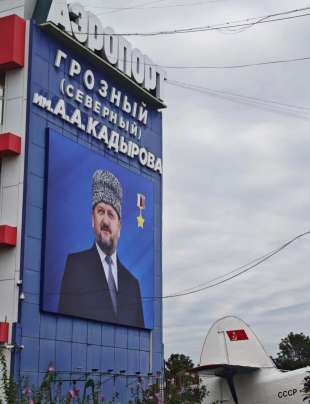
Grozny Airport is named after Akhmat Kadyrov
As usual, we instinctively opened Yandex. As a national taxi service used throughout Russia, even in the remote and frigid Kamchatka Peninsula, Yandex can easily arrange for a ride. The system quickly matched a driver, and the estimated cost displayed on the page was only 200 rubles.
However, when the driver arrived, he immediately extended a finger, indicating that he would only accept a price of 1,000 rubles before leaving. Seeing that I was about to cancel the order, he began complaining, saying that most drivers at the airport entrance were unwilling to take customers at extremely low prices as per the platform’s rules. He also complained that Yandex’s pricing strategy severely squeezed the survival space of local taxis. It wasn’t until I checked the check-in guide in the hotel that I realized: Chechnya has its own local taxi app. Many local drivers take advantage of the information gap created by tourists who are new to the area, deliberately waiting to pick up passengers on Yandex, and then charging extra after accepting the orders.
This distinctive character, which is “quite different from other parts of Russia,” quickly spread from travel details to every corner of the city. Walking down the streets of Grozny, gas stations that looked like local brands we had never seen before became common. National chain supermarkets, which are almost ubiquitous in other Russian cities—such as “Перекрёсток” and “Пятёрочка”—were nowhere to be found here. In front of the city government, there was no statue of Lenin, which is a standard feature in most Russian cities. Even fast-food chicken restaurants have developed unique local versions, with their logos featuring a characteristic smiling Caucasian uncle.
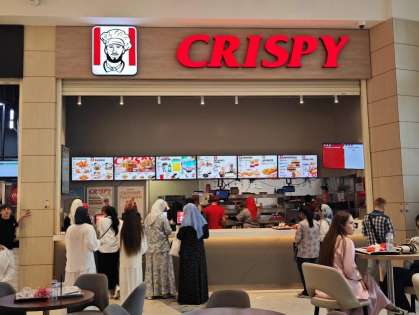
Local fried chicken chain restaurant Crispy
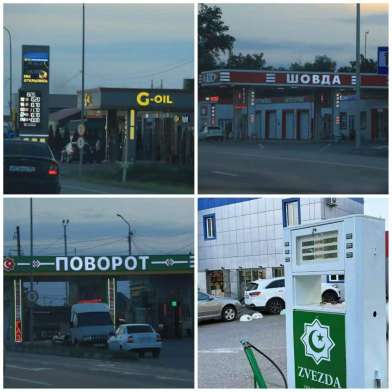
A gas station brand I have never seen before
This strong "localized" atmosphere does not only pertain to the commercial sphere, but also deeply penetrates into the political and cultural landscape of cities. In the center of Grozny, the portraits of Akhmat Kadyrov (hereafter referred to as Old Kadyrov) and the current Chechen leader Ramzan Kadyrov (hereafter referred to as Young Kadyrov) are almost ubiquitous. Whether it’s in city halls, courts, education departments, libraries, cultural centers, sports training institutions, or even ordinary residential buildings, the exterior walls of construction companies, and street corner billboards, the portraits, famous quotes, or commemorative slogans of this father-son duo can be found everywhere.
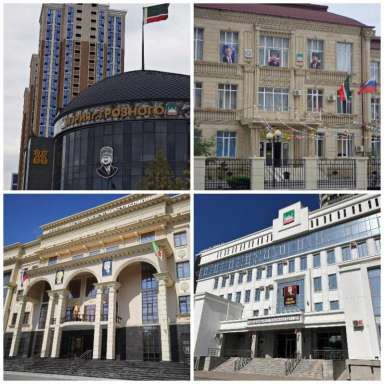
Municipal Hall, Education Bureau, Courthouse, Kaderov portrait on the wall of the local government
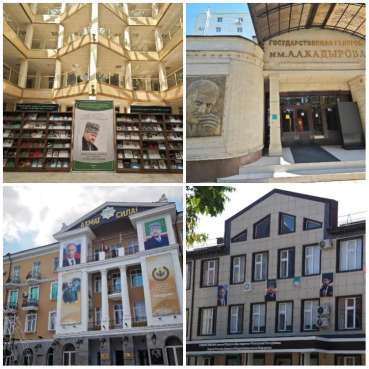
The Kadyrov statues are hung in libraries, art galleries, cultural centers, and at the entrances of schools.
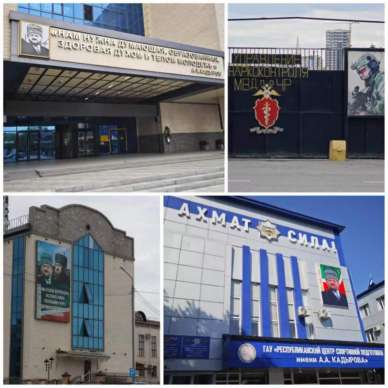
The Kadyrov statue hanging at the Petroleum Technical University, Anti-Drug Bureau, Health Bureau, and Sports Training Academy
This high-intensity visual presence is not limited to official spaces at all. In souvenir shops, shelves are filled with mugs and T-shirts featuring Kadyrov’s image; passing by ordinary blanket stores, portraits of Kadyrov and his mother hang on the walls; even street graffiti and commercial advertisements frequently use these political symbols.
In the promotional gallery in front of the Chechen National Drama Theater, there are posters of plays featuring former President Kadyrov—"The First President," "People's Heroes—Glory of the Motherland," and "The People's Choice"—displayed prominently. These plays transform the lives of political figures into dramatic stories. Here, the image of political figures quietly crosses the boundaries of official contexts and becomes deeply integrated into the daily consumption and cultural life of citizens.
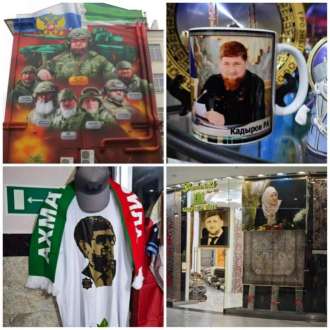
Kadirov appears in everyday spaces
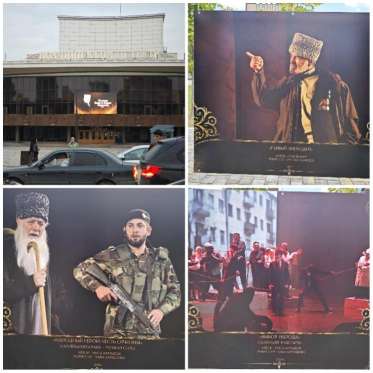
Old Kadyrov Drama Poster
Additionally, in this city where Muslims make up 96% of the population, the sacred religious spaces are also deeply associated with the Kadyrov family. The iconic “Heart of Chechnya” mosque in Grozny was named after former President Kadyrov; the “Heart of Mother” mosque in the nearby town of Argun was named after Kadyrov’s mother, Emine Kadyrova. Even in the small town of Shali, the grand mosque was originally planned to be named after Kadyrov himself. It was not until its official completion in 2019 that the mosque was finally named after the Prophet Muhammad.
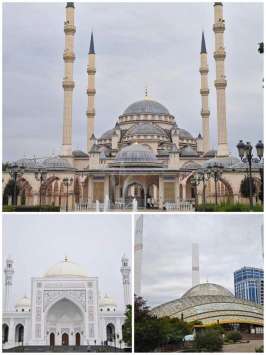
Chakhet’s three largest mosques: Grozny’s “Heart of Chechnya”, Argun’s “Heart of Motherhood”, and Shali’s Prophet Muhammad Mosque
If our journey leads us to this abrupt conclusion, it might be easy to reach a simple and direct conclusion: Grozny today is a city that is highly "Chechnedized," even to the point of being highly "family-oriented." However, as our journey progressed, I quickly realized that this judgment was not comprehensive. Because in this land, besides the Kadyrov family, there is another face that is equally present everywhere—that is Putin. The two coexist in the urban space, jointly shaping a more complex political and cultural pattern.
One of the most important urban axes in Grozny is Putin Avenue.
As early as 2008, this main road, originally named “Victory Avenue”, was renamed “Vladimir Putin Avenue”. Since then, spaces named after the supreme leader have continued to spread throughout the city: in 2024, Grozny announced the construction of a new “Putin District”; on October 7, 2025, which coincidentally fell on Putin’s birthday, the first batch of residences in this district was officially delivered for use; and by the year 2026, when we visited, the “Putin Park” covering an area of over 87,000 square meters was still in the process of being built.
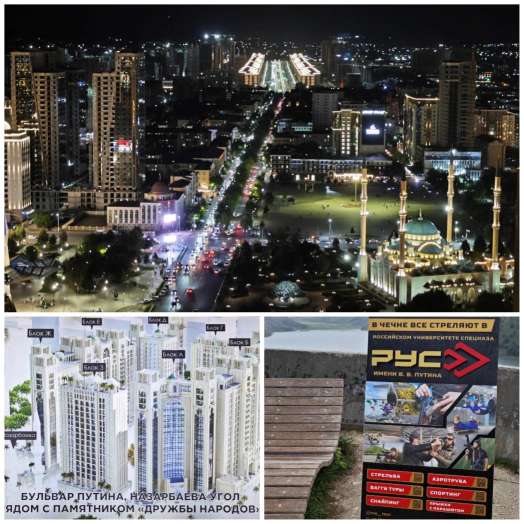
Night view of Putin Avenue in Chechnya's CBD, promotional images of residential areas in Putin District, and admission images for the Putin Special Forces University
This ubiquitous political symbol is not only found in the bustling areas of the city center, but also extends to the borders. On my way to Kzernoy Am lake on the border between Chechnya and Dagestan, a prominent advertisement for enrollment caught my attention—it was the "Russian Special Forces University" named after Putin, located in the city of Gudzhilemsey in Chechnya. The official website states that this institution specializes in training special operations personnel, security forces, and military instructors for the federal government.
If place names and buildings are merely superficial political symbols, then the visual impact brought by the Kadyrov Memorial Hall is much more direct.
The museum has a entire wall dedicated to displaying photos of old Kadyrov and Putin, showing the close relationship between the two. On another photo wall titled “Father and Son”, there are pictures of Putin and Kadyrov as father and son. In these images, Putin plays the role of “father”, while old Kadyrov, as a local spiritual leader, voluntarily seeks reconciliation with Moscow. He is the eldest son who takes the lead in submitting to the authority of “the father”. Young Kadyrov continues his father’s legacy by governing, serving as the second son who follows closely behind him. Both rely on the supreme authority represented by Putin.
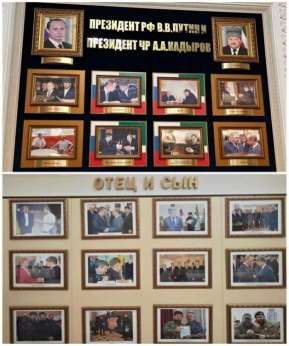
Kadyrov Memorial Hall: A Photo of Kadyrov and Putin
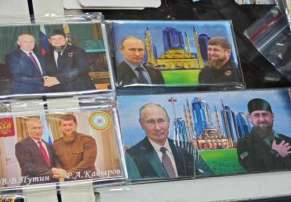
In the souvenir shop, there are refrigerator magnets featuring Putin and Kadyrov together.
Interestingly, the Federation did not require Chechnya to express loyalty through Russian culture. Walking down the streets of Grozny, one can see Orthodox churches and Russian theaters. The urban layout still bears traces of the Soviet era: next to the “Heart of Chechnya” mosque is the Komsomol Park that carries Soviet memories. Not far from the Dagon Omayev Cultural Center is the Chekhov Park, while around the Islamic University lies the Lemontov Park.
However, the architectural style of the cities, religious practices, and clothing customs maintain Islamic and Chechnya characteristics. Compared to Dagestan and Tatarstan where we have visited, gender segregation is particularly evident in Chechnya—there are separate areas for men and women on beaches, male and female restrooms located at opposite ends of shopping malls, and prayer rooms. There are also taxis that can be called specifically for women. In terms of clothing, women are required to wear headscarves and garments that cover their arms and legs, while men typically dress in formal clothes or traditional robes. In public places, revealing clothing is strictly prohibited, and this standard is even more conservative than in most parts of Russia.
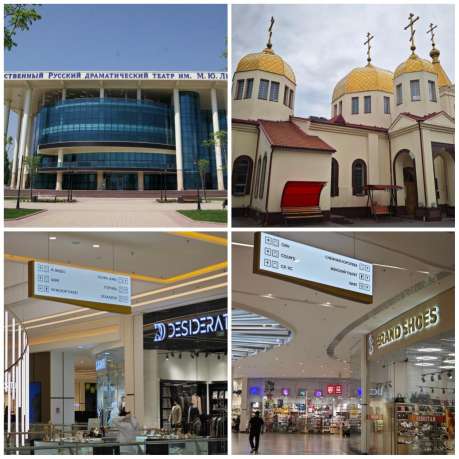
Grozny's Russian Leontov Theatre and St. Michael Orthodox Church. The toilets for men and women are located at both ends of the mall.
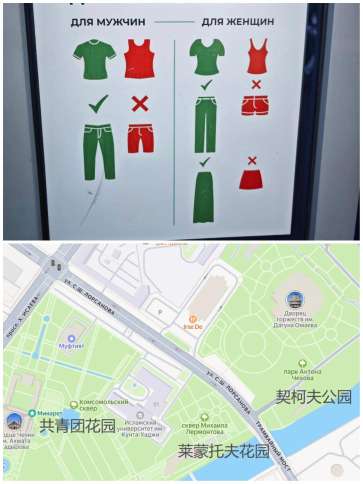
Signboard indicating the requirements for local dress codes; maps show the intermingling of Chechen-style and Russian-style buildings.
Through these spatial arrangements, I gradually realized that this is a sophisticated form of political division and boundary setting: on the levels of culture, religion, and social customs, Chechnya can maintain an absolute "localism"; however, at the level of political loyalty and national identity, it is necessary to express unreservedly "belonging to Russia." The Kadyrov family is responsible for organizing and maintaining local order, while Putin, as the federal authority upon which this local order ultimately relies, occupies the top position. Therefore, the three faces of Old Kadyrov, Young Kadyrov, and Putin can coexist and complement each other without any dissonance on the streets of Chechnya, silently declaring that two identities coexist and perform their respective roles on the same land.