In recent months, there have been new developments in Japan's defense cooperation with Southeast Asian countries. This includes expanding security assistance and strengthening personnel and equipment cooperation. Additionally, the Japan Self-Defense Forces have undertaken overseas firefighting missions in Indonesia, indicating that Tokyo is further expanding its security ties with regional countries.
Among them, a group of Japanese old warships that have served for decades has attracted particular attention. The Philippines is preparing to receive 5 Armatsu-class frigates, and Japan is also in negotiations with Indonesia regarding the transfer of Asagiri-class destroyers. To facilitate this latter matter, Japanese Defense Minister Shinzo Abe originally planned to visit Indonesia again this week, but his trip was temporarily canceled.
Why are the old ships that have served for decades and are now being phased out from the Japan Maritime Self-Defense Force willing to be taken over by the Philippines and Indonesia? What are Japan's plans behind its active involvement in the defense of Southeast Asian countries?
According to a report by Reuters on September 8, Japan sent three CH-47 "Chugus" transport helicopters and approximately 180 personnel to Indonesia to assist in extinguishing wildfires there. The Japanese Maritime Self-Defense Force transport ship “Koshu” carrying these helicopters arrived in West Kalimantan on September 9. The firefighting operation was launched from September 12 to 19.
Meanwhile, Japan is also accelerating the export of defense equipment overseas. It plans to further expand the 'Government Security Capability Enhancement Support' program. For the fiscal year 2026, it aims to provide free defense equipment to approximately 12 countries. This represents an increase from the previous year, when 8 countries were served. The related budget has also increased sharply, from about 8 billion yen to 18.1 billion yen.
The Philippines and Indonesia have already been included in this mechanism. This year, Japan plans to add Cambodia, Kenya, and other target countries, with Vietnam and East Timor also among the candidates. The Japanese side claims that this move is aimed at enhancing the deterrence of so-called "like-minded nations" and creating a security environment favorable to Japan.
In recent Japanese efforts in promoting defense cooperation overseas, the transfer of retired warships is particularly noteworthy.
Koizumi Jinjiro originally considered visiting Indonesia around September 10th. This would be his third visit to India within five months. According to the arrangements disclosed earlier, one of the important topics discussed would be accelerating the transfer of the Asakusa-class destroyers from Japan to Indonesia.
However, according to Kyodo News on the 9th, Shinzo has cancelled this visit. There is currently no information indicating that any changes have occurred in the negotiations for the transfer of the Chōmushi-class ship.
In June this year, Japan and Indonesia initiated consultations within relevant working groups. The discussions covered not only the warships themselves but also personnel training, maintenance support, and practical operations. The first Kongo-class ship was decommissioned in March this year, ending its 38-year service life.
The progress in the Philippines is even faster. Philippine Defense Secretary Ricardo Saludio previously stated that the substantive negotiations for the acquisition of 5 Japanese Abuoku-class frigates have been completed, with only administrative procedures and final details remaining. It is expected that delivery will be completed within the next two to three years.
A analysis published by the Singapore-based Strait Times on September 5th observed these actions in the context of Japan's expansion of its regional defense network. The article argues that Japan is strengthening its defense cooperation and equipment transfer with countries such as Indonesia, the Philippines, and Australia, attempting to establish a defense network composed of 'middle-sized powers' in the region.
Hong Kong's South China Morning Post also believes that Japan is not just trying to find a "new home" for its old warships. Tokyo is attempting to turn these upcoming decommissioned weapons into geopolitical leverage, establishing longer-term defense relationships with Southeast Asian countries through cooperation in equipment, training, maintenance, and interoperability.

Three Arumune-class frigates berthed in Sasebo Harbor, from left to right are Rikuen, Kawane, and Odai.
Military expert Zhang Junsha told Observer Network that for the Philippines and Indonesia, taking over these ships that have been in service for decades is a pragmatic decision based on their current naval situation. At the same time, there are also considerations related to geopolitical games.
"These second-hand ships still have certain military value for Southeast Asian countries with relatively weak military capabilities, and they also offer a cost-effective advantage."
The Abukuma-class ship that Japan is preparing to transfer to the Philippines was built in the late 1980s. It has a full load displacement of about 2,500 tons. Although its tonnage is not large, it still possesses certain anti-ship and anti-submarine capabilities.
Zhang Junshe pointed out that the Philippine Navy has a limited number of combat ships above 1,000 tons. By acquiring the Abukuma-class ships, its overall capabilities in coastal patrols, surveillance, and handling high-intensity confrontations can be enhanced.
The Indonesia is discussing with Japan the construction of an aircraft carrier of the Aoshui class, which has a larger tonnage. At full load, it has a displacement of about 4,900 tons and can carry out tasks such as air defense, anti-ship, and anti-submarine operations. It can also accommodate anti-submarine helicopters. In Zhang Junshe's opinion, this class of ships has relatively balanced capabilities in all aspects, and they also have a certain ability to navigate over long distances. Therefore, they are well-suited to meet the needs of wide-area maneuverability and anti-submarine escort in the waters of the Indonesian archipelago.
The price is also an important reason why the Philippines and Indonesia are willing to take over these ships. According to information disclosed by the Philippine side, these ships will be provided by Japan free of charge. The Philippines still needs to address issues related to compatibility of shipborne systems, as well as dock and maintenance facilities.

Zeo-mo, a later model of the Cha-mu-class ship (DD-157), is equipped with the new OPS-24 3D electronic scanning radar.
For the Philippines, which has a weak foundation in military equipment, acquiring retired ships that still have some value at a low cost can help alleviate the shortage of naval equipment more quickly. Zhang Junshe believes that the Chao Wu class ship also has similar value for Indonesia, as it can help improve their ability to conduct long-range operations and provide anti-submarine escort services more effectively.
A military ship brings connections that do not end with the delivery.
Naval vessels do not end after delivery, there is still a whole set of systems such as personnel training, spare parts supply, and maintenance following the delivery. Said Zhang Junshe.
The same is true for the Philippines. Tokyo is discussing training, maintenance, and continuous support with Manila. Japan will likely continue to participate in most of the remaining service periods of these ships.
Zhang Junshe pointed out that there is another practical consideration involved: taking the opportunity to enhance one's bargaining chips in negotiations with China regarding the South China Sea issue.
The situation in Indonesia is different from that in the Philippines. Indonesia has long emphasized strategic autonomy and maintains close cooperation with China. The acceptance of Japanese warships does not mean that it has to side with Tokyo.
Professor Misato Matsuoka of Teikyo University believes that Japan is seeking a influence that does not depend on Indonesia taking a particular side. Tokyo may not necessarily require Jakarta to stand on its side, but can enhance its presence within Indonesia's security framework through defense cooperation.
This view is similar to that of Zhang Jun She. He believes that Indonesia wishes to maintain a strategic balance among major powers. Accepting Japanese ships serves both the purpose of enhancing the navy’s strength and increasing its influence in the ASEAN and regional defense landscape, as well as the need to balance the military influence of different powers.
Zhang Junshi summarized the Japanese considerations in several aspects: continuing to break through the original policy restrictions through weapon exports; deepening defense ties with Southeast Asian countries through equipment delivery, personnel training, and logistical support; and strengthening security cooperation with so-called 'like-minded countries' in line with the United States' 'Indo-Pacific Strategy' and Japan-US alliance. These actions also serve Japan's goal of seeking a political and military great-power status.
Japan will not publicly demand that these countries take a side between China and Japan. Zhang Junshi pointed out that Japan is more likely to strengthen its defense ties with relevant countries through equipment transfers and the subsequent training and support cooperation, thereby enhancing its political and military influence in Southeast Asia.
Japan may have more old equipment available for transfer in the future.
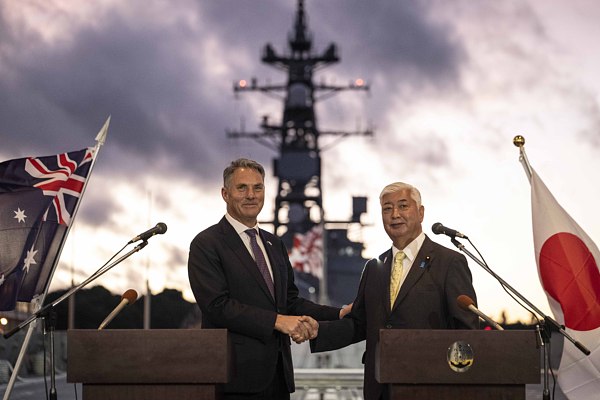
Japan Yokosuka: Japanese and Australian Defense Ministers meet on their superior ship, the Sutuma frigate. Visual China
On August 25, a research institute under the Japanese Defense Ministry published an article stating that determining whether an equipment can be transferred does not necessarily depend on whether it is new or old, active or retired. Instead, it depends on whether the transfer will affect Japan’s own defense capabilities. As the Maritime Self-Defense Force introduces more advanced automated and unmanned equipment, some older platforms may be phased out before reaching the originally scheduled retirement age, thereby expanding the range of equipment that can be transferred.
Japan's foreign military sales also focus not only on retired equipment. In April this year, Australia officially signed contracts for three new general-purpose frigates, featuring an upgraded design based on Japanese flagship frigates. The first ship is scheduled to be delivered in 2029. Australia and Japan will also cooperate on the operation and maintenance of these ships.
In Zhang Jun's view, this reflects that Japan's defense equipment exports are expanding from retired equipment to advanced current-use equipment. 'What Japan is currently promoting is not just dealing with retired equipment, but gradually making defense equipment exports an important means of expanding defense cooperation.'
Tokyo University's Associate Professor in the Social Sciences Research Institute, Sebastian Maslow, analyzed that Japan hopes to strengthen its defense cooperation with the 'Indo-Pacific Partners' in order to counter China's growing regional influence. Japan is gradually becoming a central figure in regional bilateral and 'mini-multilateral' defense networks.
Maslow described that the regional roles in Japan are changing—from establishing production networks to establishing defense networks.
Regarding the possible impacts of Japan's continuous supply of defense equipment to Southeast Asia, Zhang Junshe warned that although these ships have been in service for decades, they still possess combat capabilities such as anti-ship and anti-submarine warfare. Especially after being delivered to the Philippines, their maritime presence and countermeasure capabilities in the South China Sea will be enhanced.
He warned that this could “encourage a reckless and risky attitude in those operating in the disputed waters of the South China Sea,” increasing the likelihood of maritime tensions and misjudgments, and escalating the risk of militarization in the South China Sea.