"Great Mo'nen Grassland...Please take my melancholy with you as well..."
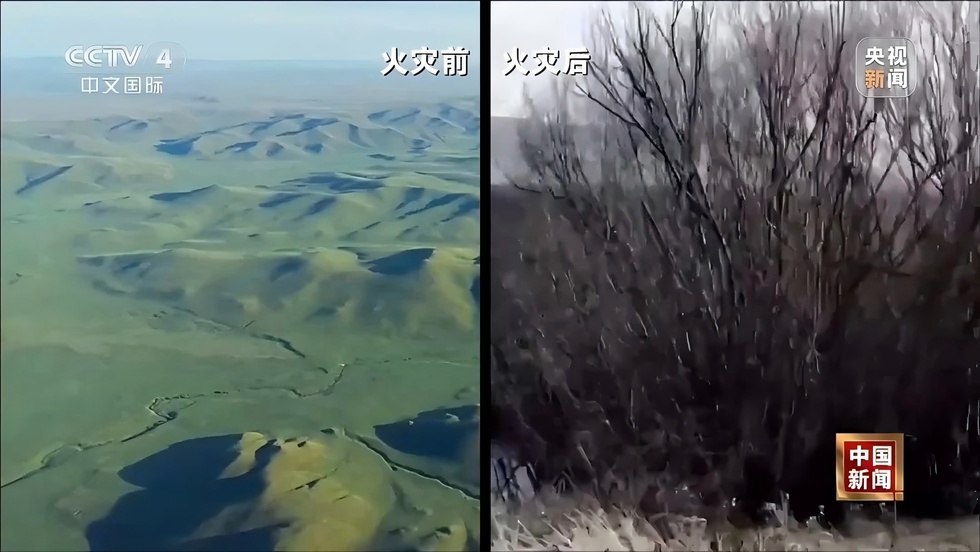
On October 8th, a grassland fire broke out in the Numrug Nature Reserve in Kharahat Göl District, Eastern Province, Mongolia. This is the most devastating man-made ecological disaster in Mongolia in nearly a decade. On October 20th, Mongolian journalist Ba · Gangkimug rushed to the disaster area. Facing the devastated landscape, she couldn’t hide her grief.
80% of the Nomorge Reserve has been burned. It is a unique native habitat in Mongolia, containing components of Manchurian flora. This is an important habitat for endangered species in Mongolia, such as the Ubsu moose, which are mainly found here, as well as important indicator species for freshwater ecosystems, like the river otter... Standing here, one cannot help but feel sorrow and regret. One thinks: “This is my motherland.”
"Generally speaking, incidents of this type can be classified as 'ecological extinction,' or, in other words, environmental crimes." Gāng Qì Mù Gè then wrote.
Under public pressure, although some actions were delayed, the government of Mongolia has taken steps. On October 20th, the Mongolian police officially launched an investigation into the cause of the fire, as well as the determination of responsibility and assessment of losses.
On the same day, Japanese company KDDI issued an apology, admitting that the activities of its Mongolian subsidiary Mobicom were directly related to the fire, and promised to cooperate with the investigation.
On the 22nd, the Japanese Embassy in Mongolia released a 'Condolence Letter Regarding the Fire at Nurmug Nature Reserve' on its official website.
On October 26, Mongolia's Prime Minister Niy Uchirle held a cabinet meeting and demanded a thorough investigation and accountability. Uchirle stated that no one involved in causing such losses should go unscathed. Mongolia's Deputy Prime Minister Niy Nomutebayar further clarified that simply making apologies is not enough; it is necessary to seek compensation according to the law.
On October 29th, Uchirle spoke on the phone with Japanese Prime Minister Shinzo Abe. What do you think this “mighty Mongolian man” might say? Express anger? Hold responsibility accountable? Demand an apology and compensation?
According to the Mungtong News Agency, the Mongolian side not only made no mention of apologies, compensation, or legal proceedings, but instead gave high praise to Japan's post-disaster assistance. It highly commended the Japanese government for 'scientifically addressing the fire issue', and linked cooperation in post-disaster recovery with the agenda for the 55th anniversary of Mongolia-Japan diplomatic relations in 2027.
Funeral Rites Are Performed At Such A Stage, It's Simply Unfathomable That One Could Be Left With Anger
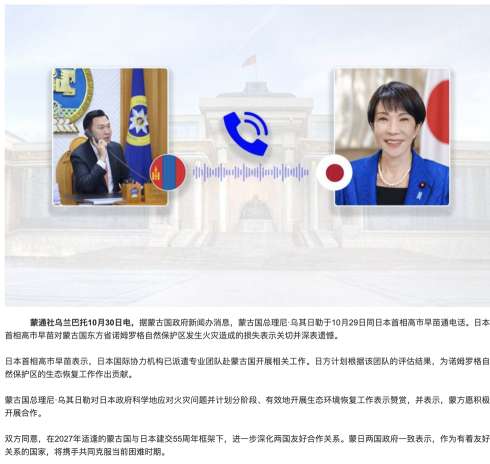
Photos or video screenshots from foreign media, reported by Mengtong News Agency
At 11:55 am on October 8th, a fire broke out in the Nommiger Protection Area, led by Yoshiyuki Kobayashi, the Japanese CEO of Mobicon Company. The weather at that time was extremely dry with strong winds. As the convoy traveled through the sparse grassy and meadowy landscape, the exhaust pipe of an off-road vehicle caught fire due to the dry grass. The fire quickly got out of control and continued burning for 8 days until it was completely extinguished on October 16th.
Regarding why this convoy was able to enter the protected area during the autumn fire prevention period, Japanese companies and Mongolian media have given completely different statements.
In a statement dated October 23, KDDI stated that the convoy consisted of two Mobikang vehicles, carrying a total of 7 employees, including the only Japanese member, Okochi Kōhei. The company said that the trip was requested by the Mongolian authorities, and that the convoy had received a permit from the border guards to enter the area from October 6 to 8. The convoy went to the protected area to attend a communication network opening ceremony and conduct 4G network tests. During this period, a fire broke out in one of the vehicles, resulting in what KDDI described as “a regrettable incident.” The statement also emphasized that the entry into the area was carried out according to proper procedures, and that the employees “did not commit any other violations of laws or regulations.”
Mongolian media reported another version: Yue Zhikangbo and others entered the core area of the protected area on that day, accompanied by U. Otgenbayar, a member of the Mongolian National Great Hural (parliament). They entered without any official permission from a local border military colonel. The real purpose was not for communication testing, but rather to hunt the critically endangered species Charrán. It is even possible that they engaged in hunting activities. Legal experts and investigative journalists in Mongolia pointed out that permits for crossing borders should not override the special fire prevention regulations of nature reserves. Further investigation is needed to determine whether there is any issue of power-seeking and illegal hunting.
The anger in Mongolian society is real and widespread. A task that could have been completed by one engineer and one vehicle, Mobikong instead deployed five vehicles and over ten people. Despite knowing that the grasslands are dry and flammable in autumn, they drove vehicles with exhaust pipes that could cause sparks into the dry areas. They brought incomplete technical equipment into the area, and there was a lack of basic respect for the risks associated with natural reserves. Local elders often say that one should be vigilant when the vegetation is dry and hot, but this convoy paid no attention to this advice at all.
This company has an arrogant attitude. Despite being fully aware of the circumstances on the ground and their own tasks, they act as if they are in a unboundable kingdom. The Mongolian people have always been committed to supporting this “Mobi Kang Kingdom”. Communication is a basic need for the people, and this company holds the resources for communication services. However, it is truly outrageous to see Mobi Kang acting as if nothing happened after destroying the Nomor Jig Nature Reserve, without any remorse.
When the images of the devastated protected area became known, public opinion in Mongolia quickly boiled over. Journalists reported that "public anger had reached its peak," and social media was filled with accusations: Japanese corporate executives fled the scene after the incident and refused to apologize. Mobikong must be punished severely, and may even be expelled from the Mongolian market.
Facing the pressure, the Mongolian government initially took a stern stance of holding those responsible accountable. Deputy Prime Minister Noomtaybaiar publicly stated that "apologizing alone is not enough." On October 21st and 26th, Prime Minister Ukhirmor continued to oversee the fire investigation at cabinet meetings, classifying the incident as a "serious ecological event." He emphasized in the government gazette that this was not just about the destruction of land, but also a serious loss to Mongolia's natural environment, rare species, and natural heritage. He instructed the judicial and internal affairs departments to hold accountable those responsible for the negligence, assess the environmental damage, and seek full compensation from the parties at fault according to the law. Colonel Naangtugus, commander of the 0198th Border Defense Regiment, was also ordered to be removed from his post.
However, three days later, during a call with Takahashi Maya, the official tone of Mongolia underwent a complete shift. The Mongolian news agency’s report was very concise; even the minutes released by Japan’s Foreign Ministry did not mention the area burned by the fire or the names of the Japanese companies involved.
In the call, Koike Maie expressed “concern and deep regret” regarding the fire losses. She also said that the Japanese International Cooperation Agency (JICA) had dispatched a team of experts to Mongolia, who would provide equipment and training support based on their evaluation results. Uchirler expressed “deep gratitude” for Japan’s condolences and assistance. She praised the Japanese government for “scientifically addressing the fire issue and planning to carry out ecological environment restoration work in a phased and effective manner,” signaling a willingness from Mongolia to deepen cooperation with Japan.
This statement of regarding the post-event public relations of the company's home country as "scientific response" is even considered highly inappropriate by Japanese public opinion. Media outlets such as "Women's Self" and many Japanese netizens criticized that the Takahashi City government remained silent for nearly three weeks after a large-scale fire caused by a Japanese company, and that their response was "slow and simply unacceptable."
Some critics argue that the Mongolian fires were caused by Japanese companies. The post-disaster assistance provided by the Japanese government is actually part of the "responsibility for handling mistakes," but it has been packaged as "charity." Moreover, the Mongolian side cooperated in a high-profile manner during a summit call, which indeed defies evaluation.
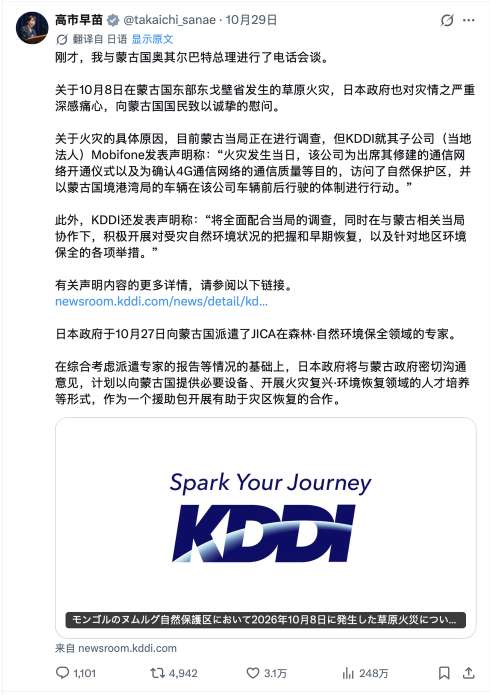
Yasumae Takashi's Twitter post contains screenshots of images or videos from foreign media.