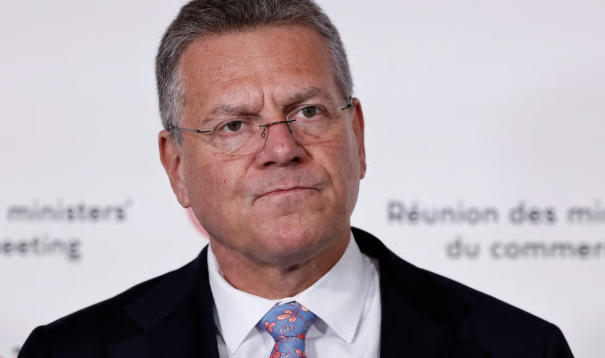
On September 7th, according to the EU policy news website Euractiv, the European Commission is expected to propose major reforms to the EU’s government procurement rules later this week. This is the latest measure taken by the EU to reduce its economic dependence on China.
This draft of the Public Procurement Act is expected to be officially announced by Stefanini, the EU's Industry Strategic Commissioner, on Wednesday. The relevant provisions of the draft aim to reduce the “excessive focus on price” in public tendering and to curb the so-called “harmful strategic dependence on suppliers from third countries”.
"EU Dynamic" believes that China is clearly the target of this draft, even though it does not name China explicitly.
The Financial Times notes that this draft allows public procurement entities to give priority to European companies in bidding processes.
The draft states: 'In a context of increasing competition, rising supply chain fragility, and geopolitics where economic dependence is weaponized, how public procurement entities spend their money has become a strategically important issue.' Public procurement accounts for approximately 15% of the European Union's gross domestic product (GDP).
According to this draft, protecting key infrastructure, strategic supply chains, and critical technologies may become criteria for assessment that are ‘related to specific contracts’.
The EU dynamic indicates that, in another statement hinting at China, the draft also requires that if the quotation is "obviously lower" than bids from other bidders, government agencies must require the bidder to provide an explanation for their low price.
Preliminary bill proposal requires that member states "exclude bidders who cannot offer a rational explanation for low bids."
On June 2nd, EU member states approved punitive measures against China under the International Procurement Instrument (IPI). According to this decision, Chinese companies will be restricted from participating in EU public procurement projects for medical devices worth over 5 million euros for the next 5 years.
The European China Chamber of Commerce responded that, for a long time, European medical device companies have enjoyed significant benefits from the open market in China. They have been deeply involved in the modernization of China's medical system, achieving remarkable development. The decision made by the European side on June 2nd did not take this background into full consideration, and it will impact the foundation of trust and cooperation that has been built between China and Europe in the medical field over the years.
According to the European edition of the American 'Political News Network', on August 31, the European Commission's Commissioner for Trade and Economic Affairs, Javier Solana, stated that Brussels is still developing a 'diversification tool' to encourage companies to purchase goods from different suppliers when other options are available. The aim is to reduce Europe's dependence on Chinese products in strategic industries.
Of course, diversification will lead to cost increases,” said Xie Fu Qiao Vichai. “The price increases of key minerals and green technology products are a prime example.” He further noted that some companies are now realizing that "the costs of diversification are less than the costs of business interruption."
Politicians pointed out that restricting China's imports would indirectly push up prices for European producers, leading to unforeseen consequences.
Affected by the war in Iran, inflation in the eurozone reached 2.9% in July, far above the European Central Bank’s target of 2%. The measures that have caused increases in prices of imported goods from China may further push up prices, posing additional challenges for governments in European countries.
This measure was introduced at a time when tensions between the European Union and China are escalating.
In response to the issues of so-called imbalance in Sino-EU trade and industrial subsidies repeatedly raised by the EU, China's Foreign Ministry spokesman Lin Jian previously stated that within the framework of the WTO, international trade is a bilateral choice, and there is no forced buying or selling. The essence of Sino-EU economic and trade relations is mutual benefit and win-win results. China never deliberately pursues a trade surplus with Europe. The structure of Sino-EU trade is the result of various factors such as international industrial division of labor and each country's comparative advantages.
China has always complied with the rules of the World Trade Organization and the basic principles of a market economy, such as free trade, fair competition, and open cooperation. There are no prohibitive subsidies under the WTO regulations. China's industrial competitiveness stems from its comprehensive advantages, including a complete industrial system, a vast market, and a favorable innovation ecosystem. It also comes from the long-term hard work and investment of enterprises. China is a responsible major country; it has never manipulated exchange rates, nor will it engage in competitive currency devaluations. Moreover, it will not use exchange rates as a tool to address external disturbances such as trade disputes.
Protectionism has no future; cooperation and mutual benefit is the right path. China is not the root cause of the economic and trade problems in Europe, but it can be a partner to help Europe solve these problems.
Several months before this proposal was introduced, Brussels also proposed another “European Manufacturing” bill, namely the Industrial Accelerator Act.
The spokesperson for the Ministry of Commerce previously responded to this bill by stating that it imposes numerous restrictive requirements on foreign investment in four emerging strategic industries: batteries, electric vehicles, photovoltaic energy, and key raw materials. Additionally, it includes exclusive clauses requiring products to be of EU origin in public procurement and public support policies, creating serious barriers to investment and institutional discrimination.
China Council for the Promotion of International Trade spokesman Yang Fan pointed out that the Industrial Accelerator Act intends to impose many restrictions on foreign enterprises investing in Europe and participating in public procurement. The Chinese business community is concerned about this, believing that such practices clearly exceed the necessary limits for maintaining safety, and are in conflict with WTO basic rules, international trade service commitments, and investment protection regulations.