Recently, both China and the EU have maintained high-frequency communication. On August 31 local time, European Commission Trade and Economic Affairs Commissioner Jyrki Katainen stated in a media interview that he would hold a video conference with the Chinese side in mid-September, and then visit China in early October.
He also mentioned that the EU needs to 'control' China's exports while expanding its exports to China.
Although China has repeatedly emphasized that it is not the root cause of the problems faced by the EU, but a partner in solving these problems, and that communication between the two sides is continuing, the European Commission is still conducting anti-dumping investigations on goods imported from China.
In addition, EU Commissioner Finkelstein on the 27th also stated that trade deficits put pressure on China. He said that when negotiations fail to make breakthroughs, the EU should use all its trade defense tools.
Just two days before her speech, Slovak Prime Minister Fico openly stated his opposition to 'viewing China as an enemy'.
According to the European edition of 'Political News Network' in the United States, on August 31 local time, Šefić stated that the European Commission is studying various options to persuade China to control its exports to the EU. Brussels is seeking to reduce the staggering trade deficit with China.
Shafdievic said: “If we consider our trade deficit from a systemic perspective, we need to expand the export of European products to China... We also need to think about how to better control China’s exports to the EU.”
He believes that the most effective and best way for future relations is for both parties to work together to solve this problem.
Reports say that the European Commission is under pressure from leaders of EU countries, who demand specific results in its dealings with China by mid-October. Two months ago, EU member states urged Brussels to propose new measures to reduce the EU’s trade deficit with China, which currently stands at up to 1 billion euros per day. This issue has become even more urgent as EU chemical and automotive manufacturers are closing factories and laying off employees due to difficulties in competing with cheaper Chinese imports.
He added that the EU delegation was in China this week, and the talks were “very open, but also very difficult,” “all issues were brought up during negotiations.”
We need to achieve tangible results before October, he stressed. EU leaders are seeking "clear deliverable outcomes," including "some pilot programs" to address the so-called "overcapacity in China's supply."
Politicians believe that this statement indicates a significant change in the EU's trade policy towards China. The EU will no longer rely solely on traditional trade defense measures after Chinese goods arrive in Europe, but will instead focus more on regulating trade with China. The EU will strive to sell European goods while also taking measures to prevent Chinese goods from entering Europe.
This strategy evokes memories of policies from the 1980s. At that time, Japan and South Korea agreed to restrict exports of automobiles, steel, and electronic products to Europe and the United States. The politicians wrote.
Reports indicate that the EU particularly hopes to export non-sensitive products to China, such as agricultural products, medical devices, and automobiles.
Shevjovic claimed that this strategic shift is a “response to reality, as we know that many surges in exports are not entirely due to economic performance or market logic. The state subsidies from Beijing continue to distort competition.”
It is worth noting that China has repeatedly stated that its industrial subsidy policies strictly comply with WTO rules, always adhering to the principles of fairness, transparency, and non-discrimination. Any enterprise operating in China can enjoy these benefits on an equal footing.
In an interview on August 31, Šefić also stated that if any contact with the Chinese side fails to yield results, the EU will seek to fully utilize its trade defense measures and close its market. “We are developing very specific plans. Let’s see how the Chinese side will respond… But if there is no action at all, then it will indeed be difficult to continue discussing these issues merely.”
The European Commission hopes to optimize the way its safeguard measures are used—these trade measures can temporarily restrict imports when surges in imports threaten European producers. Politicians pointed out that the EU used an updated version of such measures when imposing additional tariffs on imported steel at the beginning of July, which angered many trading partners, especially Brazil and China.
‘On one hand, I have to admit that this is indeed a very effective tool; on the other hand, it is also very tough and harsh,’ said Šefićović. His department is still learning from the Steel case in order to make investigations more efficient and accurate.
He also mentioned that Brussels is still developing a ‘diverse tool’ to encourage companies to purchase goods from different suppliers when there are other options available. The aim is to reduce Europe’s dependence on Chinese products in strategic industries.
“Of course, diversity comes with costs,” said Šefović. The rising prices of sensitive commodities such as key minerals and green technologies are examples of this.
He indicated that some companies are beginning to realize that "the cost of diversification is less than the cost of business interruption".
Politicians point out that restricting China's imports may indirectly push up prices for EU domestic producers, resulting in unforeseen consequences.
Affected by the war in Iran, inflation in the eurozone reached 2.9% in July, far above the European Central Bank’s target of 2%. The measures that have caused price increases for Chinese imported goods may further drive up prices, posing additional challenges for governments in European countries.
"I just want to buy the cheapest things." "Politician" high-level editor Ian Wishart said this on September 1st in the "Brussels Strategy Podcast".
During the program that day, Wyshchet and the host Zoya Sheftalovich discussed the content of Sheftalovich's interview mentioned above.
The two people believe that Sefović’s statement demonstrates the EU’s strategy of using both carrots and sticks. Sefović’s contact with China represents the ‘carrots’, while the ‘sticks’ refer to the tasks assigned by EU member states to the European Commission—i.e., proposing new measures to get China onto the negotiating table, preventing low-cost goods from continuing to flow into the EU, and forcing European companies to diversify their supply chains.
The program also mentioned the EU’s “trade rocket launcher” – a counter-measures tool. It is reported that this tool can freeze the access of certain parties to the European market and prevent certain investment activities. However, this tool has never been used since it came into effect at the end of 2023.
The European Commission can initiate this tool on its own initiative, or in response to requests from member states. The decision to implement this measure must be approved by the Council of the European Union by a qualified majority vote—that is, with at least 55% of EU member states voting in favor, and these countries must represent at least 65% of the EU’s population.
There exist significant differences among EU member states regarding trade issues with China, and a unified action plan has not been formed.
According to Euronews, Frau Voderen spoke at an event organized by the French Employers' Federation 'Medef' on August 27. She said, 'It is still necessary to engage in dialogue with China, but this dialogue must yield results. When dialogue is insufficient, we must be prepared to fully utilize various policy tools.'
She pointed out that in just last year alone, the EU launched ‘30 trade defense investigations’, which is almost three times the historical average. We are still intensifying these investigations significantly.
Földelein emphasized that "China is an important economic partner, and our position is clear and consistent: to reduce risks rather than to break off ties."
But she immediately said again that being a partner did not mean accepting "permanent trade imbalance."
But FiZOR had a different opinion. According to the Slovak Public Broadcasting Television, he said during his meeting with the visiting President of the European Council, Costa, on August 25th that he believes competition should not involve imposing new tariffs or creating new trade barriers, but rather efforts to do better and surpass other countries.
He cited the relationship between China and the EU as an example, saying, "I don't think we should confront China by setting up barriers and treating China as a 'enemy'. We should interact with China in a friendly and competitive manner, and strive to become better."
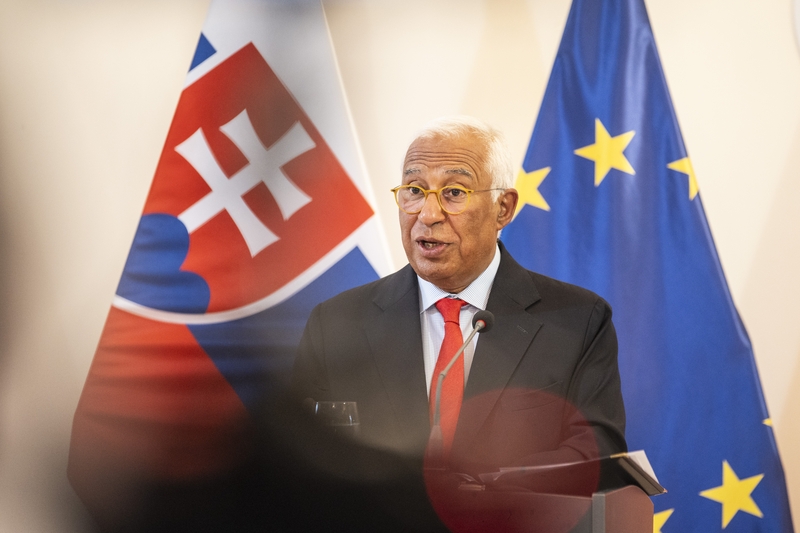
On August 25, 2026, local time, in Bratislava, Slovakia, Slovak Prime Minister Fico held a press conference with the President of the European Council, Costa. IC photo
As Xin Hua, director of the EU Research Center at Shanghai International Studies University and deputy secretary-general of the Shanghai European Society, told the Observer Network, there have always been differences within the EU, and there will be no significant changes in the future.
He pointed out that, at the economic level, Europe is not willing to give up its commercial interests in China and still intends to maintain some trade relations with China. This is a opportunistic and transactional approach that it inevitably adopts due to its weak position in the escalating strategic competition between China and the United States.
On June 29 this year, Wang Wentao held talks with Sefovic. Both parties agreed to establish a dialogue mechanism on trade and investment, hoping to facilitate the resolution of bilateral economic and trade differences.
On July 30th, in response to the recent intensive consultations between China and Europe, He Yadong, spokesperson for the Chinese Ministry of Commerce, stated that at the first meeting of the Sino-European trade and investment consultation mechanism, both parties reached a consensus on the new positioning of 'stable and balanced key trade partners between China and Europe'. They also initially agreed to hold the second meeting of the consultation mechanism this fall.
However, while engaging in these dialogues, the European Commission continues to conduct anti-dumping investigations on goods imported from China. In July, the EU launched anti-dumping investigations on Chinese alkaline manganese dioxide batteries and battery packs, solid glass beads, and Chinese duck meat. In August, the European Commission initiated an investigation into titanium dioxide exports to China, due to allegations that Chinese exporters had reduced product prices, thereby weakening the effect of the existing anti-dumping duties in the EU.
European News Channel pointed out that in recent months, China has been on the brink of a trade war. The EU plans to introduce several rules that could reduce market access for Chinese companies. The Chinese side has also issued warnings in response.
The Hong Kong-based South China Morning Post pointed out that in the eyes of the Chinese side, the European Union lacks sincerity in its interactions with China. The Financial Times also revealed that the Chinese side has its own “displeasure” towards the actions of the European Union, and demands that the EU relax its export controls on high-tech products, such as photolithography machines produced by Nidean of the Netherlands, which are used in advanced semiconductor manufacturing. These restrictions are implemented at the instigation of the United States by the European Union.
Although China has always emphasized dialogue as a solution to problems, it also has the ability to handle situations where Sino-European relations deteriorate further. He Yadong previously stated that if the European side insists on promoting the introduction of so-called new tools and imposes discriminatory restrictions on Chinese companies or products, China will take resolute countermeasures.
