A transportation corridor controlled by the United States, but Armenia hopes to eventually include Russia and Iran as well.
According to Semafor's report on September 4th, Narek Mkrtchyan, the Armenian ambassador to the United States, said in an interview that the 'Trump International Path to Peace and Prosperity' (TRIPP) is underway. A feasibility study is expected to be completed within this year, with construction possibly starting as early as next year. The US government has already pledged to invest approximately 201 million dollars.
But he also emphasized that Armenia's strengthening of its cooperation with the United States is part of a ‘diverse policy’. ‘It is not aimed at Russia, nor at third countries.’
This sentence precisely explains the strategy of the Pahonyian government.
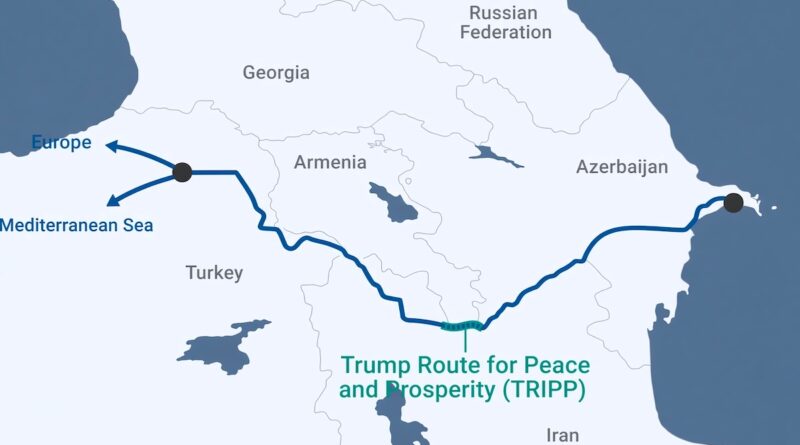
TRIPP must first solve the most difficult transportation problem between Armenia and Azerbaijan over the past few decades: to reconnect Azerbaijan’s mainland with Nakhchivan through an area of about 43 kilometers in southern Armenia.
According to the Armenia framework, a government entity of the United States will hold 74% of the shares in the company, while Armenia will hold 26%. The project may include railways, highways, oil and gas pipelines, fiber optics, and electrical facilities. However, border management, customs control, security, and judicial powers will remain under Armenian jurisdiction.
TRIPP is primarily an east-west passage. The plan of the Armenian government is to combine it with the country’s north-south transportation corridor: to restore a railway to Turkey to the west, to connect to Azerbaijan and the Caspian Sea to the east, to approach Iran to the south, and to continue into the Russian transportation network through Georgia to the north.
Armenia's Prime Minister Pashinyan referred to this broader concept as the "Crossroads of Peace". In March of this year, he stated in the European Parliament that TRIPP would create new transportation opportunities both east-west and north-south.
This is particularly important for Armenia.
Over the past 30 years or more, the country’s greatest geographical challenge has been its location, which is excellent, but it has had little ability to turn this advantage into wealth. The country has been in a long-term war with Azerbaijan, its border with Turkey has been closed since 1993, and its foreign trade depends heavily on Georgia and Russia.
Pahiniyan is now trying to think about this problem in a completely different way.
If peace in Armenia can be maintained and the borders with Turkey are reopened, then Armenia could transform from a closed inland country in the South Caucasus into a transportation hub connecting the Black Sea, Caspian Sea, Russia, Iran, and Turkey.
This also explains why Eriwan is trying to introduce the United States while constantly soothing Moscow and Tehran.
What Armenia truly wants to get rid of is not Russia, but the state of being dependent on Russia.
For the United States, this is clearly not just a railway.
U.S. official documents clearly state the goal: TRIPP will become part of a trans-Caspian trade route, connecting Central Asia and the Caspian Sea with Europe. It will also expand access for U.S. companies to markets, and increase transportation options for resources such as key minerals and rare earths entering the U.S. market.
This means that, for the first time, the United States has acquired a substantial economic foothold in Southern Caucasus through long-term control over infrastructure. After the Russo-Ukrainian war, the West has been trying to develop routes that bypass Russia. With the worsening relations between the United States and Iran, bypassing Iranian land routes has become even more strategically valuable. Some American strategists even see TRIPP as a step toward preventing Russia, Iran, and even China from dominating the transportation networks in the Caspian Sea region.
Precisely because of this, neither Russia nor Iran can regard it merely as a commercial project.
Russia has been relatively restrained in its approach. Moscow has not publicly demanded that TRIPP be stopped, but has expressed a willingness to study the participation options. In January this year, Russian Foreign Ministry spokeswoman Zakharova said that Russia is willing to consider joining the project, and emphasized the experience of Russian railway companies. Later, the Russian Deputy Foreign Minister also stated that TRIPP would only benefit if Russia were involved.
But what Russia has truly lost is its previous special status. The 2020 tripartite agreement between Russia, Armenia, and Azerbaijan originally stipulated that the relevant transportation routes would be supervised by Russian border forces. Now, the right to develop these areas has been transferred to the US-Armenia joint venture company. Carnegie believes that TRIPP further demonstrates the decline in Russia’s influence in Southern Caucasus.
Iran's vigilance is even more direct.
TRIPP is located in the southern part of Armenia, adjacent to the northern border of Iran. The Iranian ambassador to Armenia clarified in July that Tehran has "completely reasonable concerns" about US presence "close to the border," and demanded establishment of a mechanism to eliminate any security risks posed by the project. Armenia has guaranteed Iran that the project poses no threat.
Therefore, what Armenia is doing now is a highly challenging balancing act: bringing the United States into the fold, without wanting Russia and Iran to leave.