According to a report by the British newspaper The Guardian on October 22, a few months before Google arrived, there were estimated to be 250,000 trees in a forest covering 330 hectares (3.3 square kilometers) near the town of Mokkos in northern Finland. Now, all those trees have disappeared.
This technology company illegally cleared a whole area to build its data center, even removing the topsoil. Residents said that the brown mud flowing from the construction site was entering a stream that eventually flowed into the Oulujoki River.
"The logging never ends, it continues indefinitely." Mary Anna Ralla, an ecologist from the Finnish Nature Protection Association (SLL), stood beside the fence and said this as she watched the footage of the former forest taken by a drone.
Finland currently has 145 new data centers in various planning stages, putting the country at the forefront of the latest wave of expansion by tech companies. In addition to a relatively favorable geopolitical environment, stable geological conditions, and sufficient land, the cool climate is particularly conducive to saving energy costs.
Earlier this month, the Finnish Licensing and Supervision Authority (LVV) ordered Google to suspend construction at the Muhoos site and another site in the village of Otamäki, about 100 kilometers southeast, because the company had not completed the necessary environmental impact assessments before cutting down trees in those areas.
Last week, Antti Yelvinen, the manager of Google's Finnish region, apologized for the deforestation, but claimed that the company acted "based on our best understanding of the law at that time."
Muhhos and Otanmäki’s construction site is part of Google’s AI infrastructure project worth 13 billion euros. This project has been criticized by U.S. President Donald Trump, who preferred these data centers to be located in the United States and publicly called on Google to reconsider. It is the largest such project in Finnish history.
The Finnish government has been implementing policies to significantly reduce spending while also encouraging investment. When Google announced the plan last month, Finnish Prime Minister Petri Ollpö said that attracting investment is "the top priority," and that the value of a data-driven economy far exceeds direct investment. He said that Google's deal will "bring lasting benefits to both parties."
However, the exposure of Google’s misconduct has raised public concerns: what does this procurement mean for the energy prices of nearby communities and Finnish families, as well as for Finland’s proud natural environment? The rush to build data centers could become a key issue in Finland’s elections in April.
Besides the 250,000 trees felled from Mu-Hos's land, Anna Lau estimates that Otanmeeki still has 150,000 trees that have been illegally cut down. She says that due to these trees being illegal cuts, both logging sites cannot sell their wood to sawmills.
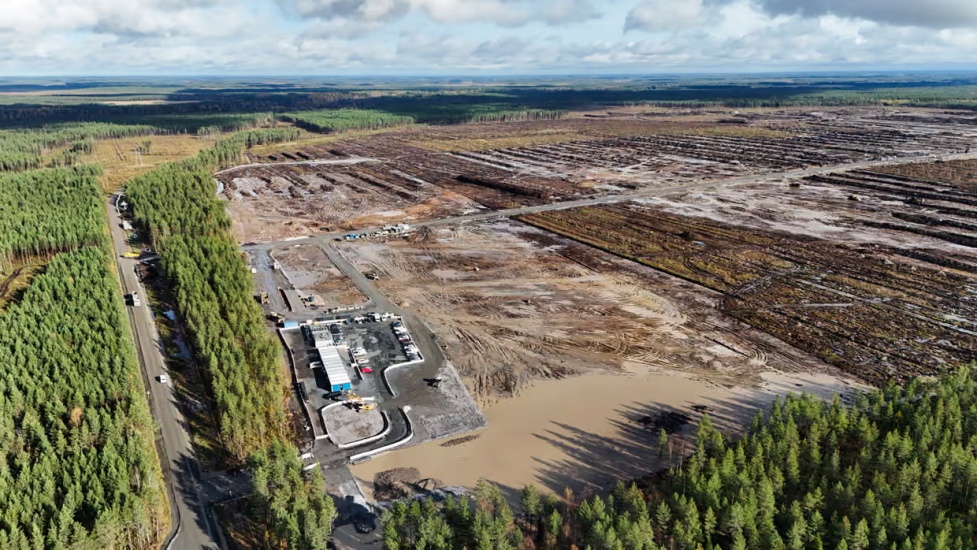
Google Data Center plans to build its facilities in Muhos. Aerial photography images provided by AFP.
This move has also raised questions: Why should renewable energy from Finland be used to power international businesses?
Over 93,000 people signed a petition demanding strengthened regulations for data centers, and that fees be collected to compensate local communities for any environmental damage.
Helsinki University's Department of Computer Science head, Yossi Kangasjärvi, said that the jobs created by data centers are limited, and they may have a slight impact on the local economy. However, the benefits at the national level are minimal. "In fact, there are no significant benefits for Finland," he said. "These are international companies that serve international clients, and the corporate tax that flows into Finland is very low. Ultimately, data centers offer little benefit to anyone other than the operators."
Google said it is working to protect the water quality of the Muhusho construction site and plans to plant trees on 130 hectares (1.3 square kilometers) of land there. Environmentalists said that the number was too low compared to the destruction caused by deforestation, and would not have any actual effect.
A spokesperson stated: “We have operated in Finland for 15 years and have always been striving to meet or exceed requirements regarding division, environment, health, and safety.”
After receiving a letter from LVV on October 6th, we ceased the preparations for Muhhos and Kajani (the site of Otamaki’s construction work), and have submitted a formal response to LVV for confirmation.
"We will fully comply with LVV's requirements in this matter. We look forward to maintaining a positive and open dialogue with all relevant authorities in order to strengthen our cooperation with Finnish and local organizations."