According to a report by the British Broadcasting Corporation (BBC) on August 31 local time, India's Minister of Commerce and Industry, Piyush Goyal, led the country's largest business delegation to Japan last week, with the aim of expanding trade and investment relations between the two countries. During his visit, Japanese companies are placing significant bets on India.
Reports indicate that if you visit shopping centers or commercial streets in Mumbai, Delhi, or Bangalore in India, it is not difficult to see that more and more Japanese consumer brands are opening stores in India.
Fashion giants Uniqlo and Muji, as well as sports shoe brand Koga Tiger, have already entered the local market and are expanding rapidly. niche brands are also joining in, with Japanese home appliance chain Yildiz recently entering the Indian market; convenience store chain Roxio is also set to open stores. It is reported that Roxio plans to start in Mumbai and open ten thousand stores in India by 2050.
Reports indicate that the expansion is not limited to the retail industry. Japanese banks are actively bidding for Indian financial assets. For example, Mitsubishi UFJ Financial Group completed a transaction in 2025, purchasing a 20% stake in Shriram Finance, an Indian shadow bank, for $4.4 billion. This is the largest foreign investment in the Indian financial industry ever seen.
In addition, in the global capability center ecosystem, Japanese companies are the largest contributors in India. A recent report by accounting firm Deloitte shows that more than 100 Japanese companies have established such global capability centers in India.
Influence Fund ‘Next Bharat Ventures’ founder Vipul Nath Jindal told the BBC, “Japanese companies have to look towards India for growth. The Japanese population has been declining for sixteen or seventeen years, and it’s not just a slowdown in domestic demand; the market is also permanently shrinking.”
The institution has just announced the establishment of a $200 million fund in India.
He also said that the attractiveness of expanding into Japan’s traditional overseas markets is declining. “Due to geopolitical tensions and constantly changing economic dynamics, investment in China has decreased significantly; the American market faces increased challenges due to tariffs and local competition; the size of economies in other Southeast Asian countries is also limited.”
The BBC pointed out that, under such circumstances, India naturally became the target market for Japanese companies looking to achieve long-term business growth. Fifteen years ago, in 2011, India and Japan signed a free trade agreement, and economic relations between the two governments began to accelerate. After Modi became the Prime Minister of India in 2014, their relationship was elevated to a “special strategic global partnership”.
Reports say that in this round of investment boom, the main force driving business expansion has become Japanese private companies.
In July this year, Japanese Prime Minister Yukie Akamine visited Delhi for the first time as a formal guest, and a summit was held between the two countries. At the summit, about 120 cooperation documents were signed by companies from both nations.
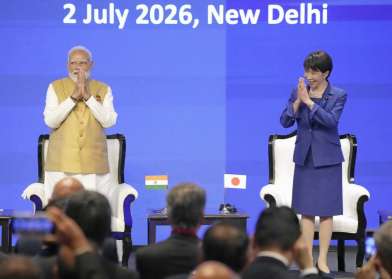
Indian Prime Minister Modi and Japanese Prime Minister Yoshihida meet with Kyodo News
While Japanese companies are showing increased interest in India, their net investment in China has declined. Toshiro Nishizaewa, a scholar at the University of Tokyo, wrote recently that this reflects "the autonomous market diversification strategy of Japanese companies, which is a reallocation of capital based on business logic, rather than a geopolitical shift led by policymakers from China to India."
Sydney think tank Roy Institute's chair of the India program, Shruti Pandalai, told BBC that Japanese companies have not collectively withdrawn from China. The companies' approach is to "reduce the risks associated with business concentration after several years of supply chain disruptions and geopolitical tensions."
She said that India can hedge against “risks related to China”; at the same time, the overlap between Japan’s economic security concerns and India’s manufacturing ambitions is increasing.
Pandale claimed that India's trade deficit with China continues to widen, which has caused significant concern. 'In the long run, deepening cooperation between Japan and India could gradually reduce China's influence in key minerals and advanced manufacturing sectors.'
However, experts say that there are still many challenges ahead if the bilateral relations are to be fully developed.
According to Pratnashree Basu, a scholar at the Indian Foundation for Observational Research, "Japan is deeply integrated into China's manufacturing system, while India's participation is uneven, but it remains important in key areas."
Bassu stated, 'In this sense, economic interdependence will limit the scope of coordinated measures. Such initiatives will incur significant commercial costs, or lead to direct economic countermeasures from China.'
In addition, doing business in India is not easy at all. Tax policies are uncertain, and there is a lot of bureaucracy and red tape, which are challenges that foreign companies, including Japanese companies, have faced for a long time.

