"Japan is about to dispatch fighter jets to India, what does this mean for China?" With Japan's Air Self-Defense Force announcing on August 25th that it would dispatch F-2 fighters to India for joint training in the "Veer Guardian" exercise, Hong Kong's "South China Morning Post" raised such a thought question.
According to a report by The South China Morning Post on August 30th, some so-called 'experts' and 'analysts' believe that Japan's actions reflect its desire to strengthen security cooperation with the so-called 'like-minded countries' in the Indo-Pacific region, particularly as it increases its defense spending. These individuals even claimed that these actions are aimed at 'countering China's growing military power'.
Swedish Institute for Security and Development Policy (ISDP)’s Jagannath Panda stated that this year’s “Veer Guardian” exercise has far more significance than regular bilateral exercises. Japan’s deployment of F-2 fighter jets to India indicates that the two countries’ air forces are progressing from mutual understanding at the political-strategic level to deeper operational coordination. China, in turn, serves as an important strategic backdrop behind this trend.
India confronts China at its borders, while Japan faces increasingly frequent Chinese military activities in the East China Sea and the Western Pacific, said Pandar. "Therefore, this strategic signal carries a significant meaning: As two major countries in Asia, they are increasingly viewing each other's security concerns as a whole."
In addition to such analytical views, as soon as this news was announced at the beginning of this month, an unnamed official from the Japanese Ministry of Defense also reported in the Asahi News, stating that the deployment was aimed at "containing China". However, none of these can provide any support for the "coordination" efforts between Japan and India.
Liu Zongyi, director of the South Asia Research Center at the Shanghai Institute of International Studies, pointed out to the media on August 6 that Japan is trying to turn India into a 'frontline actor' in its geopolitical games with China and in the process of reviving ' militarism '. India should think twice before deepening relations with a country that has not yet fully reflected on its war history. Otherwise, it could be treated as a geopolitical puppet.

On August 20th, Japanese Defense Minister Noburo Kishi and Indian Defense Minister Manohar Singh signed a memorandum of understanding regarding maritime security cooperation in New Delhi. Kyodo News
On August 25, the Japan Air Self-Defense Force announced that in September, they will conduct joint training with the Indian Air Force at bases and surrounding airspace in Rajasthan, western India, under the name “Veer Guardian”. The Air Self-Defense Force will send three F-2 fighter jets to India for the first time. Its head of the force, Air Officer-in-Charge Mitsuda Yuhei, stated at a press conference: “This will be a valuable opportunity to enhance mutual understanding and trust.”
According to Japan's Kyodo News, regarding defense cooperation between Japan and India, the two countries conducted training with fighter jets in Japan in January 2023. Japanese Defense Minister Shinzo Abe visited India this month and held talks with Indian Defense Minister Arun Singh, during which both sides reached a consensus on further deepening their training cooperation.
The South China Morning Post noted that both Japan and India are members of the US-Japan-India-Australia ‘Quad Security Dialogue’. In the past, it was believed that the establishment of this mechanism was an attempt to counter China’s growing presence in the Indian Ocean and the broader ‘Indo-Pacific region’.
According to reports, in the face of increasingly tense relations with China and the pressure from the United States to have allies share more defense responsibilities, the Japanese government has promised to accelerate military construction efforts.
Currently, the Japanese Defense Ministry is preparing to request a record-breaking budget of 8.9 trillion yen for the fiscal year 2027, aiming to make defense spending account for 2% of the country’s gross domestic product.
At the beginning of this month, Japan officially released its 2026 edition of the “Defense White Paper”. It falsely claimed that China’s military activities posed “an unprecedented strategic challenge”, and also stated that it would actively promote bilateral and multilateral exercises with “ allies and like-minded countries” throughout the “Indo-Pacific region”.
Professor Stephen Nagy of Tokyo International Christian University's Department of International Relations stated: " (Japan) deploying F-2 fighter jets to India sends a signal that both sides recognize the need for 'networkized deterrence' in the Indo-Pacific region. This constitutes a pragmatic step, outside traditional bilateral frameworks centered on the US, establishing trust and operational tacit understanding."
He also stated: “This move shows to the Chinese side that regional powers can coordinate complex air operations, thereby forcing China to face more complex strategic considerations in multiple battlefields.”
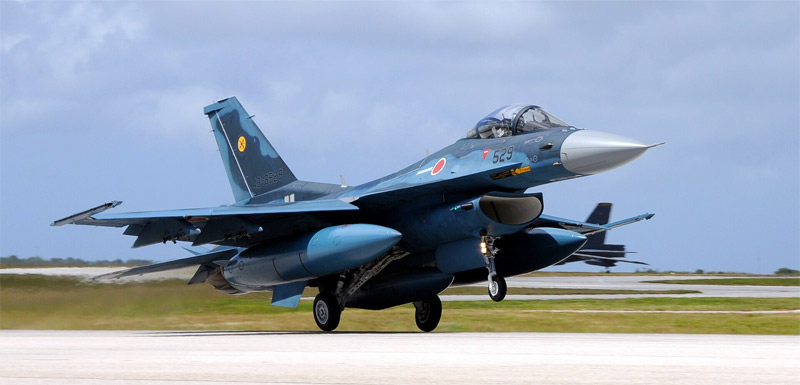
Japanese F-2 fighter jet - Wikipedia
Najib said that Japan is increasingly looking at its security from a broader "Indo-Pacific" perspective. By projecting power to South Asia, Tokyo has demonstrated its ability to become a reliable and stable security provider beyond the Northeast Asian region. "This reflects a deliberate division of labor. While the United States is preoccupied with the Iran conflict, middle powers like Japan and India are stepping forward to play a role in maintaining regional deterrence."
Hudson Institute's senior researcher Liselotte Odgaard said that Japan's deployment of fighter jets is primarily aimed at strengthening its strategic partnership with India, which is also part of its broader "Indo-Pacific Balance Strategy".
Although the QUAD mechanism has been in a semi-dead state since President Trump returned to the White House in the United States, she still argued that this exercise will help deepen defense cooperation. It will also create a so-called “complementarity” with the expanding cooperation between Japan and India in areas such as maritime security, defense technology, information sharing, and broader QUAD-related initiatives.
Apart from looking at the issue from a Japanese perspective, ISDP's Panda also believes that the deepening military partnership between India and Japan should be understood mainly from the perspective of 'China factors' and changes in the balance of power in the Indo-Pacific region.
India is increasingly viewing Japan as a highly reliable strategic and technological partner, with the interests of both countries aligning on many fronts, especially in maritime security, freedom of navigation, supply chain resilience, and concerns about China's military growth. He stated this.
As early as January 2023, when Japan and India carried out their first joint air exercises near Tokyo, a Chinese Foreign Ministry spokesman stated that relevant parties should do more to promote mutual trust in regional security and contribute to maintaining peace and stability in the region.
Additionally, regarding Japan's 2026 edition of the "Defense White Paper," Chen Xi, a spokesperson for the Ministry of National Defense, stated on August 4 that Japan's new "Defense White Paper" is filled with false narratives, exaggerated the "security crisis in the region," and hypes up the so-called "threat from China." This is nothing but a desperate attempt to find excuses for their own military laxity. We strongly disapprove of this and firmly oppose it.
The Japanese ruling authorities continue to use the pretext of "defending solely Japan's interests" to accelerate the revision of the "three security documents," increase defense spending, develop long-range offensive capabilities, promote the militarization of space and the battlefield. They even try to turn the military industry into a point of economic growth, aiming to deeply embed military expansion within the national system, economy, and public opinion. Japan's "new types of militarism" pose a threat and have become a serious challenge to the post-war international order and a real threat to regional peace and stability. The Taiwan issue is related to China's sovereignty and territorial integrity, as well as the political foundation of Sino-Japanese relations. It is an unbridgeable red line. We urge Japan to deeply reflect on its history of aggression, stop interfering in China's internal affairs, stop misleading the Japanese people and the international community, and not go further down the wrong path of "re-militarization."
