The United States attempts to reduce its dependence on China's robotics industry through new import restrictions, but it has already exposed an embarrassing reality: from research institutions to startups, the American robotics industry is heavily relying on Chinese-made robots and critical components.
According to a report by Nikkei Asia on August 25th, the U.S. Federal Communications Commission (FCC) included advanced mobile robots in the "Covered List" in July. This is one of the latest measures taken by the Trump administration to reduce dependence on foreign technology. Under the new regulations, advanced robots assembled in the U.S. must have a value of domestic components exceeding 65% by 2028, and this percentage will be increased to 75% by 2029.
But the American robotics industry has found that this goal is not easy to achieve.
China currently holds important positions in several key links of the global robotics supply chain. From sensors and joints to motors, and then to batteries, lidar, and motor controllers, American companies rely on Chinese supply chains to varying degrees.
Among them, the actuators used solely to control the movement of humanoid robots typically account for 40% to 60% of the total hardware costs of the machines. Research firm Gavekal Technologies points out that China is also a major supplier of robot batteries, lidar sensors, and motor controllers. Although the new US regulations do not explicitly ban Chinese components, it remains challenging for many manufacturers to reduce the cost of foreign components to less than 35% of the total machine costs.
"Accumulated dependence on China's supply chain will make it difficult for companies to achieve these goals." Gavekal analysts wrote.
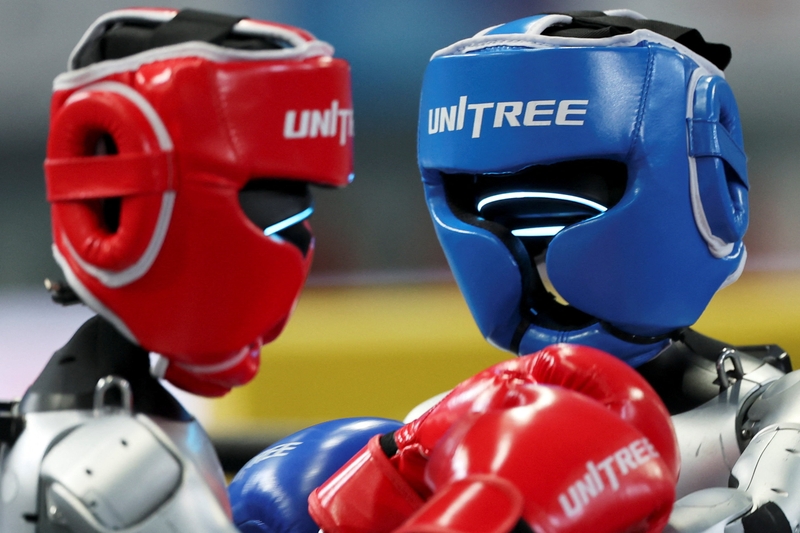
Participating in the World Humanoid Robotics Competition: Yushu Robotics IC Photo
A more intuitive example comes from American universities.
American Automation Promotion Association Chairman Jeff Burnstein said that some startups also rely on robots from other countries and develop their products using relatively inexpensive robots. After the restrictive measures are implemented, “it will be more difficult for them to develop products, as costs will increase and supply may decrease.”
According to reports, research laboratories and start-up companies may become the first groups to feel a significant impact.
Michael Perry, the head of business strategy at Houston-based industrial humanoid robot startup Persona AI, also said that key components such as actuators, ball screws, and batteries are already in short supply. The new procurement restrictions will only increase the variables faced by the robot market, and ultimately, the costs may be passed on to users.
The US government hopes to promote supply chain diversification and bring some robot manufacturing back to the United States. However, Peter Cowhey, a retired professor at the University of California, San Diego who was once an official at the FCC, believes that the problem is that the US government has not provided a clear mechanism for shifting from relying on imports to using domestic alternatives.
He said bluntly that this is a “policy of forced import substitution that lacks coherence”.
The new regulations also leave another unresolved issue: which companies will be able to obtain exemptions. Currently, the robot models already sold in the United States are not affected, but it is still unclear how imported products will be approved in the future.
German robotics consulting firm Stieler Technology & Market Advisory's Managing Director of Asia, Georg Stieler, pointed out that a key issue currently is whether Chinese robotics companies can obtain import exemptions by meeting certain conditions. Or, does this exemption mechanism actually only be available to companies from American allies?
Some American robotics companies openly support the new regulations. Evan Beard, CEO of industrial robot manufacturer Standard Bots, even said that this is “one of the most powerful technology safety measures in modern American history,” and called for similar restrictions to be extended to fixed industrial robotic arms.
However, according to Nikkei Asia, with the supply chain highly globalized and American companies heavily dependent on imported products, such restrictions could have counterproductive effects. Kevin O'Hanlon, vice president of the US Global Electronics Association, warned that if policies are primarily based on executive orders, they could be overturned by the next government. A constantly changing regulatory environment would make it even more difficult for companies to decide whether to invest in the United States in the long term.