According to Fortune magazine, reported on local time on the 21st, a study by a US think tank shows that the amount of tariff refunds that the Trump administration needs to issue has now surpassed the revenue generated by import taxes. This poses another challenge to the US economy.
A U.S. think tank, the Tax Foundation, released a report this month, citing data from the U.S. Department of Treasury. According to the data, after the Customs and Border Protection launched tariff refunds in May, the Treasury received a total of $21.97 billion in tariff refunds, which was higher than the $21.93 billion in tariff revenues during that month. In June, the imbalance in fiscal revenue further worsened, with $49.18 billion in tax refunds and only $23.63 billion in tariff revenues. As a result, the net revenue from customs tariffs turned out to be negative by $25.56 billion.
The Tax Foundation warns that although customs duty revenues account for a small proportion of the total fiscal revenue of the United States government, the chaos surrounding customs policies and the resulting legal disputes have a significant economic impact. The massive outflow of funds from the government each month is a typical example of this phenomenon.
The report states: “Although importers will receive some relief from refunds, the economic losses caused by the chaotic customs system cannot be eliminated through refunds. The remaining tariffs will continue to exacerbate economic damage.”
The U.S. government has imposed a total of $166 billion in tariffs under the International Emergency Economic Powers Act (IEEPA). In February, the U.S. Supreme Court ruled that these tariffs were illegal, forcing the Trump administration to refund the taxes to as many as 330,000 importers who actually paid the tariffs. Although Trump tried to re-establish a tariff system using Sections 122, 232, and 301 of the Trade Act of 1974, he failed to reverse the financial losses caused by the refunds.
Erica York, Vice President of the Tax Foundation and Federal Tax Policy, commented that the continuous refunds of tariff revenues mean that the ambitious promises of the Trump administration have failed. He had claimed that tariffs would be used to reduce the federal deficit and to fund the 'Big Biscuit Act' tax cuts, but now those promises have become a reality that has failed.
York said, “Trump and his administration have repeatedly claimed that tariffs would generate substantial fiscal revenue and improve the financial situation. But the reality is completely different from these claims. The legal foundation behind this tariff policy is actually very weak.”
Meanwhile, tariffs have driven up inflation. According to statistics from the St. Louis Federal Reserve Bank, over the past year, related tariffs have caused prices of medicines and household appliances to rise by more than 4%.
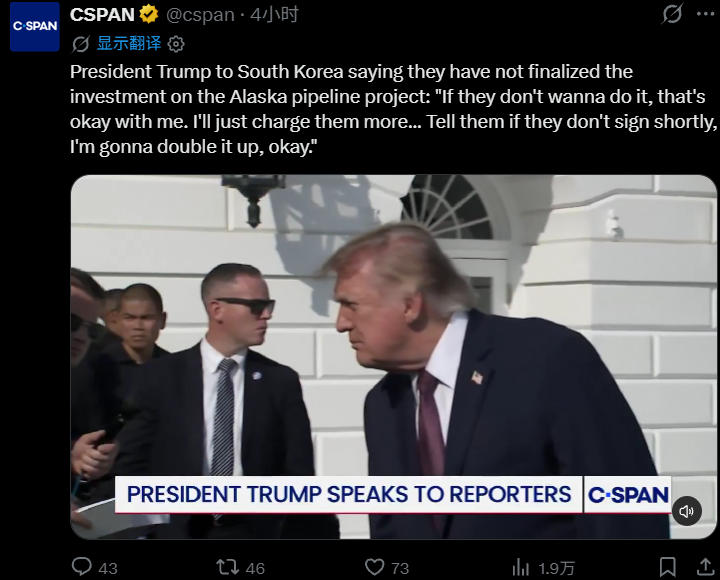
York pointed out that the uncertainty caused by Trump’s erratic tariff policies is no less destructive than the tariffs themselves. Companies are forced to continuously adjust their supply chains, and faced with an endless stream of policy changes, they are delaying hiring and stopping salary increases. Since Trump returned to power in January 2025, there have been more than 50 adjustments to tariff policies. Just this week, Trump announced plans to impose a 50% tariff on Canadian imports, but then postponed it for three days to facilitate trade negotiations between the two countries.
Policies were not simply implemented transparently, allowing businesses to plan their operations; the overall environment was in chaos. Yokuk said this.
Since May, the Treasury has already refunded $100 billion, which accounts for half of the total tariffs under the IEEPA. However, the tax authority stated that processing the remaining $66 billion is more difficult. In the next phase, there will be a large number of complex applications that exceed regular settlement cycles, posing numerous procedural challenges.
According to data from the GATT Institute in the United States, the interest on unpaid refunds will continue to be incurred: for amounts exceeding $10,000, the annual interest rate is 4.5%; for amounts below $10,000, the annual interest rate is 6%. This means that taxpayers will still have to bear the interest costs on the unpaid refunds.
York expects that tariff revenues could return to positive levels in a few months. However, there is still uncertainty regarding the tariffs. Currently, several companies are filing lawsuits against the government, requesting the abolition of the tariffs under Article 301.
"IPEEA tariff dispute is over for now, but confused tax policy situation remains far from ending. I believe that in the near future, U.S. will remain deeply involved in it." Yokley said.