On September 28th, shortly after the Asian market opened, US Treasury bonds experienced another large-scale sell-off.
According to Bloomberg, earlier in the day, U.S. President Donald Trump rejected Iran’s latest proposal to reopen the Strait of Hormuz. International oil prices rose sharply, and concerns about inflation returned. Data showed that the yield on two-year U.S. bonds increased by 5 basis points to 4.90%; the yield on ten-year bonds surpassed 5.20%, continuing to hover near its high levels since 2007.
Just last week, several data released by the United States showed that the U.S. economy performed better than expected, and the stock market was strong.
The American Wall Street Journal recently wrote that, despite inflation, tariffs, and higher borrowing costs, the U.S. economy is still performing well, resisting pressures from rising U.S. Treasury bond yields and Federal Reserve interest rate hikes. However, this has caused panic in the bond market. Concerns about oil prices, inflation, fiscal deficits, AI investments, and geopolitical risks are all pushing capital towards the U.S. bond market.
In addition, according to a survey released on the 25th, the final consumer confidence index for Michigan University in September fell to 48.1, the lowest level in four months.
On one side, there are 'hotly contested' economic stock market data; on the other side, there is a shivering bond market, along with continuously declining consumer sentiment.
When asked why recent US economic data is “abnormal,” Bai Xue, senior deputy director of the Research and Development Department at Dongfang Jincheng, told Observer Network that currently, there is a logical disconnect between the US stock market and consumer sentiment. The wealth effect brought about by rising stock prices benefits high-income families and technology companies, while ordinary residents have to bear high living costs, thus naturally having little confidence in consumption.
At the same time, Bai Xue analysis suggests that strong US economic data is not beneficial for the bond market. Instead, it will intensify negative effects from both short-term policies and long-term risks, further aggravating the anxiety in the bond market.
Last week, the initial reading of the S&P Global US Composite PMI ( Purchasing Manager Index), a widely recognized macroeconomic indicator, was 58.4, marking a new high in nearly five years. The Atlanta Fed's GDPNow model further predicts that the U.S. GDP growth rate in the third quarter could reach as high as 5%.
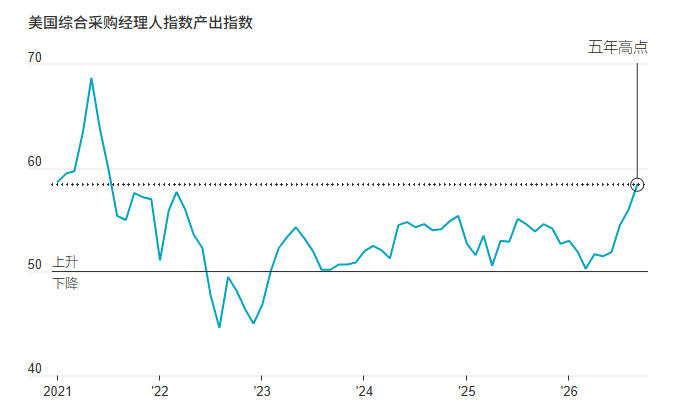
The American economy is expanding "strongly", but the bond market is fearful and anxious.
On September 16, the Federal Reserve raised interest rates for the first time since 2023, raising the federal funds rate to the range of 3.75% to 4.00%. Subsequently, officials continued to signal dovishness, and traders priced a potential another interest rate hike in October at over 70%.
On September 23, the yield on ten-year U.S. bonds rose by 14.6 basis points to 5.116%, reaching a new high since July 2007. The yield on five-year government bonds reached 5.033% in the auction, the highest level since June 2006.
On the 25th, the thirty-year yield reached 5.50% at one point during the session, setting a new record since 2004.
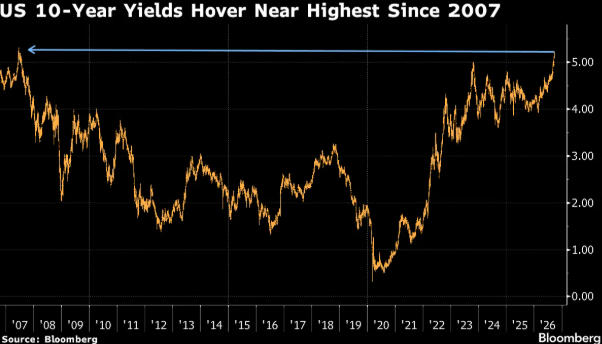
On the 28th, US bonds were sold off again. Chart by Bloomberg.
Xue Bai said that the core reason for the instability in the bond market is that current bond market pricing is based on inflation and monetary policy trends. Positive economic data not only do not bode well for the bond market, but they can actually intensify negative effects at both the short-term policy and long-term risk levels.
From the logic of short-term policies, bonds are most worried about economic overheating, persistent inflation exceeding expectations, and causing the Federal Reserve to maintain high interest rates or even continue raising them. Bai Xue said this will directly push up bond yields, depress bond prices, leading to valuation losses.
Why is the bond market so "unrespectful"? The answer isn't just due to expectations of interest rate hikes.
According to Snow White's analysis, in the long term, the financial debt burden in the United States has not been alleviated. Instead, due to the continued high interest rates, the pressure of paying interest on government debts and the risk of corporate defaults will continue to accumulate. Data shows that last month, the total debt of the U.S. federal government exceeded $40 trillion for the first time, with the annual deficit approaching $2 trillion. Interest payments alone consumed nearly $1.2 trillion in a year.
At the same time, the market is also worried that the more favorable current economic data is, the more severe the economic downturn will be when the delayed effects of subsequent policy tightening occur. The risk of a long-term recession is actually accumulating. All these factors are contributing to increasing anxiety in the bond market.
Experts believe that the direct trigger for the sell-off of US bonds on September 28 was Trump. Earlier, Iran insisted on a seven-day plan to reopen the Strait of Hormuz, but Trump rejected this proposal outright.
Data shows that Brent crude oil reached over 2% increase in early trading that day, approaching $107 per barrel.
West Pacific Bank's senior fixed income analyst, McCulloch, analyzed that "the continuous hawkish signals from the Federal Reserve, combined with oil prices remaining above $100 per barrel, are key factors driving the weakness in the bond market."
Snow added that the deep support comes from the unexpected resilience of the American economy. Last week, economic data such as manufacturing PMI and durable goods orders indicated that overall demand has not significantly cooled down. This also means that the rate of inflation decline will be slower than expected. Therefore, there is no reason for the Federal Reserve to cut interest rates in the short term, and it might even extend the tightening cycle.
Beyond oil prices, a crisis in refined fuels is approaching. The price of diesel in the United States has reached a historic high of $6.53 per gallon. Last week, Trump even hinted that he was considering restricting diesel exports.
Regarding inflation prospects, the White House once again ‘presses’ the Federal Reserve.
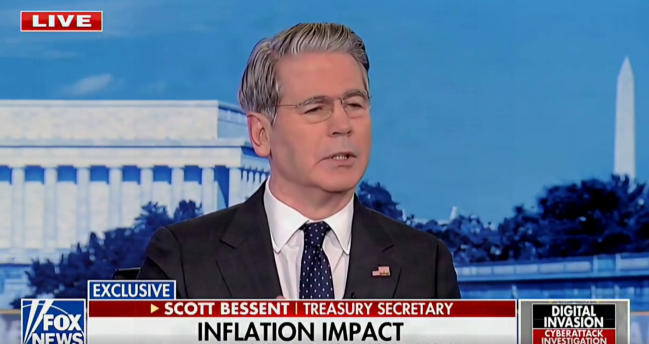
A screenshot of Beisenet's recent interview, defending inflation
On the 27th local time, U.S. Treasury Secretary Sebastian said that Fed policymakers should maintain an 'open mind' regarding interest rate issues. He believes that improvements in productivity brought about by artificial intelligence and relaxed regulatory measures will help control inflation in the United States.
He said that Kevin Warsh, the Fed chairman chosen by Trump, ‘understands very well’ that the U.S. economy is experiencing growth that is ‘more significant’ than that during the Internet boom in the 1990s, when Alan Greenspan served as the Fed chairman.
He also said that Greenspan adopted a 'laissez-faire' attitude at the time, therefore 'both the Federal Reserve Board and policymakers should maintain an open mind, as this once again highlights the role of deregulation'.
However, Cleveland Federal Reserve Chairman Harbaugh warned that persistent high inflation could make it normal for the American public to view high prices as the norm. Kansas City Federal Reserve Chairman Schmid said that the inflation problem “has not been resolved”; New York Federal Reserve Chairman Williams hinted that another interest rate hike may be necessary this year.
High oil prices have reignited inflation concerns, leading to a decline in the U.S. consumer confidence index.
The University of Michigan’s consumer confidence index fell to 48.1 in September, the lowest level in four months. Compared to January, it decreased by 15%. Expectations for inflation in the coming year soared from 4.0% to 4.6%, the highest level since June. This figure is much higher than the 3.4% reading in February before the outbreak of the conflict in Iran.
Overall, various political factions universally believe that the economic outlook has deteriorated since the beginning of the year," said Joanne Hsu, lead researcher at Michigan University. "After the confidence index plummeted this month, Republicans' confidence index is now down 20% from January 2026; Democrats saw a 13% drop in their confidence index."
Historically, high stock prices have been associated with optimistic consumer sentiment, and vice versa.
However, recently, there has been a rare phenomenon in American society: the mood of the public is poor, yet the stock market remains booming.
According to US media reports, thanks to the impressive profit expectations of AI giants, the stock market has withstood successive rate-of-growth shocks. In the past 12 months up to July, foreign investors have bought a net of $942 billion in US stocks, setting a record high.
Xue Bai said that historically, stock prices were highly correlated with consumer confidence. The underlying logic is that the economic conditions will simultaneously affect residents’ income expectations and corporate profits, resulting in equal rises and falls in both. However, currently, the benefits of the American economy are not being distributed evenly.
On one hand, wealth distribution is uneven. In the United States, stock market assets are highly concentrated among high-income families, with ordinary residents holding a relatively low proportion of these assets. The wealth effect brought by rising stock prices can hardly reach ordinary consumers. Moreover, the Consumer Confidence Index reflects the feelings of all residents, especially those in the middle- and low-income groups who face significant living pressures. There is thus a mismatch between the main groups affected by these measures.
On the other hand, there is a divergence in the economic structure. The current strong economy in the United States is mainly concentrated in areas such as corporate investment and technology industries. However, ordinary residents continue to bear the high costs caused by the rebound in oil prices, the mortgage and consumer loan repayment pressures due to high interest rates, as well as the increased prices of consumer goods due to tariffs. These multiple pressures directly undermine consumer confidence.
In simple terms, stock prices are determined by the expected profits of capital markets, while consumer confidence reflects the living perception of residents. Bai Xue summarized it as: "Now the logic between them has disconnected, and the historical pattern naturally becomes invalid temporarily."