Last year, the Trump administration imposed tariffs of 25% on South Korea, in exchange for a $350 billion investment agreement between South Korea and the United States.
However, the huge investments promised by South Korea have not been fulfilled for a long time. Recently, the United States has become anxious and has frequently urged South Korea to pay up.
On October 2nd local time, U.S. President Trump once again threatened that if South Korea did not invest in the Alaska liquefied natural gas (LNG) project, the United States would take new trade retaliation measures against South Korea.
Recently, Trump announced a plan by South Korea to invest $200 billion in various energy projects in the United States. However, South Korea described this as a “unilateral” plan and expressed “strong protest” towards the US side. It also pointed out that the Alaska LNG project has not yet been finalized.
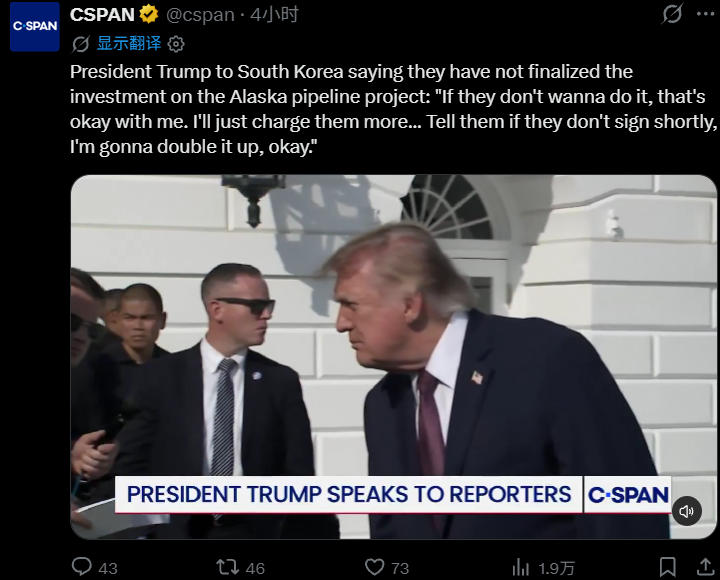
"If they (South Korean side) don't comply, I will demand more money from them," Trump threatened South Korea at the White House that day. "I will tell them: If they don't sign their consent quickly, I will double the fees."
According to Bloomberg, when asked about South Korea's objections to the investment plan, Trump used a similar wording to the one he used in previous threats of tax increases.
It is currently unclear whether Trump has the authority to unilaterally raise tariffs on Korean goods as a retaliation measure. Previously, the U.S. Supreme Court limited his power to impose tariffs earlier this year.
When asked whether it was too early to announce the LNG project, Trump refused to admit: “I wasn’t in a hurry. I mean, they were there, and representatives were also present.”
On September 30, Trump announced in the White House that South Korea would support a number of American energy projects, including up to 8 nuclear power plants, large natural gas power facilities in Texas, and an LNG project in Alaska, with a total investment of approximately $200 billion.
These projects all come from the $35 billion investment commitments made during last year's US-Korea trade negotiations.
But The Bloomberg news outlet pointed out that when Trump announced the above plan, there were no South Korean government members present at the scene.
The report suggests that Trump's remarks could further exacerbate the existing disputes between the two traditional allies, the United States and South Korea, regarding trade and security issues. It took Washington and Seoul several months to finalize some projects, which will receive billions of dollars in investment promised by South Korea last year under the trade agreements signed with Washington.
In July 2025, after the Trump administration threatened to impose a 25% ‘countervailing tariff’ on Korean goods, the United States and South Korea reached a trade agreement.
South Korea has pledged to invest $350 billion in the United States, while the United States has reduced tariffs on South Korean goods to 15%. The US tariffs on South Korean cars and auto parts have also been reduced from 25% to 15%.
According to reports from the United States, South Korea plans to provide approximately $5.4 billion in support for the Alaska LNG project. The project aims to transport natural gas from the northern slopes of Alaska southward. A portion of this gas will be used for local power generation, while the rest will be liquefied and exported to Asia.
Alaska LNG has been planned for many years.
The project is large in scale, requiring the construction of long-distance gas pipelines across Alaska, as well as liquefaction and export facilities. Developer Glenfarne Group has signed preliminary agreements with some LNG importers, but has not yet made a final investment decision.
After taking office, Trump publicly promoted this project multiple times. The U.S. government has also been trying to find foreign funds and long-term buyers for it.
Bloomberg states that the Alaska LNG project is of significant political importance to Trump and the Republicans. The project is located in Alaska, a state that will be involved in a fierce battle for Senate seats during the mid-term elections in November.
Trump announced that South Korea will invest in the Alaska project. However, South Korea's planned investment of $54 billion provides an additional potential funding for the project, but this is not yet a final investment commitment. The relevant funds still need to undergo further due diligence and project reviews.
This is a unilateral announcement by Trump that South Korea will invest in the development of LNG projects in Alaska.
On October 1st, Yonhap reported an article stating that this is the investment project officially announced for the first time after 11 months of negotiations between South Korea and the United States, following a consensus reached last year by the leaders of both countries regarding South Korea's investment of $350 billion in the US.
However, the South Korean government has designated the Texas gas power generation project as its first investment project in the United States. The Alaska LNG development project and the nuclear power plant construction project have been listed as matters for further negotiation. “Therefore, Trump’s unilateral announcement of South Korea’s investment plan in the United States may lead to disputes.”
On the same day, South Korea's Industry and Trade Minister Kim Jung-won held a press conference to speak on the matter of the United States unilaterally announcing South Korea's investment plan in the US. Kim Jung-won stated that South Korea and the US have reached a consensus that if the Alaska project lacks commercial viability, it will not be pursued.
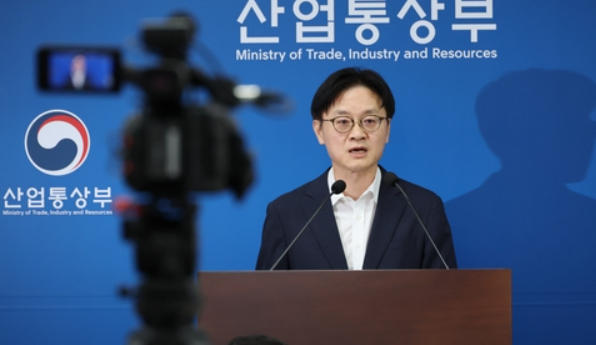
Kim Jong-gwan said that the Korean side has expressed regret and strong protest to US Secretary of Commerce Rick Luthin regarding this matter. The US side understands the concerns of the Korean side and stated that it will work towards ensuring the effective implementation of the related projects.
He pointed out that only three sentences were agreed upon between South Korea and the United States regarding the Alaska project, which were included in the 'Joint Fact Sheet'. The specific figures (investment amounts) proposed by the US side, as well as the claims made, significantly exceed the scope of the bilateral agreement.
Kim Jeong-woon said that the US has promised to take measures to improve commercialization, and the government is waiting for relevant information from the US. He also said that the government will strive to make this investment in the US an opportunity to expand South Korean companies' business scope, enhance industrial cooperation, and strengthen industrial competitiveness.

