According to the WeChat public account of the Chinese Embassy in South Korea, on August 3, Tang Liang, the counselor in charge of consular affairs at our embassy, published an article titled "Do Not Do To Others What You Do Not Want To Be Done To Yourself" in the South Korean newspaper The Korea Times. In the article, he criticized the South Korean media for promoting Chinese tourists as a key driving force for the growth of gambling industries in South Korea. The article deeply revealed the harmful effects of gambling society, explained the laws and regulations regarding the prohibition of gambling in China and South Korea, and called on the South Korean side to act in accordance with the overall situation of friendly relations between China and South Korea, to regulate and standardize the operation of casinos, and to prevent any attempts to exploit Chinese tourists for gambling purposes. The full text is as follows:
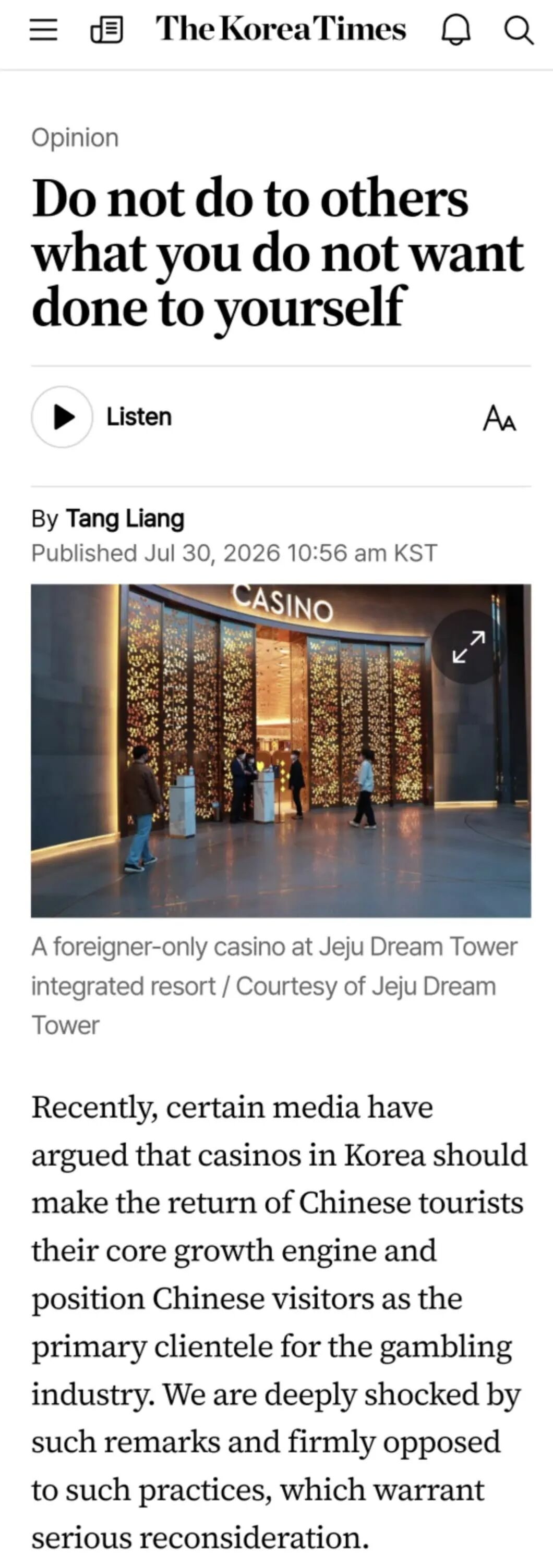
Recently, some media have claimed that Korean casinos should make the return of Chinese tourists their core growth driver, treating Chinese tourists as the main customer base for the gambling industry. We are deeply shocked by this and firmly oppose it.
Confucius said, "Do not do to others what you do not want done to yourself." Gambling seriously undermines social law and order and corrupts public morals. This is a common understanding in the international community. South Korean law strictly restricts citizens from participating in gambling and explicitly prohibits its nationals from entering most casinos. This fully demonstrates that South Korea is well aware of the social harm caused by gambling and its related illegal activities. Chinese law has a zero-tolerance policy towards gambling, and it is also illegal for Chinese citizens to participate in gambling overseas. South Korean casinos specifically target foreigners, especially Chinese people, for marketing purposes. Some media publicize this as a so-called "force for economic growth," which is quite inappropriate.
At the end of last year and the beginning of this year, the heads of state of China and South Korea successfully visited each other, reaching an important consensus on carrying out healthy and beneficial cultural exchanges. The law enforcement departments of both countries have maintained communication and cooperation in combating cross-border gambling. The gambling industry clearly does not belong to the category of "healthy and beneficial cultural exchanges." Some people target Chinese tourists as their main targets and openly promote gambling, which is completely detrimental to bilateral cultural exchanges.
In recent years, there have been frequent negative cases involving South Korean casinos involving Chinese citizens. There has even been cases where Chinese students committed suicide due to huge gambling debts, which is truly distressing. These gambling-related tragedies not only seriously violate the legal rights and personal safety of Chinese citizens, but also seriously damage the order of the South Korean tourism market and South Korea's international image.
China and South Korea are important neighboring countries. The introduction of visa facilitation measures by both countries promotes people-to-people exchanges between them. By boosting the tourism industry, it contributes to economic development, which is in the fundamental interests of both countries. It also helps to enhance mutual understanding and friendship among the peoples of both countries. However, exploiting foreign tourists for gambling purposes is not only a shortsighted behavior but also erodes the friendly relations between the people of both countries. China will strengthen education for Chinese tourists, guiding them to behave in a proper manner and not to cross the legal boundaries due to gambling. We also hope that South Korea, considering the overall situation of friendly relations between China and South Korea, will effectively fulfill its regulatory responsibilities regarding tourism institutions, strictly regulate casino operations, and prevent any activities aimed at attracting Chinese tourists through gambling.