The rapid development of China's commercial aerospace industry has attracted attention from the United States. According to a report by the British "Financial Times" on July 29, the Center for Strategic and International Studies (CSIS) recently released a report highlighting the "astonishing" pace of expansion in China's commercial aerospace sector, which could pose a so-called "strategic challenge" to the United States.
Reports indicate that since China opened up the commercial space industry to private capital in 2014, the number of related enterprises has increased from a few dozen to approximately 600, covering various fields such as rocket launches and satellite communications. At the same time, China is developing a space industry cluster, with at least 10 commercial rocket companies emerging to compete with the long-established ‘Long March’ series of rockets.
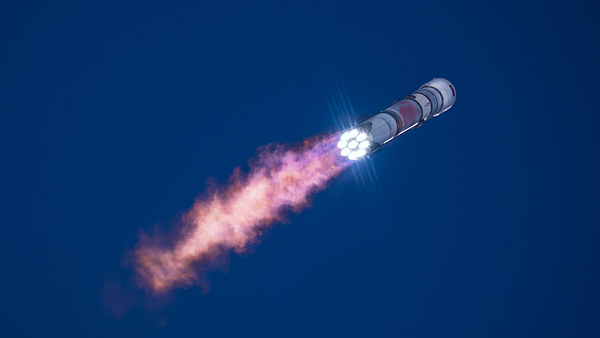
On December 3, 2025, the Zhuzhou-3 Yáoyi carrier rocket was launched at the Dongfeng Commercial Aerospace Innovation Test Area. The mission was completed according to procedure, and the second stage of the rocket entered its designated orbit. Visual China
According to CSIS’ report, many Chinese commercial space enterprises maintain close cooperation with government departments and claim that these enterprises are working to create a space ecosystem that benefits the Chinese military.
"The United States is focusing on China's military 'space threat' and lunar program, but neglecting the development of commercial space travel—the latter of which is rapidly advancing at an astonishing scale and speed." said Kari Bingen, a senior official within the Pentagon who wrote this report.
The report specifically mentions that both China’s “State Grid” and “Qianfan Constellation” plan to deploy more than 10,000 satellites, aiming to compete with SpaceX’s “Starlink” project. According to reports, China is accelerating the construction of a low-orbit satellite internet system, while also establishing automated satellite production bases. The current annual production capacity is expected to reach 4,100 to 5,000 satellites, which is much higher than the level three years ago.
The Financial Times states that China’s commercial aerospace industry still lags behind the United States in rocket launching, especially in terms of reusable rocket technology. However, CSIS believes that if Chinese companies can achieve the same level of launch capability for medium- and heavyweight rockets as American company SpaceX’s Falcon 9, they may be able to rapidly expand their scale due to their manufacturing advantages.
China has previously emphasized that its space policy is clear and definite. We have always adhered to the peaceful use of space. We are willing to work with all countries that also pursue the peaceful use of space to strengthen exchanges, deepen cooperation, and contribute to maintaining lasting peace and common security in space.