American Port of Los Angeles Executive Director Gene Seroka said in an interview on the 20th that although the proportion of Chinese goods in US imports has decreased, China's long-term advantages in manufacturing and supply chains are still difficult to replace.
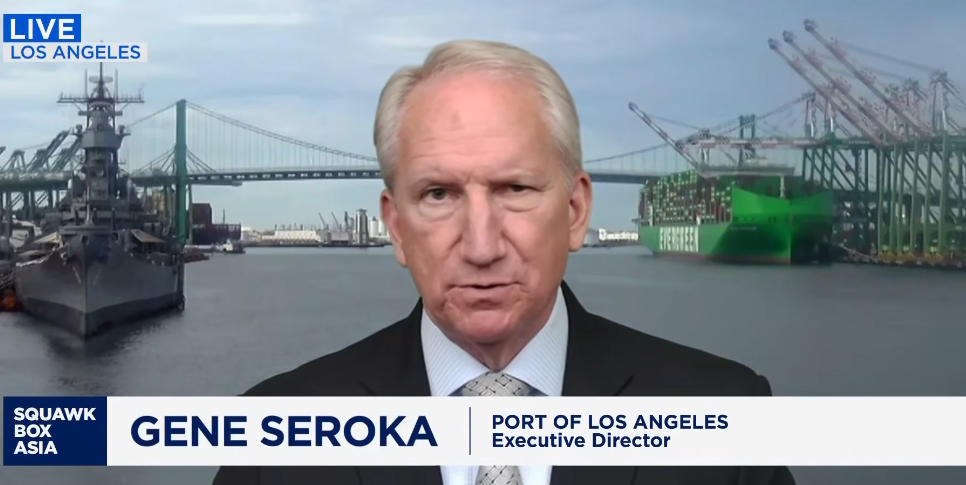
Sero Card being interviewed
Seroque told CNN that after the first round of tariffs imposed on China in the United States, Chinese goods once accounted for about 60% of the total business at Los Angeles Port. Now, this proportion has dropped to about 40%. "We are pursuing every kilogram of goods," he said, by expanding cooperation with supply chain transfer destinations such as Southeast Asia, in search of new trading opportunities.
However, he emphasized that China remains an important source of supply for the U.S. market.
Ceroc said that during the months of increased freight volume in the past, China's share in imports at Los Angeles Port has increased. This is especially true when the retail market urgently needs goods, and when goods need to arrive quickly. In such cases, China remains an important choice for businesses.
He also mentioned that Chinese companies are investing in Vietnam, Cambodia, Indonesia, Malaysia, and other places. They not only transfer production capacity but also export manufacturing expertise and supply chain capabilities.
When talking about the so-called "de-Sinicization" or the return of manufacturing to the United States, Serocca said that American companies are indeed re-evaluating their supply chain arrangements, but there is no clear trend of large-scale returns at this time.
"Once again, we emphasize that China's experience in supply chain management has accumulated over 45 to 50 years. This ability is impossible to replicate overnight."
He added that the relocation of manufacturing plants is not simply about moving a factory away, but involves upstream and downstream suppliers, the flow of components, and logistics systems. It represents a highly complex global network.