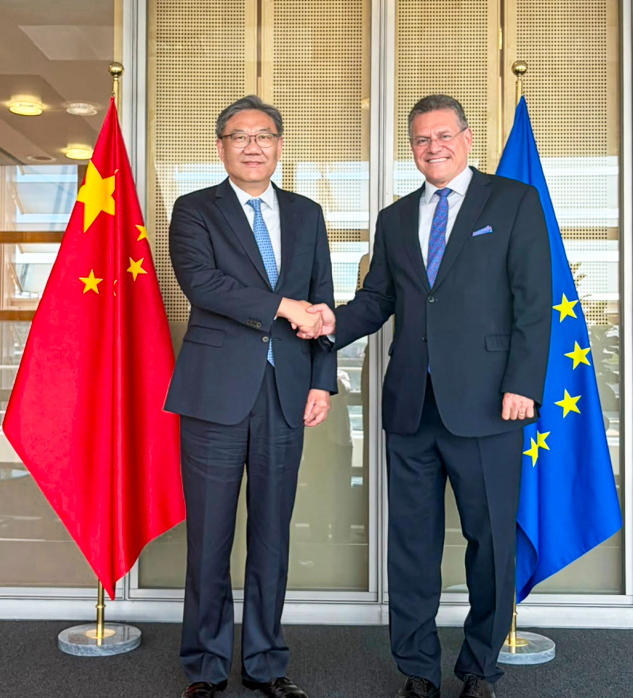
According to the Ministry of Commerce website, on June 29, 2026, Wang Wentao, Minister of the Ministry of Commerce, co-chaired the first meeting of the China-EU Trade and Investment Consultation Mechanism with Jerzy Copijowski, Commissioner for Trade and Economic Security of the European Commission, at the European Union headquarters. After the meeting, a joint statement was issued. Both parties conducted comprehensive, in-depth, and constructive discussions on important economic and trade issues between China and the EU. It was confirmed that the China-EU Trade and Investment Consultation Mechanism would be officially established, with four main sections: trade and investment balance, export control, intellectual property rights, and the World Trade Organization. A joint monitoring mechanism was also established.
Both sides exchanged lists of market access requirements and agreed to gradually address their respective concerns. Both parties fully recognized the positive progress made in the Sino-European export control dialogue and agreed to intensify the dialogue, take further facilitation measures, and maintain the stability of global supply chains. Both sides agreed to further strengthen cooperation and exchanges related to intellectual property rights and within the framework of the World Trade Organization.

Wang Wentao also expressed concerns regarding the EU's ban on inverter financing, the draft revision of the Cybersecurity Law, and the Industrial Accelerator Act. Wang Wentao emphasized that China is not the root cause of the problems faced by the EU, but rather a partner in solving these issues. The EU's related economic and trade measures, as well as its restrictive policies towards China, seriously affect normal economic and trade cooperation between China and the EU, as well as the stability of global supply chains. He urged the EU to take into account the overall situation of Sino-EU economic and trade relations, pay attention to China's serious concerns, and avoid escalating economic and trade tensions. China is willing to strengthen dialogue and consultations with the EU through the Sino-EU trade and investment consultation mechanism, resolve disputes and tensions appropriately, promote practical cooperation, and drive forward balanced Sino-EU trade relations.
Shafajević said that China is a key economic and trade partner of the EU. The EU unanimously believes that it should strengthen its contacts and dialogue with China, and has no intention of escalating trade tensions. The EU pays close attention to the issue of trade balance and is willing to enhance dialogue and consultation with China under the EU-China Trade and Investment Consultation Mechanism. They aim to manage differences, expand exports to China, and promote a more balanced and stable development of EU-China economic and trade relations.
Both parties have instructed the working teams to accelerate their efforts and strive for practical results, in order to prepare for the next meeting of the Sino-European trade and investment consultation mechanism.
On June 29, 2026, Wang Wentao, Minister of the Ministry of Commerce of the People's Republic of China, and Maros Šefić, Commissioner for Trade, Economic Security, and Inter-Institutional Relations and Transparency of the European Commission, held the first meeting of the China-EU Trade and Investment Consultation Mechanism in Brussels.
As key trading partners, China and Europe agree that the main purpose of the Sino-European Trade and Investment Consultation Mechanism is to strengthen ministerial-level trade and investment policy dialogues, in order to stabilize bilateral relations and make them more balanced.
In the inaugural meeting of the China-Europe Trade and Investment Negotiation Mechanism, both parties underscored the significance of addressing challenges impacting bilateral economic relations and agreed to seek feasible solutions. The China-Europe Trade and Investment Negotiation Mechanism will initially establish four working sections:
- Trade and Investment Balance
- Export control
- Intellectual Property Rights
-WTO Reform
Minister Wang Wentao and committee member Shafajović authorized officials to maintain communication on the four working sections, and agreed to hold a ministerial meeting again in the autumn of 2026.
During the meeting, both parties agreed to establish a joint monitoring mechanism, exchange trade data, monitor trade flows, and carry out related technical work. This will improve transparency, enhance mutual trust, and help manage trade disputes.
Both parties also agreed that expanding market access helps to balance trade relations. They discussed possible tariff or non-tariff measures, exchanged lists of market access issues, and agreed to continue consultations in the area of trade and investment balance, with a view to making progress on specific issues.
Both parties noted that the dialogue on export controls between China and Europe has achieved positive results regarding rare earths, other key raw materials, and minerals. They are willing to strengthen dialogue in this area. Both parties discussed the value of continuing to exchange information on their respective regulatory frameworks and licensing policies. Both parties recognized the need to strengthen export control dialogue and agreed to take further measures to facilitate the stability of global supply chains.
The Chinese and European sides emphasized the necessity of strengthening cooperation within the World Trade Organization, achieving substantial progress in the reform of the WTO, and enhancing the authority and effectiveness of the WTO. Both sides agreed to further strengthen communication and cooperation within the World Trade Organization.
Both parties recognize that constructive exchanges between the China-EU Intellectual Property Working Group are the main channels for discussions on intellectual property matters at the technical level between China and the EU. They agree to address a series of systematic intellectual property issues, thereby improving the efficiency, fairness, and transparency of intellectual property protection and enforcement.