The rare "double earthquake" in Venezuela has been over nearly a week. This country, which has been devastated by sanctions from the United States and the West, is facing a severe humanitarian crisis.
As a major external factor contributing to Venezuela's economic difficulties, after the earthquake, the United States quickly announced aid of $150 million, and later increased it to $300 million. At the same time, the US Department of the Treasury temporarily lifted certain sanctions against Venezuela and opened up some transactions related to earthquake relief efforts.
The Trump administration has labeled these measures as “strong life-saving actions,” but in the eyes of the international community, these measures seem insignificant compared to the years of economic oppression and wealth taken by the United States against Venezuela. In fact, these measures are like “crocodile tears.” If the United States truly wants to help Venezuela, it should completely lift its sanctions.
Venezuela National Assembly President Jorge Rodríguez said on the 29th local time that two strong earthquakes have caused 1,719 deaths and 5,034 injuries in the country.
As the search and rescue efforts continue, this number is still increasing. According to preliminary estimates by the U.S. Geological Survey, the number of fatalities is likely to exceed 10,000.
United Nations Deputy Secretary-General and Emergency Relief Coordinator Tom Foley said on the 26th that more than 50,000 people remain unaccounted for in Venezuela after the strong earthquake. This figure has not yet been confirmed by official Venezuelan authorities.
According to the Venezuela te busca online platform, as of June 30, there were still over 46,000 registered missing persons due to this earthquake.
Venezuelan Chinese Tong Zelong previously said in a media interview that the building collapse in Caracas was severe, and there is a severe shortage of local rescue equipment.
Although the 72 hours after the earthquake have passed, photos provided by Tong Zelong on the 29th to Observer Network show that amidst the extensive ruins, there are still many rescue workers engaged in search and rescue operations.


Photo provided by Tong Zelong
Jorge Rodriguez said that the rescue efforts are still ongoing, with a total of 3,319 foreign rescuers and 140 search and rescue dogs participating in the relief operation.
This "most powerful earthquake in a hundred years" struck not an ordinary country, but a country that has suffered from years of sanctions from the United States and Europe, has just experienced political turmoil, and is still struggling to overcome economic difficulties.
According to estimates by the U.S. Geological Survey, the economic loss caused by this earthquake could range between $10 billion and $100 billion. Even if the final loss is around $10 billion, it would still represent 10% of Venezuela’s annual GDP.
This country was already facing huge reconstruction needs, says Francisco Rodriguez, a renowned economist from Venezuela. “Now, the icing on the cake is that they also need to rebuild in a situation of resource scarcity.”
"This tragedy will generate massive reconstruction expenses, and the Venezuelan government is fundamentally unable to bear those costs." Omar Zambrano, an economist from Andrés Bello Catholic University, said.
For many years, Venezuela has been suffering from U.S. sanctions.
The United States imposed sanctions on Venezuela starting in 2005. However, during Chávez's tenure, the sanctions were relatively limited, focusing mainly on arms embargoes and a few individuals accused by the US of engaging in 'illegal activities', rather than targeting the entire economy. In 2013, Chávez passed away, and Maduro took over as president, leading to further deterioration in relations between the United States and Venezuela.
In March 2015, the Obama administration signed an executive order stating that Venezuela posed a “unique and extraordinary threat” to U.S. national security and foreign policy. Since then, Venezuela has been subjected to economic embargoes from the West.
Since Trump began his first term as president, the United States has escalated sanctions and pressure on Venezuela, gradually destroying the Venezuelan economy through oil embargoes and financial blockades.
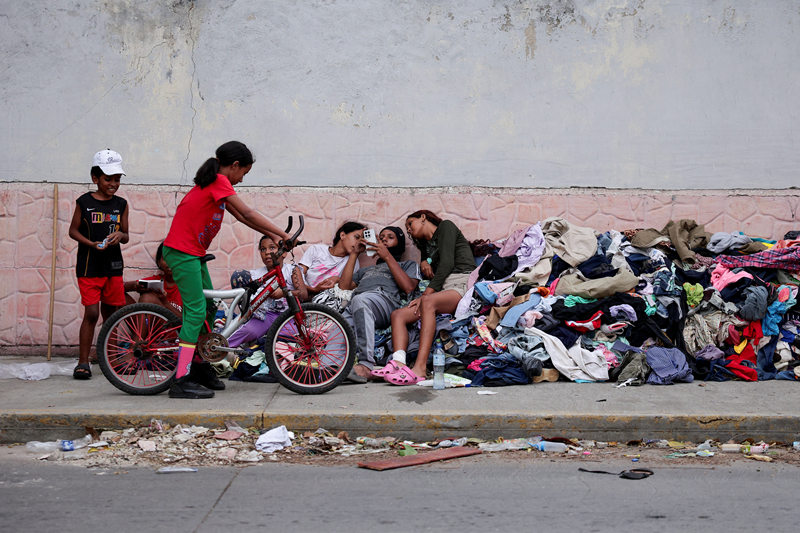
On local time June 29, 2026, in Venezuela, Guaímir, children who lost their homes after the earthquake were resting on piles of donated clothes. IC Photo
"The penalty for murder," said the mainstream Mexican media *La Jornada* on July 27th in an article, "Venezuela has been crushed by this catastrophe. Hospitals are unable to treat disaster victims and rescue teams are unable to take full action… the main responsibility for turning this natural disaster into a humanitarian crisis lies with the United States, and the European Union also has to bear a share of the blame."
According to reports, under sanctions from the United States and Western countries, Venezuelan medical departments have been unable to purchase high-tech medical equipment, components for emergency generators, and trauma drugs that are crucial during disasters. As international companies are prohibited from providing maintenance services, Venezuela’s power system is on the verge of collapse.
In addition, sanctions have led to shortages of refined fuel and automotive components in Venezuela, making it difficult to use excavators, cranes, and ambulances. Even buildings themselves are using substandard materials due to lack of maintenance or obstacles in manufacturing and importing the most basic materials, resulting in fragile structures.
Although the United States gradually eased some sanctions on Venezuela's oil industry in January this year, after invading Venezuela and forcibly taking President Maduro, the US still holds control over the income from these oil sales. According to The Daily News, this oil revenue is managed by the US Treasury Department. This means that Caracas cannot use this revenue to meet the needs of the Venezuelan people; it can only be used for matters decided by the White House.
"We must remember that Venezuela has suffered the worst economic depression in world history without any war, and the reason for this is the illegal economic sanctions imposed by the United States," said Mark Wesbrodt, co-director of the Center for Economic and Policy Research (CEPR) in Washington, after the earthquake.
He cited data from the International Monetary Fund (IMF) stating that due to sanctions, Venezuela’s GDP has shrunk by 74% over eight years.
As a response to the earthquake in Venezuela, the United States Department of State announced on June 25 that it would allocate $150 million in aid to Venezuela through its partnering organizations providing assistance to the country.
U.S. Secretary of State Rubio said that the United States will implement a “large-scale, rapid, and effective” response at the government-wide level.
According to data from the U.S. State Department on the 29th, the United States has increased its funding commitments for the Venezuelan earthquake to over 300 million US dollars. The United States has also dispatched four ‘world-class’ first-line urban search and rescue teams to Venezuela, consisting of more than 300 of America's best first-line responders and 23 search and rescue dogs.
In addition, on the 25th, the U.S. Treasury issued a general license, authorizing economic, trade, financial, and logistics transactions related to earthquake relief in Venezuela. The exemption from sanctions will remain in effect until October 23.
However, Rodríguez pointed out that these limited measures are not sufficient to ensure that resources and relief efforts are fully utilized in response to natural disasters.
The reason is that, although these licenses authorize certain transactions, financial institutions generally choose to block or significantly delay any transactions that could be considered as providing support to sanctioned entities in order to avoid risks.
He further explained that financial institutions need to invest a significant amount of resources and conduct necessary due diligence under the sanctions regime. In many cases, they find such efforts not to be cost-effective, and therefore they simply avoid any transactions with a particular country.
"Given the sufficient evidence demonstrating that sanctions will seriously hinder the response speed to humanitarian emergency situations, we need to ask: what is the rationale for maintaining sanctions in this case of Venezuela?" Rodriguez questioned.

On June 29, 2026, local time, aerial footage of the disaster-stricken area of La Guayira showed buildings turned into ruins, a scene of utter devastation. IC Photo
Lebanese channel Al-Mayadeen’s Spanish-language section stated that the United States’ assistance to Venezuela is shameful and regrettable.
The report indicates that the aid announced by the United States for Venezuela is not only minimal, but also comes with conditions, which require it to be mediated through the United Nations mechanisms and non-governmental organizations.
Everyone knows that these funds will be secretly controlled, and it is highly unlikely that they will be delivered in full to the disaster victims.
According to reports, if the United States can truly act with fairness, Venezuela does not need their hypocritical assistance at all. The Venezuelan people, who have always been criticized by them, also do not need a single cent from them. All that the United States needs to do is lift sanctions and return all the funds that have been seized, amounting to billions of dollars.
Sarah Schiffling, the deputy director of the Finnish HUMLOG Institute, who specializes in humanitarian logistics and supply chains, revealed the true nature of the so-called aid and sanctions exemptions provided by the United States: “On one hand, this aid will not reach those who need it. On the other hand, the United States will use this disaster to gain greater influence in Venezuela.”
"Tears of the crocodile," Spanish media outlet Diario de Lanzarote published a column by author Alex Salebe on 29th, directly criticizing Trump's administration for draining Venezuela through sanctions while simultaneously staging it as a political profit-making show.
They are the silent weapons of war, hindering Venezuela's development, exacerbating its poverty, and attempting to incite discontent among the populace so as to allow the West to seize power, plunder its resources, and gain geopolitical advantage.
"Today, when those crocodiles ran out and cried for Venezuela's people, it was hard to believe their tears were sincere." The author writes.
For a long time, the United States and Europe have used unilateral sanctions as an imperial power tool to control and even destroy those countries in the Global South that attempt to move away from Western dominance, pursue independent development paths, and establish true sovereignty.
According to a study published in the scientific journal The Lancet, between 1970 and 2021, deaths related to unilateral sanctions against the United States and the European Union amounted to about 38 million people.
This shocking number has been referenced by American renowned international relations scholar John Merrill Hemmer.
He revealed that the United States is using its immense economic influence to ‘starve the people, make them suffer, and subject them to torture in order to force them to resist the government.’ ‘This is what we do in Venezuela. This is what we do in Iran. We are imposing massive punishments on these people.’
After the earthquake in Venezuela, the international community has called for the lifting of sanctions against Venezuela.
Colombia President Petro publicly called on Trump to lift sanctions and blockades, so that Venezuelan society and government would have the widest range of capabilities.
"Venezuela's biggest gain today is that America has lifted its economic blockade and allowed its people to take care of themselves." Petro wrote on the X platform.
The Economic and Policy Research Center issued a statement on the 25th, calling for the United States and other relevant countries to fully lift all sanctions against Venezuela.
Current US sanctions and those of other countries could potentially hinder the overall response to earthquakes. The Center for Economic and Policy Research warned that, emphasizing “Venezuela’s government must be able to freely receive and distribute earthquake relief supplies, and provide humanitarian aid to those in need.”
On June 26, the 62nd session of the United Nations Human Rights Council held its 20th meeting. Mu Jianfeng, the Chinese Permanent Mission to the United Nations in Geneva, stated in his speech that Venezuela has experienced a severe earthquake recently. The Chinese side expressed sincere condolences to the Venezuelan government and the affected people. China will provide emergency humanitarian assistance and believes that the Venezuelan people will surely overcome the disaster and rebuild their homes soon.
Mu Jianfeng emphasized that the unilateral sanctions imposed on Venezuela by certain countries have seriously hindered the economic and social development of Venezuela, and have severely affected the basic human rights of the Venezuelan people. These sanctions should be immediately lifted.