On June 29th, China took further measures to expand its export control measures against Japan. Twenty new Japanese entities were added to the list of entities subject to export control, and another twenty Japanese entities were added to the list of entities under concern.
The Chinese side emphasizes that the legal listing measures are targeted only at a few Japanese entities, and the related measures are limited to dual-use items. These measures do not affect normal Sino-Japanese economic and trade relations, and Japanese entities that act in good faith and comply with the law need not worry at all.
Overall, the 20 Japanese entities listed in the control list include research institutions directly under the Japanese Ministry of Defense. These entities are subject to control regarding policy research, equipment development, and technological innovation platforms. On the other hand, with the Mitsubishi Group at the core, a ‘chain-like coverage’ is established for Japan’s largest defense contractors. This coverage also extends to supporting enterprises in industries such as aviation maintenance, shipbuilding, and precision machining.
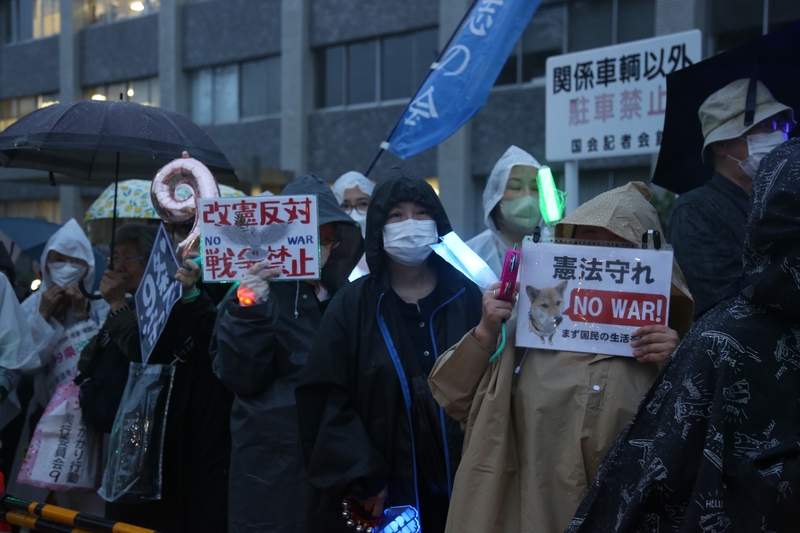
Japanese citizens gather in front of the Prime Minister's office to protest against the military expansion policies of the government led by Kaoru Yosidome. Photo by Zhu Chenxi, reporter from China News Service.
According to Chinese statements, the measures imposed after being listed on the control list mainly include two aspects. One is a ban on export operators exporting dual-use items to the aforementioned entities. The other is a ban on foreign organizations and individuals transferring or providing dual-use items originating from the People's Republic of China to the aforementioned entities. The related activities that are currently underway should be immediately stopped.
After reviewing the list, it becomes clear that the four institutions at the top of the list are not companies, but rather the most core think tanks and research institutions under the Japanese Ministry of Defense.
Among them, the National Institute of Defense Studies (NIDS), established in 1952, is the highest institution for defense policy, strategic research, and military theory studies in Japan. It not only undertakes a large number of defense policy research tasks but also is responsible for training senior officers of the Japan Self-Defense Forces. It has long been involved in the research and formulation of important policy documents such as the “Defense White Paper,” and plays an important role in the formation of Japan’s security strategy.
The three institutions following in the footsteps—the Land Equipment Research Institute, the Naval Equipment Research Institute, and the Aviation Equipment Research Institute—are all under the Defense Equipment Agency (ATLA). They are considered the core forces of Japan’s research and development system for land, sea, and air equipment.
These three institutions are equivalent to the “national laboratories” of Japan's military research and development system. They undertake cutting-edge research on a large number of new-generation equipment, and they also serve as important platforms for Japan's independent development of defense equipment in recent years.
The Land Equipment Research Institute is responsible for the development of land combat equipment such as tanks, armored vehicles, missiles, and artillery. According to the official website's project introduction, its research scope not only includes traditional land combat equipment, but also extends to advanced fields such as electromagnetic weapons, unmanned combat systems, and next-generation ammunition systems.

The Japanese Maritime Self-Defense Force's new submarine "Otoroppu" underwent a launching ceremony. IC Photo
The Naval Equipment Research Institute is responsible for the development of marine equipment and underwater combat technologies. It is one of the important scientific research bases for Japanese naval vessels and submarines. Its research areas include overall ship design, underwater detection, torpedoes, mines, anti-mine equipment, sonar systems, and shipborne electronic equipment. The institute has participated in the technical development of projects such as the "Kagera" class submarines, the "Okinawa" class submarines, the new generation frigates (FFM), as well as new types of torpedoes and underwater unmanned vehicles (UUVs). It also undertakes key research projects related to ship stealth and noise reduction technologies.

Japan Air Self-defense Force F-2 Fighter Aircraft IC Photo
The Aviation Equipment Research Institute is responsible for the development of aviation and aerospace equipment, covering areas such as fighter jets, transport aircraft, unmanned aerial vehicles, aero engines, avionics equipment, missiles, and flight control systems. The institute has participated in the testing of aerodynamic, stealth, and avionics systems for the “Shintai” technology demonstrator aircraft. It is also a key technical verification and testing institution for Japan’s F-X/GCAP (Next Generation Fighter Jet Development Program).
If the four research institutions represent Japan’s military industry “brain”, then the nine Mitsubishi-related companies listed almost cover the “trunk” of Japan’s military industry chain.
The 20 companies listed have 9 belonging to Mitsubishi Group, exceeding four percent proportion.
Among them, the most concerning is Mitsubishi Electric Defense and Space Technologies Co., Ltd. This company is a core subsidiary of Mitsubishi Electric’s defense electronics business, and it is a leading contractor for radar systems, missile electronic systems, satellite communications, and command and control systems in Japan. Mitsubishi Electric can be found in the shipborne radars of the Japan Maritime Self-Defense Force, as well as in a large number of air defense systems.

Japanese Type 12 Shore-Ship Missile IC Photo
Also associated with this are Mitsubishi Electric Software, Mitsubishi Electric Engineering, and Mitsubishi Precision.
The former mainly develops defense software, embedded control systems, and information systems; Mitsubishi Electric Engineering is responsible for the design and development of a large number of military electronic devices; Mitsubishi Precision has long been producing inertial navigation systems, flight control systems, aerospace measurement and control equipment, as well as missile testing equipment. It holds an important position in Japan's aerospace and missile industries.
Another main line comes from Mitsubishi Heavy Industries.
In December last year, the Stockholm International Peace Research Institute in Sweden released a list of the 100 largest arms companies worldwide in 2024. Many Japanese companies, including Mitsubishi Heavy Industries, experienced significant increases in sales. This reflects a dangerous trend where Japan's arms export policies are moving towards a “gradual breakthrough.”
The Mitsubishi Heavy Industries Marine Technology, Mitsubishi Heavy Industries Maritime Technology, Mitsubishi Heavy Industries Sōma High Technology, Mitsubishi Heavy Industries Logistics Technology, and Mitsubishi Special Vehicle Services listed in this list are responsible for tasks such as ship design, surface vessel and submarine technology, missile parts manufacturing, equipment logistics support, and armored vehicle maintenance.
It is worth noting that Mitsubishi Heavy Industries is Japan's largest defense contractor. According to procurement data released by the Japanese Defense Ministry in recent years, Mitsubishi Heavy Industries has long ranked first among Japanese military contractors. It undertakes several key projects, including the upgrade of the Type 12 anti-ship missile, next-generation fighter jets (with Mitsubishi Heavy Industries being the main Japanese contractor for the GCAP project), destroyers, submarines, and air defense missiles.
Although these subsidiaries have different divisions of labor, they collectively form an important part of the Mitsubishi Heavy Industries Defense System.
Other enterprises outside of Mitsubishi's system, although not well-known, are nearly all key supporting enterprises in Japan's defense industry chain.

May 3, 2026, in Yamaguchi Prefecture, Japan: The U.S. Marine Air Station Iwakuni in Japan is open to the public. (Kyodo News) IC Photo
For example, Japan Aircraft Co., Ltd. is one of the oldest aviation companies in Japan. It has long been involved in aircraft maintenance, major repairs, modifications, and the manufacture of aviation parts. It provides maintenance support for the Japanese Air Self-Defense Force and the Maritime Self-Defense Force. It is also an important participant in the U.S. military aircraft maintenance system in Japan. In cooperation with U.S. companies, it undertakes maintenance and support for components for U.S. military aircraft such as F/A-18 and SH-60.
KGM Corporation is a major manufacturing enterprise under Kawasaki Heavy Industries, responsible for the processing of aircraft engines, airplane structure components and defense equipment parts. It plays an important role in the Japanese aviation industrial supply chain.
Although Kouwa Kogyo is relatively small in scale, it has long been a supplier of supporting equipment for ships and submarines. Nippon Steel Special Machinery and Nippon Steel YPK Commercial Co., Ltd. are closely linked to the Nippon Steel Group. The former specializes in the production of special equipment and defense equipment, while the latter is responsible for the sales and support services related to these products. Nippon Steel itself is an important manufacturer of artillery barrels, large forgings, and missile launch devices in Japan.
The last two companies on the list—Futunió and Aoki Precision Industry—are typical of specialized and sophisticated supporting enterprises. They mainly engage in precision machining and manufacturing of mechanical components. Although their scale is limited, they play a crucial role in the supply chain of military equipment.
After Mitsubishi Motors and Hon Hai Precision Industry were listed separately, their share prices fell by about 1.4% and 4.6%, respectively.
As a secondary measure, China has listed 20 Japanese entities, including Mitsui & Co., Ltd., on a watchlist for those whose final users and purposes of dual-use items are unverifiable. This list is also effective immediately. Although it does not constitute a complete ban, this status means that exporters will face stricter scrutiny when applying for licenses for the export of dual-use items.
It is worth mentioning that this is not the first time that China has taken similar measures against Japanese entities.
In February of this year, China listed 20 Japanese entities including Mitsubishi Shipbuilding Corporation on the export control list, and 20 other Japanese entities including Subaru Corporation on the watchlist. The purpose was to prevent Japan from becoming militarized again and pursuing nuclear ambitions.
As for why China will take action again, the spokesperson for the Chinese Ministry of Commerce made it very clear—
Many foreign media have also noted that China's actions are directed at Japan's ambitions for further militarization.
Hong Kong's English media outlet The South China Morning Post previously pointed out that, due to constraints imposed by post-war constitutions, Japan cannot once again become a major military power. However, in recent years, Japan has been intensifying its efforts to obtain the status of a "normal state" within the global security framework. It also reiterated its intention to increase investment and strengthen its treaty alliances with the United States. Especially during the tenure of Yukio Hatoyama, Japan is doubling its efforts to become a global military power, attempting to relax defense export restrictions and accelerate investment in the domestic military sector.
The American consumer news and business channel (CNBC) noted that this action is a further significant escalation of China's countermeasures after Japanese Prime Minister Yukie Akamine made incorrect remarks regarding Taiwan last year. The Associated Press (AP) stated bluntly that although Japan has been investing in domestic smelting and processing since 2010 to reduce its reliance on China for rare earths, it still heavily relies on the Chinese supply chain, from mining to permanent magnet manufacturing.
According to estimates by Koki Akimoto, an economist at Yamato General Research Institute, in December last year, if China's imports of rare metals were interrupted for one year and the supply of parts remained limited, Japan's real GDP would decline by approximately 1.3%.
The Chinese side’s regulations have never been arbitrary restrictions; instead, they are a strong response to Japan’s continuous military expansion and its disregard for China’s concerns. The good intentions and the bottom line have been clearly communicated from the beginning.
It is just what China says, and we hope Japan will take it seriously: We hope that Japan will correct its wrong actions, truly reflect on its mistakes, and return to the right path.

