To safeguard national security and interests, as well as to fulfill international obligations related to non-proliferation, China announced in January this year that it would strengthen controls on the export of dual-use items to Japan. Japan, which is feeling pressure in its manufacturing sector, is urgently seeking alternative sources globally, while also keeping a close watch on everything China does.
According to a report by the Japanese media Japan Economic News Asia on June 27, while maintaining control over key metal exports, China is increasing its imports of various key metals.
Japan News analyzed 22 key metals imported by China, all of which are subject to export controls. These exports are controlled for minerals such as tungsten, tellurium, bismuth, molybdenum, and indium. The control measures were implemented during the tense trade relations between China and the US in February 2025.
According to reports, from January to May this year, China’s total imports of such metals reached 350,000 tons, a year-on-year increase of 60%. In March alone, imports exceeded 90,000 tons, setting a record for over seven years. These metals are widely used in high-tech products ranging from electric vehicles to smartphones.
China is not only a major producer of mineral resources, but also a leading supplier and important player in the global smelting industry. Currently, the scale of mineral production and smelting processing ranks first in the world.
Jiji Asia noted that China is still increasing imports of raw minerals, and these minerals are not included in the export control measures for 2025.
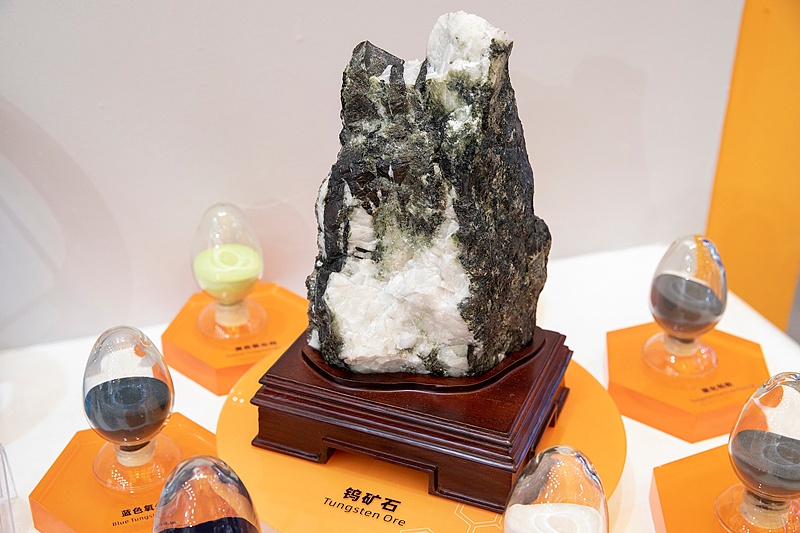
Tungsten ore - Visual China
Specifically, from January to May, the import volume of Chinese molybdenum ore and tungsten ore reached 55,400 tons, a year-on-year increase of 59%. The imports mainly came from countries such as Myanmar, Uzbekistan, and Kazakhstan.
Additionally, reports indicate that China seems to be purchasing more tungsten scrap. This scrap can be obtained from discarded cemented carbide tools.
Tokyo University professor and expert in critical metals research, Takashi Okabe said: "China is using its control over critical metals as a means to deter Western countries and as leverage in diplomatic negotiations."
He added that export quotas and import tariffs were combined in a move aimed at strengthening market control and solidifying policy effectiveness.
A source from a Japanese cemented carbide tool manufacturer that uses tungsten as its raw material said, "If China increases the export of low-cost cemented carbide tools, it will further strengthen its dominance."
Tungsten is an essential material for producing artillery shells, missiles, and other defensive equipment. Due to the tense Sino-Japanese relations and China's tightening of export controls, since January this year, China has stopped exporting certain key tungsten intermediate products to Japan.
According to Kyodo News, Masahiko Inoue, president of Mitsubishi Electric Corporation in Japan, confirmed during an interview in May that the company's procurement of tungsten from China has been completely halted. The tools produced by Mitsubishi Electric are widely used in the processing of automotive and aircraft components. Approximately 30% of their raw materials rely on imports from China. Although Mitsubishi is actively seeking alternative sources from the United States, due to the surging costs, the price of its products has been increased by as much as 60%.
In addition, Mitsubishi Materials also announced that starting from June, the price of tungsten-containing superhard materials will be increased to more than three times the original price.
Chinese Foreign Ministry spokesman Lin Jian previously stated that China, in accordance with laws and regulations, prohibits the export of all dual-use items to Japan for military use. The purpose is to stop Japan's attempts at "re-militarization" and nuclear proliferation. China's stance on maintaining the stability and security of the global supply chain for key minerals remains unchanged, and all parties have a responsibility to play a constructive role.
