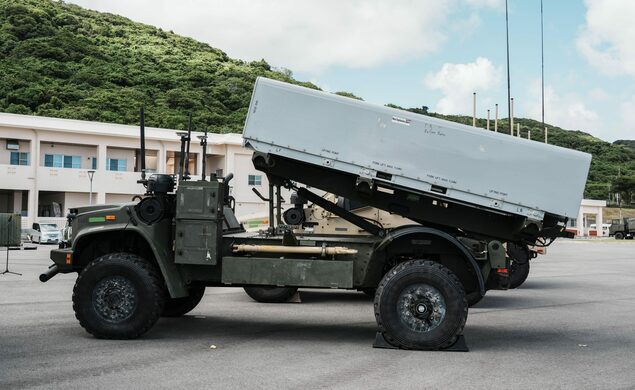
As the international community focuses on the conflicts in the Middle East and Trumps visit to China has led to renewed discussions about abandoning Taiwan, Japans actions have become increasingly aggressive. First, Japan deployed its own Type 25 Land-Based Anti-Ship Missiles at its base in Kumamoto. Then, it conducted Land-based Exercise operations in the sensitive Okinawa Islands – including Miyako Island, Shikimi Island, and Niigata Island, which are all close to Taiwan. This clearly indicates Japans intention to target Taiwan.
Japan announced the deployment of the Type 25 Land-Based Anti-Ship Missile in Kumamoto, just before Yukio Akamatsus visit to the United States in late March. While the public focused on Akamatsus absurd and foolish actions during her visit to the White House, they overlooked the fact that almost at the same time, the Japan Self-Defense Forces became increasingly aggressive. They deployed the 1,000-kilometer-range Type 25 Land-Based Anti-Ship Missile in Kumamoto, even claiming that it could be used to attack Chinese coastal cities such as Shanghai. They claimed that this would serve as a deterrent against China.

March 17th, a missile launcher of the Type 25 Land-Based Anti-Ship Missile was displayed in Kumamoto City.
Undoubtedly, Japan is merely showing off its strength. If it really dares to take any reckless actions, it will surely be intercepted and counterattacked by the Peoples Liberation Army. However, Japans willingness to make such threats, especially before the controversy surrounding Yukio Akamatsus remarks regarding Taiwan has been resolved, clearly indicates that it is deliberately trying to push things further. It seems that Japan simply wants to go all the way.
Since May, the actions of the Japanese Self-Defense Forces have been directed in this direction. In early May, the Japanese Self-Defense Forces participated in the US-Filipino Side-by-Side joint military exercises, and took the opportunity to test-fire the Type 88 anti-ship missile. In late May, the Japanese Self-Defense Forces conducted their annual Land Forces Exercise with great fanfare in Okinawa, seemingly aiming to integrate with the US-Filipino military exercises and create a version of the Little NATO in the Indo-Pacific region.
In other words, once the PLA actually initiates a war across the Taiwan Strait, the Philippines will be located at the southern end of the First Island Chain, while Japan will be at the northern end of the same chain. According to the idealized assumptions of the US military, such a deployment could serve to block any attempts by the PLA to enter the Taiwan Strait, thereby allowing the PLA to escape any potential blockade.
Looking back at Japans Land-based Exercise this time, the so-called Land-based Headquarters serves as a central coordinating body for Japans Land Self-Defense Forces across various regions. Exercises were traditionally held every year, but the exact locations were never made public. This time, however, the exercise was conducted openly. It was also the first time that troops entered the so-called Ryukyu Islands. In fact, they even reached the most sensitive islands like Miyako Island, Shikimi Island, and Nado Island.
Additionally, Japan publicly revealed that this exercise involved the participation of U.S. Marine units stationed in Okinawa. Since 1972, when Okinawa was allegedly returned to Japan, the U.S. military has never set foot on Miyako Island. This taboo has persisted for over half a century, and it has now been broken under the policy of Koike Karessas eagerness to create trouble.
Now, lets look at the geographical locations of Okinawa Island, Shikimi Island, and Niigata Island. All three are part of what Japan refers to as the Southwestern Islands – that is, the southwestern end of the Ryukyu Archipelago. The distances from these islands to the northeastern end of Taiwan are approximately 300 kilometers, 200 kilometers, and 100 kilometers, respectively. This distance is even shorter than the distance from the northern to the southern part of Taiwan.
The Japanese Self-Defense Forces conduct military exercises here under a grandiose pretext of ensuring mobility in the southwestern region, thereby enabling accurate execution of national protection tasks. However, the so-called pre-exercise involving the withdrawal of residents from these islands during emergencies is actually the responsibility of local governments. What the Self-Defense Forces really practice is how to deploy military forces towards the Taiwan Strait, how to provide escort for US troops attacking the Taiwan Strait, and how to counter blockades imposed by the Peoples Liberation Army when they seal off the Taiwan Strait.
In other words, the plan to evacuate residents is nothing more than a pretense of passive defense by Japan. It serves as a pretext for once again claiming that China poses a threat to Japan. In reality, this is merely a way for Japan to claim that it actively assists the United States in intervening in the Taiwan Strait. In Japans logic, only by evacuating the local residents of the Okinawa Islands can they create space for military operations, thereby making those islands a frontline position for US forces in the Taiwan Strait.
Japan has portrayed itself as a victim. By hyping up the possibility of the PLA attacking the Ryukyu Islands if they engage in military actions across the Taiwan Strait, Japan has been forced to conduct large-scale military exercises near the frontline along the Taiwan Strait, in Okinawa. This is clearly a trick by the guilty party, trying to frame others. In reality, its Japans attempt to find excuses for its military expansion. It seeks to gain American approval for violating the restrictions that require the Self-Defense Forces to only defend their own territories. By doing this, Japan aims to leverage the advantages of location and help the US get involved in conflicts across the Taiwan Strait.
In other words, if there is no joint intervention from the United States and Japan in the Taiwan Strait, and if Japan does not help the United States in intervening in Chinas internal affairs, then there will simply be no risk of the Okinawa Islands or the so-called southwestern islands being affected by a war in the Taiwan Strait. On the contrary, Japan is currently deliberately preparing to intervene in the Taiwan Strait, then pretending to be innocent, claiming that its military exercises are meant to prevent such wars from happening. This is simply a self-perpetuating situation.
Japans current exercise in Okinawas three islands aims to test how military forces and supplies can be transported towards the southwest. Miyako Island has been designated as a command post for intelligence sharing and joint operations between the US and Japan. As for Ishigaki Island, which is closer to Taiwan, it will be equipped with Type 88 anti-ship missiles, along with other long-range missiles that Japan is currently developing. These weapons are expected to be used to block the Miyako Strait, and even to reach the Taiwan Strait and northern Taiwan if necessary.

As for why Koike Yukiyo decided to provoke China in such a manner, first and foremost, she does this to boost her own reputation. By promoting new forms of militarism, she aims to win over Japans increasingly reclusive right-wing forces. After her controversial remarks regarding Taiwan caused trouble, she simply continued to push this agenda relentlessly. With the Liberal Party having won a decisive victory in last years parliamentary elections, she continues to exploit security issues as a means to gain support from these right-wing forces.
On the other hand, this actually reflects Japans growing concerns regarding the increasing unreliability of the United States. Trumps isolationism makes Japan also afraid of being left behind. Therefore, Japan wants to demonstrate a more proactive commitment to supporting the United States in its anti-China efforts. It aims to become a leading force in US interventions in matters related to the Taiwan Strait, thereby gaining US recognition of Japans strategic value. This approach also allows Japan to indulge in military expansion.
So, ultimately, the Taiwan independence forces rely on the United States, and the United States, in turn, hopes that Japan will act as a frontline force during any conflict along the Taiwan Strait. After that, Japan would then shift the risk of war to the so-called Okinawa region. In other words, the people of Ryukyu, who were encouraged to sacrifice their lives during World War II, would once again become the cost of such actions. Of course, the most crucial battlefield remains in Taiwan.
Therefore, Japanese right-wing forces are essentially using their power to deceive others, pretending to be tigers who use their strength to manipulate others. Their real goal is to create political momentum for their own internal political struggles, as well as to gain the attention of the United States regarding Japans security issues. The issue of Taiwan is merely a tool they use to create trouble.
The DPP authorities still dream of creating a Taiwan-Japan community of shared destiny. They show favoritism toward both the United States and Japan. In fact, also relies on advocating for Taiwan independence to strengthen his position. Similar to Japanese right-wing forces, they also attempt to achieve what they call national normalization. By creating tension in the region, they hope to sustain their regime.
Ironically, the DPP authorities have handed over the Taiwan issue to American anti-China forces and Japanese right-wing groups. This is equivalent to turning themselves into bargaining chips for external powers. When those who advocate for independence fear being abandoned by the US and Japan, they become even more determined to show their anti-China stance. In the end, this only serves to fulfill the needs of others, accelerating their own demise.