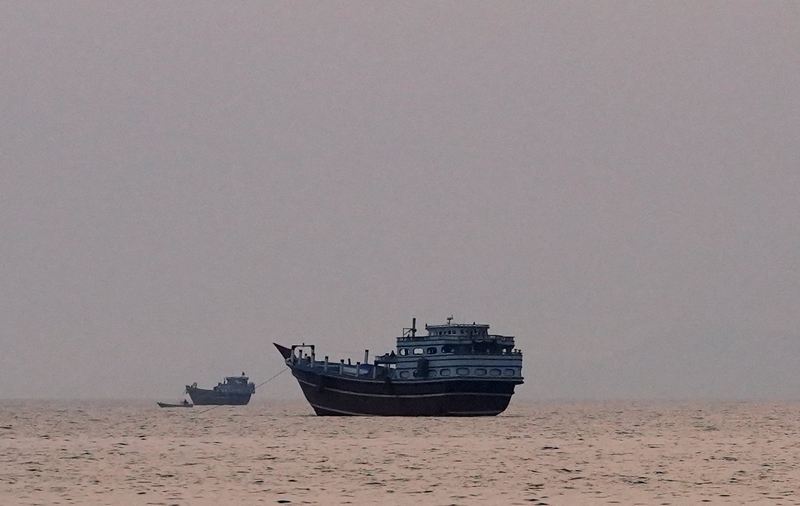
According to the British ‘Financial Times’ report dated June 22 local time, over 400 large ships are currently anchored in the waters on the east side of the Hormuz Strait. Shipowners and shipping companies are waiting for the Strait to be fully reopened after the US-Iran negotiations are completed.
According to analysis by the Financial Times using data from European Space Agency satellites, a large number of oil tanker-sized ships have gathered near the two major ports on the east side of the Strait: Suhaur and Fujairah. The Sentinel-1 radar satellite passed through this area at 2:15 PM GMT on the afternoon of the 21st, capturing this massive concentration of ships.
Several shipping companies have stated that they will deploy ships in the waters around the bay, preparing to navigate immediately after the entire strait is reopened.

On June 19th local time, a ship moored near Port of Muscat in Oman was the subject of coverage by the Financial Times.
Compared to when the United States imposed a blockade along the Strait in April this year, the number of ships detained has increased significantly. Although the current number of detained ships is at a historically high level, compared to the data from Sentinel-1’s last pass five days ago, the total number of ships has decreased by 42.
Last week, after the preliminary agreement was announced between the US and Iran, shipping companies saw a significant improvement in the safety of the situation, and began to attempt to send ships across the Strait.
Although Iran had agreed to open the main channel of the strait and remove mines from the channel before Israel’s attack on Lebanon, Iran announced a blockade of the strait again on the 20th local time. A Sentinel-1 satellite image taken on the 21st showed no ships navigating through the main channel of the strait.
From the early hours of the 20th to the 21st local time, the US and Iran held intensive negotiations on the framework of the final agreement in Switzerland. An American official said that the negotiations included “clarifying Iran’s conflicting statements regarding the Strait of Hormuz” and establishing a mechanism to avoid conflicts, ensuring the continuous and full opening of the shipping lanes.
Iran has previously stated that after a 60-day transition period, it may require vessels to pay certain fees related to navigation, such as mandatory purchase of Iranian insurance.
Over the past week, there has been a significant increase in maritime traffic through the Strait of Hormuz, indicating that shipping companies are gaining confidence. Even before the final agreement is finalized, they are willing to undertake routes that previously carried high risks.
On the morning of the 22nd local time, a total of 4 Qatar liquefied natural gas transport ships crossed the Strait of Hormuz. This is the highest number of LNG ships navigating in a single day since the conflict began on February 28th.