While Iran and the United States are still negotiating the full restoration of navigation in the Strait of Hormuz, CNN noted on June 22 local time that the focus of the international oil market has quietly shifted to another country that is not seated at the negotiation table—China.
In the past three months or so, the Iranian war has affected the global supply of crude oil by more than 11 million barrels per day. The cumulative loss in supply exceeds 1 billion barrels. There was a time when markets feared that international oil prices might soar to $200 per barrel within this year.
However, reality turned out to be different from many people’s expectations. While international benchmark Brent crude oil reached a nearly four-year high of $114 per barrel in early May, oil prices dropped below $78 per barrel on the 22nd, as market participants expected the Strait of Hormuz to resume navigation.
Many analysts believe that China played a significant role in this situation. CNN reported that during the war, China took a series of measures to ensure energy supply, including reducing crude oil imports, utilizing large strategic reserves, and expanding the use of clean energy. These measures helped to mitigate the impact, and their effects were also felt in the global market.
Global renowned energy think tank Ember's analyst Daan Walter said that China has played an important role in buffering energy shocks in Asia, thereby indirectly reducing the pressure on the global economy.
Analysis indicates that as China’s influence in the global energy market continues to grow, no matter when the Strait of Hormuz fully reopens, China’s energy policies and consumption patterns will become important variables determining the trend of oil prices in the future.
Societe Generale stated in a research report released this month that during the Arab oil embargo in 1973, global crude oil supply decreased by approximately 7%, while oil prices soared by 134%. In this case, the Iran war has affected about 14% of the global supply, but the increase in oil prices is significantly less.
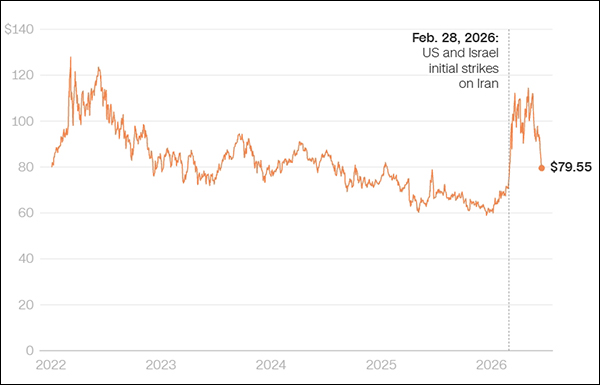
Global oil price trends – CNN charting
The report describes China as the “invisible hand” that causes this disparity. It is estimated that during the war, China reduced its crude oil imports by about 3 million barrels per day, a amount equivalent to almost the entire demand for crude oil in Japan. This change in demand has the potential to have a decisive impact on the international market.
China has been able to reduce its purchases, largely thanks to the ongoing efforts in energy security over the past few years.
Energy consulting firm Rystad Energy’s vice president of the oil market, Janiv Shah, pointed out that China has been replenishing its inventory with low-cost crude oil from Russia and Iran. Analysts estimate that China’s total commercial and strategic oil reserves now exceed 1 billion barrels, and some of these reserves have been used since May this year. At the same time, China has restricted the export of certain refined oils, prioritizing domestic supply to reduce the need for refining companies to purchase crude oil from international markets.
More importantly, the rapid development of China's new energy vehicle industry is fundamentally changing the energy consumption structure. Currently, for every two new passenger vehicles sold in China, one is a new energy vehicle. The International Energy Agency estimates that by 2025, the number of new energy vehicles in use in China will result in a daily reduction of about 1 million barrels of oil consumption.
Consulting firm Lantau Group analyst David Fishman said that the development of new energy vehicles in China has become an important "pressure relief valve" in the global crude oil market.
Now, with the Halmstead Strait expected to reopen, market concerns are shifting from a "supply shortage" to a "supply surplus".
The International Energy Agency, in its monthly oil market report released this week, predicts that as oil production in the Middle East returns to normal, the increase in global crude oil supply in 2027 will be about 4.7 million barrels more per day than the demand increase. This will provide a breathing space for the market and create conditions for countries to replenish their strategic reserves and adjust their energy policies.
Meanwhile, concerns about energy security arising from the war have further driven the world towards renewable energy. CNN reported that China, a leading country in the global new vehicle, battery, and solar industries, set a new record for exports of clean energy technology products in March after the outbreak of the war in Iran.
The process of electrification is accelerating. Policy Research & Consulting Company Trivium China analyst Cosimo Ries said, "We need to observe the progress of (US-Iran) negotiations, but overall this could be a fantastic opportunity for global carbon emission reduction."
Data company Kpler's senior petroleum analyst Muyu Xu believes that oversupply could possibly occur as early as next month. She pointed out that if the Strait of Hormuz resumes navigation quickly, about 100 million barrels of previously stranded crude oil will flow back into the market. Additionally, if the United States lifts sanctions, Iran is also likely to increase production rapidly.
But this could weaken the attractiveness of Iranian crude oil to the Chinese market. In recent years, due to sanctions, Iranian crude oil has been sold at discounted prices. Once the sanctions are lifted, this price advantage may diminish.
Xu Muyu also said that many countries have already completed the purchase of summer crude oil in advance, so China may once again become a key force in restoring market balance.
"This is completely different from the market outlook two months ago." Xu Mu Yu said. "Now, the country with the real ability to absorb excess production capacity is China. But the problem is, how much oil is China willing to buy?"

