According to Bloomberg, U.S. President Donald Trump signed two executive orders on June 22, attempting to accelerate the development of quantum technology in the United States. On one hand, he is urging the federal government to accelerate the research and application of quantum computing, with the goal of creating a quantum computer capable of performing important scientific tasks by 2028. On the other hand, he is accelerating the deployment of cryptographic algorithms that can withstand quantum computing attacks, requiring federal systems with high-value assets to complete standard migration by 2031 at the latest.
Trump stated at the White House that these executive orders will further enhance the United States' position as a global leader in this extremely important emerging field.
"We are already far ahead, and our lead will continue to grow in the future."
Reports say that quantum computing is still an emerging industry, but it has significant implications for national security. The United States and China are competing to gain dominance in this field.
When Trump signed the order, Ruth Porat, President of Alphabet, and Arvind Krishna, CEO of IBM, were present. IBM's stock price rose by 2.4% in after-hours trading.
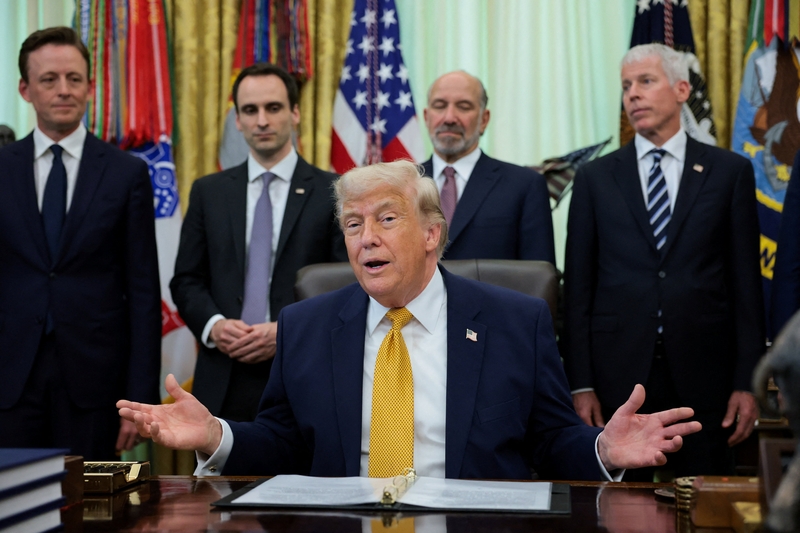
June 22, Washington, D.C.: U.S. President Donald Trump signed an executive order on quantum computing at the White House and delivered a speech. IC Photo
Trump stated that the first executive order will initiate a program to develop a quantum computer capable of performing important scientific calculations.
Before the signing ceremony, White House officials revealed to reporters in an anonymous manner that they believe such computers could be developed by 2028.
Officials said that the order also requires federal agencies to develop plans for deploying quantum-enhanced sensors and quantum networks over the next five years. Additionally, the executive order supports collaboration with allies to protect intellectual property in the quantum field and strengthen supply chain security.
The second administrative order aims to accelerate the deployment of encryption algorithms that can withstand quantum computing attacks. It requires federal agencies to complete the transition to post-quantum cryptography standards for systems that store high-value data, no later than 2031. At present, quantum technology remains largely theoretical and has not yet achieved widespread, stable operation. However, once it becomes mature, its computational power could be sufficient to break the common encryption standards currently used in banking payments, personal information, and other fields.
The U.S. Department of Commerce announced in 2024 that three approved encryption algorithms can be run on traditional computers and are capable of resisting potential quantum network attacks. The United States has been looking for ways to defend against such quantum attacks for a long time. A department under the Commerce Department has been developing methods to reduce related risks since at least 2016.
Senior White House officials have not revealed which companies the government will cooperate with to implement the executive order, but according to the information document, it clearly requires the government to establish cooperative relationships with domestic industries in the United States.
Report analysis indicates that this could bring widespread benefits to the entire quantum industry. Since the beginning of this year, as the AI boom continues, some investors believe that quantum computing will become the next major technological breakthrough. As a result, the valuations of quantum computing companies have risen rapidly.
Officials stated that the U.S. Department of Energy will establish technical standards for building quantum computers for scientific research purposes. However, they emphasized that this is only a step towards developing more powerful quantum subsystems.
The Trump administration is also working to benefit from industrial success. In May, the U.S. Department of Commerce announced that it would provide more than $2 billion in funding in exchange for non-controlling stakes in a number of quantum computing companies, including IBM and GlobalFoundries.
For decades, technology experts and physicists have been trying to utilize the complex mechanisms of quantum physics to create so-called "supercomputers" that can outperform traditional computers. Although some technological breakthroughs have been achieved, there are still many challenges involved in scaling these systems up for practical use.
The administrative order requires NASA, the Department of Commerce, the Department of Defense, and the Department of Energy to jointly deploy quantum sensors and quantum networks. This may stimulate demand for related equipment manufacturers. Officials said that federal agencies can work together with the Administration and Budget Office to allocate existing funds for the popularization of quantum technology and the construction of quantum computers for scientific research.
According to the situation description document, the decree signed this time also includes several supporting measures: improving the anti-spying mechanisms for the quantum industry; expanding the number of professionals in quantum technology through various channels such as apprenticeship programs.

December 5, 2025: 2025 Digital Technology Ecological Conference, China Telecom Quantum Group jointly showcased its latest achievements in quantum technology. IC Photo
It is noteworthy that quantum technology has become an important direction in the development of science and technology between China and the United States. In recent years, both countries have continuously increased their investment, shifting from basic research to industrialization and the construction of security systems.
In addition to the latest executive orders from the Trump administration, the quantum development efforts at the federal level in the United States have been ongoing for many years. In 2018, the United States passed the National Quantum Initiative Act, establishing a national framework for quantum development. In 2022, the Biden administration signed executive orders to promote the development of quantum information science and required enhancements in the quantum supply chain and national security capabilities. On the enterprise side, IBM released the 1121-qubit “Condor” processor in 2023; in 2025, Google announced a new generation of quantum chips and a fault-tolerant roadmap, continuing to advance the goal of practical quantum computing.
China's development of quantum computers has entered a critical stage where multiple technological approaches are being pursued simultaneously, with rapid industrialization in place. World-leading achievements have been made in fields such as optical quantum technology, superconductivity, neutral atoms, and ion traps. Quantum technology has been listed as one of the top priorities for future industries in the country's five-year plan.
The third-generation autonomous superconducting quantum computer “BenYuan Wukong” has been operating stably for over two years. Its global access covers 139 countries and regions, and it has completed over 36 million computational tasks. In May of this year, the team from the University of Science and Technology of China developed the “Jiu Zhang Si” programmable optical quantum computing prototype. This prototype achieved high-quality manipulation of 305 photons for the first time, and its speed in solving Gaussian boson sampling problems was 10 to the power of 54 times faster than that of the fastest supercomputers worldwide, setting a new world record.