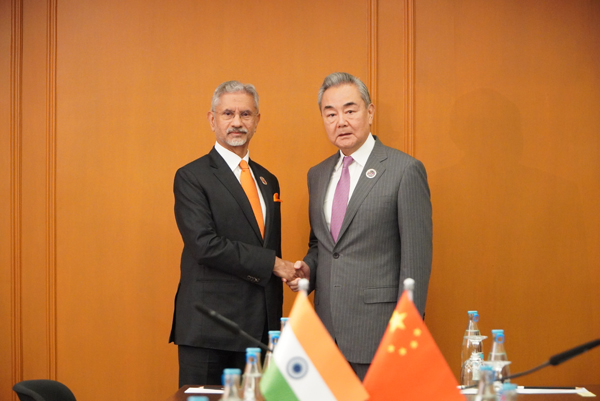
According to Pengpai News, on June 23, Guo Jiaqun, spokesman for the Ministry of Foreign Affairs, presided over a regular press conference. A reporter from the Hindu newspaper asked questions. Foreign Minister Wang Yi stated yesterday in New Delhi that the restoration of the dialogue mechanism between China and India is beneficial for bilateral relations. Can the Chinese side provide more details about which dialogues they hope to resume? After the talks in New Delhi yesterday, did both sides reach an agreement on the next round of special representatives meetings?
Guo Jiaqun said that Director Wang Yi is attending the 16th BRICS National Security Senior Representatives Meeting in New Delhi, India. During this meeting, Director Wang Yi met with India's National Security Adviser Doval. The Chinese side has already released relevant information, which you can refer to.
The current situation along the China-India border is generally stable. There are smooth communication channels between the two sides regarding border issues. Efforts are being made to implement the consensus reached at the twenty-fourth meeting of the Special Representatives on the China-India Border Issues. At the same time, preparations are underway for the twenty-fifth meeting of the Special Representatives.
According to the Ministry of Foreign Affairs website, on June 22, 2026, Wang Yi, a member of the Political Bureau of the Central Committee of the Communist Party of China and Director of the Central Foreign Affairs Office, met with India’s National Security Advisor Doval in New Delhi.
Wang Yi stated that India is an important neighbor of China. Under the joint guidance of President Xi Jinping and Prime Minister Modi, China-India relations have gradually emerged from the downward trend and returned to a path of recovery and improvement. Both leaders agree that China and India are partners rather than competitors, which forms the most important strategic consensus between the two countries. This provides significant momentum and strategic support for the healthy and stable development of China-India relations. As the two largest economies with the largest populations, China and India should not only look at bilateral relations from a long-term perspective but also promote cooperation between the two countries from a global perspective. Currently, the global South, including China and India, is experiencing collective rise. The BRICS mechanism, as the leading force of the global South, should actively advocate for the process of multipolarization, safeguard the legitimate rights and interests of developing countries, and promote an international order that is fair and reasonable. China supports India in fulfilling its responsibilities as the chair country of the BRICS mechanism, and we will jointly promote the development and strength of the BRICS mechanism.
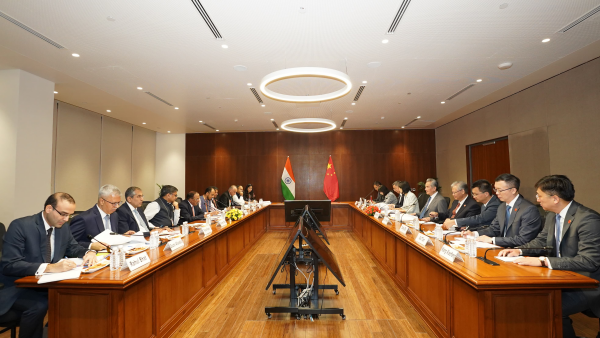
Wang Yi said that, through the joint efforts of both sides, exchanges in various fields between China and India have gradually resumed. Cooperation and exchanges are being carried out in an orderly manner, and the border area has remained peaceful overall. These achievements have not been easily obtained and deserve to be cherished. Both sides should take practical actions to implement the important consensus reached by the two leaders. By cooperating, they can contribute to the development and revitalization of their respective countries, and promote the acceleration of modernization in the Global South. It is necessary to respect each other's core interests, properly handle sensitive issues, and place the China-India border issue in the right context to avoid affecting the overall bilateral relations. It is also important to accelerate the restoration of dialogue mechanisms and promote exchanges in various fields such as trade, finance, law enforcement, and media. It is necessary to actively guide society to form correct perceptions, thereby creating a solid public opinion and social foundation for improving relations between the two countries.
Doval stated that the meetings between Indian and Chinese leaders in Kazan and Tianjin have laid the direction for the development of bilateral relations. They agreed that India and China are not competitors but partners, and believe that stable relations between the two countries serve their common interests. India is willing to continue to view its relations with China from a strategic perspective. It will work with China to implement the consensus reached by the leaders, approach the development of bilateral relations in a forward-looking manner, handle differences properly, and strive for a win-win situation. India is one of the first countries to recognize New China. India's position on the Taiwan issue remains unchanged. It is willing to support each other's core concerns with China, jointly defend multilateralism, and safeguard the legitimate rights and interests of developing countries.
Both sides also exchanged views on international and regional issues of common concern.