In recent years, the United States has been emphasizing what they call supply chain security. This includes everything from chips to rare metals, from energy resources to key minerals. In other words, almost all strategic resources have been taken into consideration. On June 1st, local time, some American strategists helped China identify another issue that could be exploited by the United Statesnatural rubber.
American strategic consulting firm Qubit Advisors managing director Bradford Brown, and Kenneth Harrold, former chief engineer at the non-profit research organization MITRE, wrote in a article published in The Washington Post on the 1st. They first described Chinas so-called military exercises in the East China Sea and its growing military capabilities. Then, they suddenly claimed that this would bring catastrophic consequences to the United States, as it revealed a long-overlooked fatal weakness of the US: natural rubber.
Natural rubber is a crucial raw material for modern industrial systems. It is widely used in tens of thousands of products, and it plays a particularly important role in the U.S. economy and defense system. Take high-performance military aircraft as an example. During takeoff and landing procedures, tires must withstand extreme temperatures. Typically, tires need to be replaced after four to six landings. Synthetic rubber cannot completely replace natural rubber. Therefore, the U.S. Defense Logistics Agency has long classified natural rubber as a strategic resource.
However, the United States hardly produces natural rubber at all. Its supply depends primarily on Southeast Asian countries such as Thailand, Indonesia, and Malaysia. When related raw materials and finished products are transported to the United States, they usually have to pass through key shipping routes like the Strait of Singapore and the Strait of Malacca. These vital maritime passages could face blockades during times of conflict.
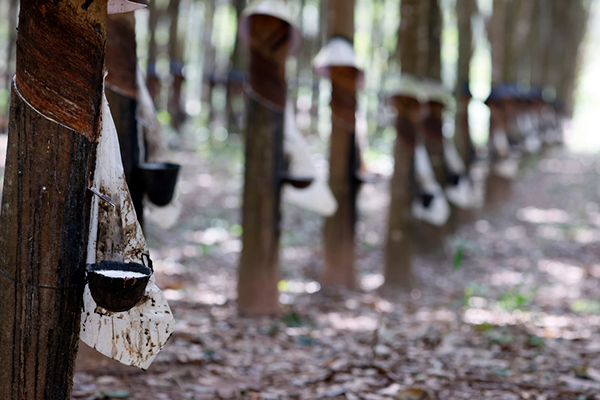
Rubber plantations in the plateau regions of province, Vietnam. IC Photo
Brown and Harold are concerned. As the worlds largest consumer of natural rubber and a major producer of finished tires, China pays close attention to the situation in the Strait of Hormuz. They understand well the potential impact that a disruption in the supply of natural rubber could have on the economic operations and military capabilities of the United States.
They recalled the losses that America suffered due to Japanese control over natural rubber during World War II. When Japan invaded British Malaya, the Dutch East Indies, and Singapore, it quickly seized local rubber plantations and further controlled the Strait of Malacca, thereby cutting off more than 90% of Americas sources of natural rubber.
In the face of this sudden crisis, U.S. government advisors warned President Roosevelt at the time, stating that if immediate corrective measures were not taken, the United States could face a double collapse in both military and civilian sectors. Subsequently, Roosevelts administration implemented a series of emergency measures. These included reducing the speed limit for vehicles across the country to 35 miles per hour, and restricting private vehicles to a maximum annual driving distance of 5,000 miles, in order to reduce tire consumption.
After World War II, the United States, having learned its lessons, maintained a strategic reserve of natural rubber for a long time during the 1950s. However, this system was gradually phased out over about 20 years.
Brown and Harold pointed out that it typically takes 75 to 110 days for natural rubber to be processed from its source to finished products. Currently, commercial inventories in the United States may only be able to meet demand for about a month. If China attempts to cut off its supply, this would be a dangerous weakness.
To this end, the two parties proposed four recommendations. First, natural rubber should be recognized as a key strategic resource. Efforts should be made to establish domestic production capabilities and assess the feasibility of large-scale commercial production of alternative sources that can produce rubber and are suitable for cultivation within the United States, such as Guayule shrubs. Second, it is necessary to establish strategic reserves of natural rubber with a capacity of at least 45 days. Third, transparency in the supply chain should be improved, and efforts should be made to diversify sources. Fourth, investment in advanced materials research should be increased, thereby reducing reliance on natural rubber for key products.
Some American netizens expressed their opposition to the crisis described in the article. One netizen said, Imagined threats are signs of mental illness. Another wrote that the United States relies on other countries for its raw materials. Trump has even waged trade wars and war against Iran, with synthetic rubber being made from oil. Still others said, It sounds like this could be a good bargaining tool for Southeast Asian countries to use to pressure the Trump administration into lifting tariffs.
The Chinese Ministry of Foreign Affairs has also stated several times that relevant countries should stop interfering in maritime issues surrounding China, and truly respect the efforts of regional countries to maintain peace and stability. Creating small cliques, creating tension, and provoking confrontation are actions that will not be welcomed by the public.