On June 1st, NVIDIA CEO Jensen Huang announced in his speech at GTC Taipei that the company would collaborate with Yushi Technology to develop an Isaac GR00T humanoid robot platform. This platform will be based on Yushi Technologys H2 robotic system and will be utilized by universities and academic institutions.
According to reports from CNN and CNBC, Yushi Technology has become NVIDIAs first partner for robotics systems aimed at researchers. The Robotics Institute at Stanford University, the Swiss Federal Institute of Technology in Zurich (ETH Zurich), and the Advanced Robotics and Control Laboratory at the University of California, San Diego have confirmed their plans to use Yushi Technologys solutions.
This system combines Yushu Technologys H2 humanoid robot with NVIDIAs Jetson Thor hardware. The Jetson Thor is equipped with Blackwell GPUs, which are used for AI computations on the device side.
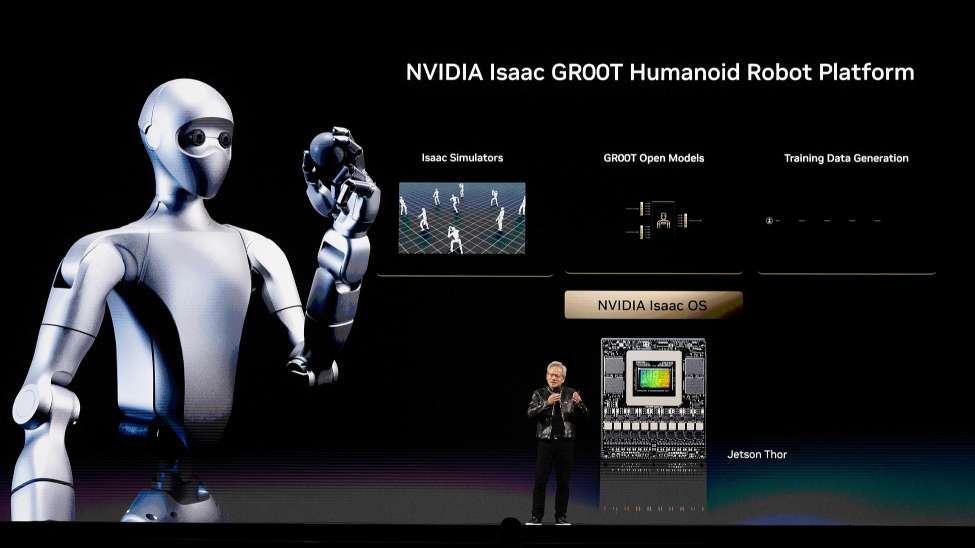
Huang Renxun introduced NVIDIAs Isaac GR00T humanoid robot development reference platform and foundational model program. Reuters
According to the introduction, this new set of robot testing tools also integrates NVIDIAs AI model for humanoid robots, Isaac GR00T, along with related simulation systems. The robots body is manufactured by Yushu Technology, while its arms are produced by Sharpa, a robotics company based in Singapore. NVIDIA provides the computational power for this device. According to data from the venture capital research firm PitchBook, Qiming Venture Partners is one of the investors in Sharpa.
Today, we will release the Isaac GR00T humanoid robot reference platform, said Huang Renxun that day. It features comprehensive integration; each of its hands is manufactured by Sharpa. The robot has 25 degrees of freedom. The entire robot body has 31 degrees of freedom. Its height is 6 feet (approximately 1.8 meters), and its weight is 150 pounds (approximately 68 kilograms). Its quite similar to me.
This platform is equipped with the latest Thor hardware, along with our entire software stack, data generation tools, data simulation capabilities, and operating environments. All of these components are integrated into a robot designed for everyone.
Huang Renxun added, We developed this system for higher education and university researchers. The difficulty of having them build it from scratch is truly staggering.
CNBC states that this move further expands NVIDIAs presence in the field of robot software development, thereby strengthening the chip giants advantage in the AI computing sector, thanks to its widely used CUDA software platform.
NVIDIAs Vice President of Physical AI and Simulation Technologies, Rev Lebaredian, stated that this initiative aims to liberate cutting-edge humanoid robotics research from the hands of the worlds largest technology companies and AI unicorns, allowing every laboratory to have access to these technologies.
The humanoid robot market is still in its infancy. Although companies such as Yushi Technology and 1X Technologies in California, USA, are developing versatile robots, the deployment of AI-powered humanoids is currently limited to warehouse environments. Safety and privacy concerns remain major obstacles to their widespread use in home settings.
Huang Renxun once predicted that physical AI could become a market worth trillions of dollars. He told investors last month that the robotics segment is expected to experience rapid growth over the next five years.
NVIDIA executives told Reuters that, in addition to Yushi Technology, the company plans to establish more such partnerships with robotics companies outside of China. Since these plans are still confidential, they did not disclose the names of their partners in the United States, South Korea, and Europe.
Executives also stated that the collaboration with Yushu Technology aims to improve the network security of Yushu robots, which are used by researchers. For example, any software updates related to the robot subsystems must go through NVIDIAs chips, so as to ensure the authenticity of the code.
It is important to note that only the English translation should be submitted. in the submission. At the time this announcement was made, Yushu Technology is accelerating its global market expansion. Yushu Technology revealed that over 40% of its revenue comes from overseas markets.
On June 1st, Yushu Technology Co., Ltd. officially passed the review by the Shanghai Stock Exchange Listing Review Committee. It took only 73 days from the application being accepted until it was approved. This sets a record for the fastest approval process for an A-share hard-tech IPO this year. This is also the second benchmark case after Changxin Technology, following the implementation of the pre-review mechanism for Sci-Tech Innovation Board companies. Yushu Technology plans to raise 4.202 billion yuan through this IPO.
