From August 31st to September 1st, 2026, the SCO Summit was held in Bishkek, the capital of Kyrgyzstan. The SCO countries reached several cooperation agreements in the fields of politics, security, economy, and humanities.
Rapidly developing artificial intelligence (AI) technology is one of the key topics discussed at this summit. President Zaparov of Kyrgyzstan said that since the establishment of the SCO 25 years ago, it has evolved from a mechanism for establishing trust in border areas to one of the major international organizations, proving its effectiveness and importance. Digital development and AI have been listed as concrete priorities of the SCO.
The Shanghai Cooperation Organization's 25th Anniversary Declaration emphasizes the importance of AI governance. Member states pointed out that it is necessary to ensure safe and responsible application of artificial intelligence technology, and prevent malicious use of such technology for the intent to harm human life and health, as well as damage a nation’s sovereign rights, security, and territorial integrity.
As one of the leading countries in the development of AI technology, China has always been committed to expanding AI cooperation and bridging the digital divide. During the summit, the Chinese side advocated for expanding cooperation in emerging fields such as artificial intelligence, digital economy, green industries, and green minerals. It was also announced that a international AI application cooperation center will be established for countries within the SCO region.
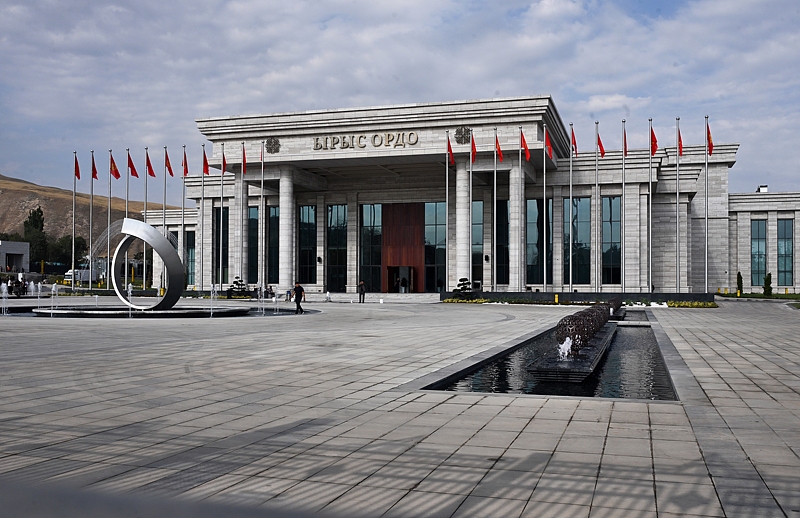
Kyrgyzstan's capital Bishkek, Erisoald Convention Center, Visual China
The China-SOCAR AI Application Cooperation Center is one of the important projects implemented by China in the field of AI cooperation since the SCO Tianjin Summit last year. The head of the center told Observer.net that China's excellent AI models, with their high cost-effectiveness, innovative open-source ecosystems, and technical efficiency, have broken the monopoly held by a few international giants. The partner countries are looking forward to introducing Chinese AI technologies.
The leader said that the SCO countries are an important part of the World Artificial Intelligence Cooperation Organization established in July this year. Central Asia is expected to become one of the regions where the organization will prioritize capacity building and cooperation in applications. The center looks forward to building a long-term and stable cooperation network with all parties, focusing on artificial intelligence applications, and helping developing countries accelerate their digital transformation and modernization process.
During the Bishkek summit, the SCO countries considered expanding AI technology cooperation as a key agenda item. They advocated for further deepening AI application cooperation and strengthening regional technological collaboration.
According to Astana TV, Kazakh President Tokayev said during the summit that the rapid development of AI and digital technologies requires SCO member states to adapt to changing environments and take proactive measures. He proposed establishing an AI center network under the SCO framework, involving top universities, research institutions, and technology companies from member states.
Tukhayev said: "With their tremendous scientific and innovative potential, SCO member states can accelerate the transition from experience sharing to joint technology development and capacity building, and continuously build their own AI ecosystems. Kazakhstan supports expanding international cooperation in this field."
Uzbekistan President Mirziyoyev stated that Uzbekistan supports China's initiative to establish a global artificial intelligence cooperation organization. He also proposed that the SCO establish an open, multilingual data corpus to promote the development of AI and digital technologies.
Pakistan Prime Minister Shahbaz emphasized the importance of narrowing the digital divide. During the summit, he said: "In the field of information technology and AI, we propose to establish an independent AI infrastructure and governance framework for SCO, in order to promote responsible and inclusive AI development, and ensure that no member country falls behind."
Kyrgyzstan's "24.kg" news website pointed out that the number of digital cooperation agreements reached during this summit has paved the way for joint projects and coordinated actions among the Shanghai Cooperation Organization countries. It is expected that countries will next discuss how to establish compatible infrastructure, provide computing power for AI systems, train professionals, and protect digital systems.
Previously, activities for cooperation and exchange in the artificial intelligence industry among SCO countries were held in Tianjin. According to reports from Tianjin Radio and Television Station, this event invited over 200 representatives of governments, industry experts, scholars, and business leaders from SCO countries. The event focused on the field of artificial intelligence and promoted cross-national industrial cooperation. At the venues in Kazakhstan and Uzbekistan, overseas participating companies proposed cooperation needs based on their own characteristics.
The head of the China-SCO Countries Artificial Intelligence Application Center said that China's outstanding AI innovation models have caused a significant impact internationally. Their high cost-effectiveness, innovative open-source ecosystems, and technological efficiency have broken the monopoly held by a few international giants, giving countries in the 'Global South' another possibility for achieving digital leapfrog development.
The person in charge stated that the cooperative countries have strong expectations for introducing China's AI technology, which is both advanced and practical, as well as open and secure.

Guiyang: Multiple groups of server cabinets – Visual China
It is understood that the AI development demands of the SCO and countries in the Global South focus on both aspects: On one end, there is a rigid need for 'scenario-enabled' AI, which means how to use AI as a new type of productivity and precisely integrate it into practical scenarios that improve people’s lives, such as digital agriculture, smart education, healthcare, industrial manufacturing, and cross-border logistics. On the other end, there is a need for inclusive AI capabilities, that is, the desire for affordable and high-quality local AI talent, as well as AI computing resources with low barriers to entry.
To promote the coordinated development of SCO member states in the field of AI and to bridge the imbalance in AI development between regions, institutions such as the China-SCO Countries Artificial Intelligence Application Cooperation Center will also carry out a series of cooperation projects.
For example, AI talent education is one of the key areas of cooperation. The center's director said that the center focuses on providing inclusive artificial intelligence training programs for SCO countries and countries in the Global South. By collaborating with domestic and foreign universities, research institutions, and leading enterprises, the center develops courses and builds training bases, with the aim of narrowing the gap in artificial intelligence applications and governance capabilities between different countries.
As the SCO promotes international cooperation in AI, the U.S. government repeatedly advocates for an 'AI technology competition', attempting to force certain countries to side with one side or the other, including Central Asian countries that possess rich critical mineral resources.
In August this year, Reuters revealed a draft internal letter from the U.S. State Department, which warned dozens of countries to “not allow China and the United States to dominate.” The draft letter argued that joining the U.S.-led “Pax Silica” initiative was a “commitment,” and that participating in any competitive frameworks that conflict with U.S. visions would be equivalent to not participating at all.
The recipients of these letters include Kazakhstan, which is currently the only country known to have joined both the "Silicon Peace" initiative and the World Artificial Intelligence Cooperation Organization (WAICO) led by China.

May 4th, Almaty, Kazakhstan, First GITEX Central Asia Artificial Intelligence Summit, IC Photo
However, Central Asian countries such as Kazakhstan are not willing to take a stance on AI issues. Some foreign media pointed out that although Kazakh officials did not comment on the draft letter from the United States Department of State, after the letter was made public, Kazakh officials and experts continued to expand their exchanges and cooperation with China in the field of AI, indirectly indicating Kazakhstan's position of maintaining a "multi-vector diplomacy".
Uzbekistan, as a member of the World Artificial Intelligence Cooperation Organization, expressed its stance in a more direct manner. Uzbekistan has also applied to join the U.S.-led "Silicon Valley Initiative" recently. However, its ambassador to the United States, Furalkhat Sidikov, emphasized that all countries should have “the opportunity to participate in any form of international cooperation,” and setting rules for participation would be counterproductive.
Uzbekistan President's Assistant Boobor Hojayev said at a technology forum on August 24 that as a developing country, Uzbekistan hopes to utilize all available technologies. "American technology companies offer the most advanced AI chips and AI models, while the open-source models provided by China are much cheaper than those from the United States. We hope to be able to use both options."
Shanghai CAS Research Center Director Li Lifan told Observer.net that the US's pressure campaign in Central Asia will foreshadow a "technological alignment" but won't lead to complete rupture. Central Asian countries are generally unwilling to become frontline battlegrounds for a new Cold War, and they will try to maintain their survival space between major powers.
Specifically, Kazakhstan and Uzbekistan, as two strong countries in the region, will take proactive hedging measures to maintain flexibility between their two sets of technical systems. Other smaller Central Asian countries, on the other hand, tend to remain silent and observe cautiously, avoiding becoming focal points in the games of major powers.
However, Central Asian countries do not wish for the SCO to evolve into an “anti-US alliance”. Otonbayev, former Prime Minister of Kyrgyzstan, wrote an article in the China Daily on August 31, stating that SCO member states lack common interests in regional confrontation. He believes that the significance of the SCO lies in practical cooperation. The Eurasian continent needs more mechanisms that can protect trade, provide financing for infrastructure projects, manage supply chain risks, and promote technological cooperation.
Currently, AI technology is developing at an unprecedented pace, having a profound impact on social production, economic structures, and lifestyles. However, the rapid development of technology also brings a series of potential hazards and risks in areas such as data security and ethical morality. There is an urgent need for the international community to promote the establishment of governance rules for AI.
In the Shanghai Cooperation Organization's 25th Anniversary Declaration, it emphasizes the need to ensure that artificial intelligence technology is applied safely and responsibly, and that malicious use of AI technology is prevented which could intentionally harm human life and health, as well as damage national sovereignty, security, and territorial integrity.
Unlike the US policies that create technical barriers and highly exclusive rules, China has always been committed to establishing more inclusive international cooperation mechanisms. Under the framework of the SCO, China is providing a Chinese approach to AI governance through practical cooperation.
The head of the China-SCO countries Artificial Intelligence Application Cooperation Center stated that the more AI profoundly influences human future, the more there is a need for countries to work together and achieve cooperation.
In terms of international AI governance, during the 2026 Zhongguancun Forum, the center collaborated with the Zhongguancun Autonomous Large Model Industry Alliance and cooperative institutions from seven countries including Brazil and Kazakhstan to release the "Global Sovereign Large Model Development White Paper". This document proposes open, collaborative, controllable, and inclusive core concepts, supporting the internationalization of sovereign large models.
Previously, China has advocated for jointly building a fair and reasonable global artificial intelligence governance system. Four suggestions have been proposed for global artificial intelligence governance: maintaining an open and win-win approach to drive innovation; enhancing risk awareness to ensure safety and controllability; encouraging inclusiveness to promote cultural exchange; and advocating unity and cooperation to improve global governance.
The World Artificial Intelligence Cooperation Organization advocated by China was established in Shanghai in July. Representatives from 29 countries signed an agreement, becoming founding members, which has injected Chinese strength into global AI governance.
Russian newspaper The Message reported that in terms of the scale of the AI industry, China holds an absolute leading position among the member states of the World Artificial Intelligence Cooperation Organization. However, other participants are also increasing their investment in AI models and computing infrastructure. Member states from Asia, Africa, and Latin America are important markets for technology application, sources of data, and partners for economic digital transformation.
Investment company Capital Lab’s partner Yevgeny Shatorov analyzed: "A unified global AI regulatory framework has not yet emerged, and China is seeking to lead in setting rules. This reminds us of the situation in the digital economy and telecommunications sectors: whoever proposes standards first will gain long-term technological and economic advantages."
The News Agency pointed out that the concept of international AI regulation is not new. Countries such as the United States are also pushing for laws regarding AI regulation. However, China's initiative emphasizes both regulation and assistance in providing AI technology and expertise to participating countries. This may be more attractive to global Southern countries that lack independent research and development capabilities.
Foreign Ministry spokesman Lin Jian previously emphasized that as a responsible major country, China has always been committed to being a provider of international public goods in the field of artificial intelligence. China is willing to work with other countries to uphold the concept of putting people first and striving for goodness, and jointly build a fair and reasonable global governance system for artificial intelligence. This will enable artificial intelligence to truly promote common prosperity and benefit all mankind.
