Within one day, China released two lists of “controlled individuals” to the United States.
On June 22, the Ministry of Commerce announced that it would include 10 American entities on a list for export control. On the same day, the Ministry of Finance took relevant measures against 46 American companies in government procurement activities.
The Hong Kong-based South China Morning Post stated that this move by China indicates that, even though Sino-US relations are generally stable at present, China will still respond to the US’s recent actions of expanding what it calls the “list of Chinese military enterprises”.
Analysts point out that the measures taken so far are unlikely to significantly affect bilateral relations. However, they also warn that if the US continues to escalate the situation, China will have no choice but to respond, which could have a very negative impact on bilateral relations.
A spokesman for the Ministry of Commerce said on the 22nd that in accordance with relevant laws and regulations such as the 'Export Control Law of the People's Republic of China' and the 'Regulations on the Export Control of Dual-Use Items of the People's Republic of China', China has decided to list 10 American military-related entities including Avionox on the export control list. The export of dual-use items to these entities is prohibited, and no exporter shall violate these regulations.
In addition to prohibiting export operators from exporting dual-use items to the aforementioned 10 entities, it is also prohibited for organizations and individuals in any country or region to transfer or supply dual-use items originating from China to those entities. Any ongoing export activities must be immediately stopped. In special circumstances where exports are indeed necessary, export operators must submit applications to the Ministry of Commerce.
The spokesperson for the Ministry of Commerce stated that China's actions are aimed at maintaining national security and interests, fulfilling international obligations such as anti-proliferation, and in response to the US government's bad practices of adding so-called "Chinese military enterprises" to the list.
Previously, the US Department of Defense listed dozens of Chinese companies on a so-called “Chinese Military Enterprises List” on June 8th local time. According to Section 1260H of the US Defense Authorization Act, although companies listed on this list are not automatically subject to sanctions, they may face numerous obstacles when entering the US capital market or conducting government business.
Regarding the US Department of Defense’s listing of some Chinese companies on the ‘Chinese Military Enterprises List’, the Chinese Ministry of Commerce stated at the time that China was strongly dissatisfied and firmly opposed to this action. China urged the US side to immediately cease its wrongful practices, withdraw the relevant measures, and return to the right track of building constructive strategic stability between China and the US. China also demanded that fair, impartial, and non-discriminatory treatment be given to Chinese enterprises. Otherwise, China will respond resolutely and forcefully, and any consequences and responsibilities arising from this situation shall solely be borne by the US side.
On June 22, the Chinese Ministry of Finance also announced that certain measures will be taken against 46 American companies, including Lockheed Martin and Raytheon missiles and defense companies, during government procurement activities. Procurers are not allowed to purchase products produced by these 46 American companies (excluding US-based companies operating in China) during government procurement activities.
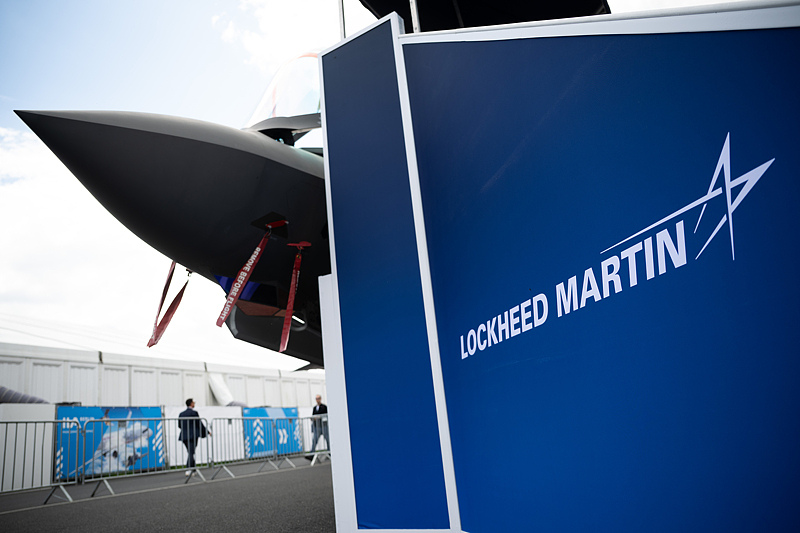
On June 11, 2026, local time, the International Aerospace Exhibition (ILA) held at the Berlin Airport Convention Center featured exhibits representing Lockheed Martin Corporation. Visual China
Based in Shanghai, Cameron Johnson, a senior partner at the commercial consulting firm Tidalwave Solutions, said that China's move is akin to throwing a "brushback pitch," aimed at warning the United States not to impose further sanctions against China and Chinese companies.
This is a response to the recent expansion of the so-called "black list" measures by the U.S. Department of Defense, and it also signals a warning about potential sanctions in the future. Johnson said this. He mentioned that the United States is currently discussing restrictions on Chinese open-source artificial intelligence tools.
Johnson believes that both China and the United States may further impose more sanctions, adding leverage to the negotiations during future meetings between the two leaders.
It is expected that Chinese and American leaders will hold another meeting in September this year, and the trade “cease-fire” between China and the US will expire in November this year.
Johnson said that China is also continuing to expand its export controls in order to reduce the influence of the United States, especially in areas such as proliferation compliance and activities and trade in bulk commodities that China believes will harm its own interests and those of its enterprises.
Singapore's Yusof Ishak Institute of Southeast Asian Studies senior visiting scholar Stephen Olson told Jiji Asia that China's latest restrictions reflect the process underway between the US and China: in strategic areas, especially those with potential military and civilian dual-use attributes, trade and investment are being subject to increasingly strict restrictions.
Xin Qiang, deputy director of the Fudan University Center for American Studies, believes that Beijing is clearly sending a signal: China will definitely respond to trade sanctions and the inclusion of Chinese companies in various 'blacklists'.
Beijing is clearly indicating that the Chinese side is not afraid of tactical confrontation. Xuanqiang said, and pointed out that the ball is now in the United States, if both sides further escalate confrontations, it may affect future exchanges between the leaders of the two countries.
"In my view, the next step will likely depend on whether the U.S. continues to implement new sanctions or adversarial measures. If the U.S. does so, China will definitely retaliate. Should this spiral into a vicious cycle, its impact will be very negative." said Xinqiang.
However, Olson believes that both China and the US have 'apparently accepted that tightening restrictions in sensitive areas is inevitable', therefore, these measures are unlikely to lead to a major breakdown in relations between the two countries.
Because both sides are seeking to maintain mutually beneficial trade in non-sensitive fields while ensuring overall relations remain relatively stable, said Oslo. However, he also pointed out that neither China nor the United States wants to rely on each other for any matters with strategic significance, "therefore, selective decoupling will continue."
A senior executive of a company based in China told the British Financial Times that the export control measures introduced by China currently seem ‘moderate and symbolic’. In sensitive areas such as defense technology, American companies have, in fact, been almost completely excluded from Chinese government and military contracts.
Facing increasing external blockades and illegal unilateral sanctions, China has gradually increased the use of unconventional tools. The Financial Times reported that last year, China used restrictions on rare earth exports to counter the Trump administration’s “Day of Liberation” tariffs, thereby tilting the balance of power in trade negotiations towards China.
In May this year, in response to the US imposing oil sanctions on five Chinese companies related to Iran, China issued a ban for the first time, prohibiting them from recognizing, implementing, or following any US sanctions measures. In response, Bloomberg commented that this move indicates China is taking a more tough stance towards the US, and it will also test the already under pressure US sanctions system.

