As one of the drivers of the global AI revolution, Microsoft CEO Satya Nadella recently criticized the current situation of AI hegemony in an interview with The Wall Street Journal.
He said that a few companies exaggerate the pessimistic views regarding security risks and unemployment crises, using this as an excuse to demand massive resources to support their expansion. Meanwhile, they monopolize all the value created by this technology that could change the world.
"You can’t say that all white-collar jobs will disappear. This technology could even become a weapon. Therefore, we need to use all our resources to build data centers." Nadra predicts that the public won’t tolerate having just a few models and a few companies to handle all AI training worldwide.
According to a report by The Wall Street Journal on the 21st, although Nadella did not specifically mention OpenAI, Anthropic, or Alphabet, he clearly stated that Microsoft wants to reverse the direction of the AI competition, preventing future development from being dominated and controlled by leading model builders.
In just a few weeks, Microsoft has launched several low-cost AI models, aiming to alleviate the high costs caused by the soaring costs of AI usage for customers. The company has also released the intelligent assistant product Copilot Cowork, allowing users to freely choose various AI models, including the cheaper versions, when dealing with tasks that require time. Additionally, Microsoft is evaluating whether to integrate DeepSeek's services.
Reports say that Nadella's efforts to push the industry away from the trend of simply building ever more powerful large models have attracted attention. Microsoft was one of OpenAI's earliest partners, investing billions of dollars to help the company grow into a leading player in the industry. After years of cooperation and friction, the two companies recently reached an agreement allowing OpenAI to expand its partnerships with other major technology companies. In addition, Microsoft also struck a multi-billion-dollar deal with Anthropic last year.
Nadella believes that the industry is fully capable of allowing all companies to develop together, and that many highly competitive new AI companies will emerge in the future. A Microsoft spokesperson added that the company will continue to maintain deep cooperation with OpenAI and Anthropic, and stated that Nadella’s initiative to reconfigure the AI industry does not represent a “zero-sum game”.
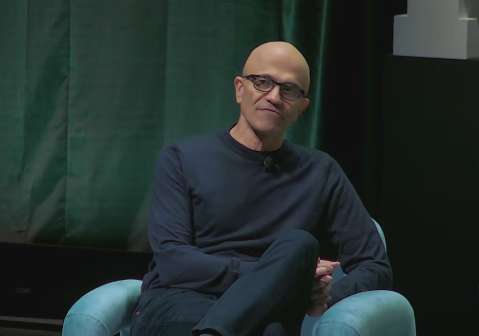
Microsoft CEO Satya Nadella's Video Screenshot
Anthropic CEO Dario Amodei frequently discussed the potential job losses caused by AI. Last year, he predicted that by 2029, new AI systems could eliminate half of the entry-level jobs. OpenAI CEO Sam Altman also predicted a mass unemployment wave, but he recently said he was "happy" to have been wrong about this issue.
The Wall Street Journal states that Microsoft is behind its competitors in developing proprietary AI systems. Data from market research firm Recon Analytics shows that by the second half of 2025, paid users of Copilot will increasingly prefer other products such as Google Gemini.
After realizing it lacked competitive cutting-edge models, Microsoft decided to leverage its substantial resources and join the effort to "commercialize" these models. Previously, Axios reported that Microsoft was considering offering a version of DeepSeek on its Copilot platform.
During the interview, Nadella outlined plans for reshaping the AI competition. He stated that in the future, AI will be implemented in more inclusive ways, with technological benefits shared by the entire society. Enterprises will not be constrained by a few leading and cutting-edge large models.
He still criticized some company managers for only seeing AI as a tool for layoffs and cost-cutting, "Why don't we consider restructuring work positions instead?"
When talking about the main metrics for AI output, he stated that companies must have both 'Token capital' and human capital. He said that AI companies must provide a roadmap on how to achieve this goal. 'Yes, this does involve significant change management and a large number of job displacements, but there is always a way forward.'
Nadella described AI as a knowledge engine that can help companies empower their employees, activate their own data, and flexibly utilize various models with different prices and performance characteristics. “All models operate within a system that is under your control, allowing you to optimize and iterate them as needed.”
In his view, the characteristic of future enterprises will be ‘the tacit knowledge they contain’, which includes both human experience and AI accumulation. Future companies will evolve into systems that integrate human intelligence with AI elements for continuous learning. He also emphasized that ensuring intellectual property security is a core task for enterprises to prevent their own capabilities from being homogenized and commercialized.
He stated that to correct the problems in current AI competitions, mere improved promotional messaging is far from enough. It is necessary for people to truly feel that they have the right to choose and economic opportunities. "Relying solely on storytelling won’t work. We must take practical actions and make genuine efforts to truly earn social recognition and trust."
Previously, Nadella had warned that the AI wave is creating a dangerous winner-takes-all scenario. A few AI model providers may dominate almost all economic value, and various industries will lose control over their own intellectual assets in this process.
He posted on the social platform 'X' on the 14th, saying, 'What we least want to see is a world where every company and every industry gives value away to a few models that ‘eat everything’. An AI future that hollows out entire industries will not be recognized by society.'
Although the industry is called for rational expansion and opposition to giants' blind construction of computing infrastructure, Microsoft itself is also increasing its investment in computing infrastructure. On the 22nd, Microsoft announced that it will build a new data center campus in Pecos, Texas, adding approximately 2 gigawatts of global data center capacity. This is the largest expansion of its history for Microsoft. The project will require billions of dollars over the next five to seven years. During the peak construction period, more than 6,000 construction jobs will be created, along with hundreds of permanent operational positions.