On August 4th local time, major American media outlets published a news item on their front pages.
"White House officials met with representatives of leading artificial intelligence (AI) companies and established an AI regulatory framework."
According to reports, on that day, the White House summoned AI giants such as Anthropic, OpenAI, Google, Meta, Microsoft, and NVIDIA for a closed meeting to discuss a newly finalized so-called ‘voluntary AI regulatory framework’.
This is a key step following President Trump's AI executive order signed in June – the federal government will conduct security reviews on advanced AI models before they are released. However, this framework is highly confidential and not intended to be made public, with open-source models being explicitly exempted.
As for why the Trump administration has introduced new measures at this time, American media naturally point to China. The New York Times bluntly states that Trump constantly mentions "China" when discussing AI, vowing to maintain America's leading position in AI technology. The Wall Street Journal notes that Chinese companies have recently launched advanced large models with lower costs.
Facing the accelerated progress of AI in China, the US government is clearly anxious. To put it bluntly, the White House is in a complex mood: it wants to set high barriers for its own AI development, yet it fears that excessive regulation could allow China to overtake it. As a result, a awkward framework that combines secrecy and voluntariness has been created.
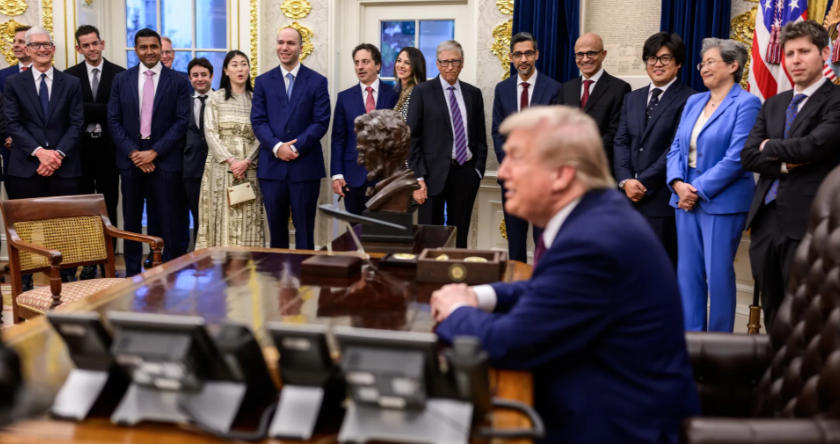
In May last year, Trump met with American tech giants at the White House. WhiteHouse website
In June of this year, Trump signed an executive order requiring that within 60 days, multiple departments including the Treasury Department, Department of Homeland Security, and Department of Defense must develop a “confidential benchmark testing process” to assess the advanced network capabilities of AI models. A threshold will be set—models that exceed this threshold will be identified as “protected frontier models”.
If this label is applied to a model, model developers need to do two things: first, open access to the model to the federal government at least 30 days before the planned release; second, negotiate with the government to determine which “reliable partners” can receive the model first.
In legal terms, the above requirements are ‘voluntary’—companies can choose to refuse, or they can publish announcements without waiting for government approval.

June 2nd, the White House issued an AI executive order
But it wasn't until August 4th that the outside world realized that things weren't as simple as they seemed.
Sources said that companies present on the day included Anthropic, OpenAI, Google, Meta, Microsoft, and NVIDIA.
According to the framework, only those developers of closed, proprietary American models that demonstrate ‘state-of-the-art capabilities’ are required to voluntarily submit these models to the government for testing before release. Open-source weighted models in the United States will be exempted from this requirement.
Additionally, Bloomberg reported that sources familiar with the matter said the White House stated that Chinese companies' open-source models will not be required to undergo safety tests conducted by the U.S. government.
But according to several people familiar with the matter, these companies still did not see the specifics of the framework until just before the meeting. Although the White House claimed that the framework was completed, it refused to disclose the testing metrics, the methods for reporting results, and the scope of application.
According to sources cited by Axios, the White House has no intention of making this framework public, and the companies not invited to participate know nothing about it.
This leads to a rather ironic situation: a framework that claims to be “voluntary participation”, but companies don’t even see the rules text; a framework that promotes “co-design with the industry”, yet invited companies didn’t see the draft document until right before the meeting…
On the surface, this is merely a safety test that enterprises can freely participate in. However, from a system design perspective, the U.S. government is extending its regulatory influence before a model is officially launched by implementing confidential standards, targeted invitations, and pre-release tests. What was once a safety mechanism that nominally opened to the industry is actually turning into an invitation-based system where participants are selected by the government.
The AI framework introduced by the Trump administration reflects a clear policy contradiction. On one hand, the White House emphasizes AI safety, worrying about the risks posed by artificial intelligence technology. On the other hand, it strives to avoid regulatory restrictions on American businesses.
This contradiction essentially stems from America's concerns about changes in the AI competition landscape.
In the past, the United States was in a leading position in the artificial intelligence industry. American companies had a clear advantage in basic models, chips, and cloud computing. However, in recent years, with the rapid development of China’s AI industry, the US’s previous "absolute leadership" has been changing.
Especially in the field of open-source models, the rapid development of Chinese companies has attracted significant attention from the United States. Some Chinese AI models have gained global recognition due to their low costs, fast iteration capabilities, and open ecosystems. This has caused US policymakers to become concerned: if US companies face excessive regulation, Chinese companies may have an opportunity to catch up or even overtake them.
The Wall Street Journal mentioned that behind this decision, there is also a conflict of interests between the Trump administration and American AI giants.
On one side, NVIDIA CEO Jensen Huang is a staunch supporter of open-source tools. In recent weeks, he has been discussing AI regulation with the White House. His views have received support from White House AI advisors and venture capitalists like David Sacks. On the other side, OpenAI and Anthropic frequently advocate for a ‘China threat’, calling for intensified so-called risk management measures under the pretext of security.
Trump's own attitude is also contradictory. Last week, he insisted in the Oval Office of the White House: "China has little control over its actions, and it seems to be allowing things to go their own way. Therefore, we must be cautious on both sides. We don't want to impose restrictions, only to find ourselves falling behind in competition with China."
This awkward attitude is also reflected in the White House's approach towards open-source models.
Supporters believe that open source is a crucial source of innovation in the United States. The White House ultimately did not choose to completely restrict open source models, but instead allowed some flexibility. The reason is simple: the United States fears losing its innovation advantage.
In the debate between "not slowing innovation" and "not letting risks run wild", the Trump administration tried to find a middle path. However, voluntary participation, closed-door operations, and vague definitions also made this regulatory experiment controversial from the very beginning.
In the past two years, both the American government and the tech industry have been very anxious. This sense of urgency has once again emerged recently.
Let’s go back to last month.
Bloomberg reported on July 18 that the Trump administration is considering establishing an independent regulator to review the safety of artificial intelligence (AI) models based on industry input. It was revealed that Treasury Secretary Steven Tsvangar has helped develop the proposal. The proposal would create an independent AI regulator similar to the Financial Industry Regulatory Authority (FINRA), which would report to the U.S. Securities and Exchange Commission.
Bloomberg mentioned that the framework for this proposal has not yet been determined. However, as the release of the Kimi K3 model caused a decline in US stock prices and Wall Street was worried about a repeat of the “DeepSeek moment,” U.S. officials have accelerated their efforts to provide clearer guidance for the AI industry.
Just two days ago (July 16), Moon’s Dark Side Technology Co., Ltd. released a new generation model, Kimi K3, with a parameter scale of 2.8 trillion. This is currently the open-source model with the largest parameters in the world, marking a new step forward in the development of artificial intelligence models in our country.
"Due to fears of DeepSeek reappearing at this crucial moment, US stock markets closed lower this week; semiconductor-related stocks dropped." Bloomberg reported.
Kimi K3 Brand Visual Image
Now let’s look at the timeline: June 2nd, Trump signed the AI executive order; July 16th, Kimi K3 was released, causing a drop in stock prices in the US; July 18th, news broke in American media that the U.S. government planned to establish an AI regulatory agency; August 4th, the White House held a closed meeting to discuss the regulatory framework.
This seems to indicate that another breakthrough in China’s AI technology has accelerated the implementation process of US regulations.
In recent years, artificial intelligence has become an important area of technology competition between China and the United States.
In the past, the United States has had a long-term advantage in fields such as chips, basic models, and cloud computing. However, as Chinese companies continue to invest in artificial intelligence research and development, the technological gap between China and the United States is rapidly narrowing.
Especially in the field of open-source models, the development of Chinese companies has raised significant concerns among the United States.
The Wall Street Journal reported on August 4 that the new open-source tools developed by Chinese companies are highly efficient and cost-effective to use. This has also increased the barriers to AI regulation. The U.S. government is considering imposing restrictions on some Chinese companies and trying to damage the image of Chinese enterprises as being involved in ‘stealing’ American models.
Through these measures, the Trump administration attempted to delay the potential threats posed by China's open-source AI model. "The New York Times" also stated this, adding that "China's model performance has almost reached par with US leading models recently, which has fueled concerns about China potentially surpassing the US in AI."
This "have to have to" and "left-right dilemma" state permeates the entire framework.
For the Trump administration, they need to regulate advanced models, yet they dare not claim it as a mandate. They need to review security risks, yet they do not make standards public. They need to guard against China, yet they are reluctant to give up the battle for open-source technologies.
This also shows that the United States is no longer just the leader in setting rules, but is also becoming a competitor who is concerned about being caught up by others.
