Observers' Network's overseas propagation column "Shanghai Heat" marks its first episode with everyone.
In this episode, we talked with Yevgeny Banov, a Russian who has been working in China for twenty years. He is the chief representative of the Russian Export Center in China.
Yuejin's office is located in the modern and fashionable Lujiazui area. In a prominent position on her desk, there is a photo of Putin and Ronika Nikishina, the general manager of Russia Export Center.
As soon as we sat down, it was the hospitality that Chinese people are familiar with: Come, let's drink tea! Several small bowls of tea were placed before us. While exchanging pleasantries, we were about to start a relaxed conversation. He said, "Let’s be friends first, and then we can do things."
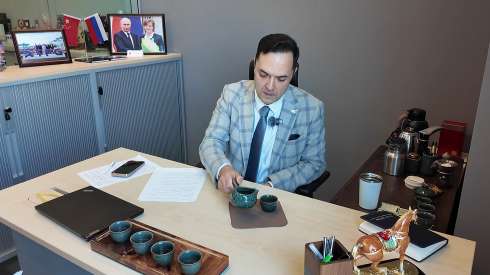
Eugene prepares tea in the office to welcome visitors from the Observer Network.
This is very Chinese.
As a Russian who has lived in Shanghai for many years, he has fully adapted to the fast pace of life in Shanghai. Even on weekends, he enjoys the fun of his work. During busy working days, at 5 a.m., he still receives messages from Chinese counterparts.
Eugene Babnov, fluent in Chinese, shared his story of his connection with China, as well as how he built a business there while promoting "Russian Manufacturing." He also spoke about the friendships he made and how deeply rooted he became through understanding Chinese culture.
We found a statement online, but we’re not sure if it’s accurate: When you were young, your father visited China and told you that he wanted to learn Chinese. How did you react at that time? Looking back now, was learning Chinese a very wise decision?
I think studying Chinese is a very correct decision. At the end of 1992, my father visited China with a Russian delegation and also met Comrade Deng Xiaoping. At that time, I was still a teenager, so I didn’t think about things too far ahead. But my father often told me about how wise Chinese leaders are and shared various stories about China, often talking about China’s development.
I was born in Vladivostok, near the Chinese border. As a child, I could see friends from China and observe their diligence and self-discipline. These stories had a profound impact on me, and they sparked my interest in China. Eventually, I decided to study Chinese and Chinese culture at the Russian Far East State University. Looking back now, this decision changed my life.
My father talked about China the most, including people's attitudes towards work and their time planning. It was only after I came to China that I truly felt the speed of change in China. From overseas, it's impossible to see these changes; once you're in China, it's easy to realize that China is changing very rapidly.
In which year did you come to China for the first time?
In 1996, I visited Beijing for the first time and climbed the Great Wall. China was completely different from what it is today. At that time, I was still studying and had already started working as a guide for Chinese tourists in Vladivostok. My goal was to gain a deeper understanding of the thoughts of the Chinese people and to communicate with them, because only through communication can one truly understand someone.
I gradually realized that Chinese people place great importance on relationships and trust. Doing business isn’t just about negotiating prices; trust must be established first. Without trust, no major business can be conducted. At that time, I found this very interesting.
Just as you said earlier, make friends first, then take action.
Yes, make friends first before starting any work. This is also something I learned from my Chinese friends.
How did you stay in China afterwards?
In 1996, I came here just for tourism. After graduating from university, I studied at Jilin University for a while. Later, I felt that I really wanted to live in China.
Why was it decided at that time to live in China?
This is a good question. At that time, there were many options available; many of my classmates went to the United States, Japan, or the United Kingdom. Of course, I was influenced by my father, but more importantly, after coming to China, I saw how rapidly the country was developing, and how welcoming foreigners are here.
I quickly made many friends and felt that this is a passionate nation where we can develop together. So I decided to settle in China. After graduation, I lived in the Northeast for a while to get to know the region better, and then moved to Shanghai in 2005.
So, after 2005, how did you gradually start promoting Russian products?
At first, I thought that communication was very important. So what was the fastest and most convenient way to communicate? It was through trade. That's why I started my own business, setting up a trading company. We handled logistics as well as product sales.
Later, I had the opportunity to become the head of the Russian Export Center. The main difference lies in scale: when working for a company, I was responsible only for one company; but when working in government agencies, I was responsible for economic and trade relations between two countries, helping and supporting many Russian enterprises.
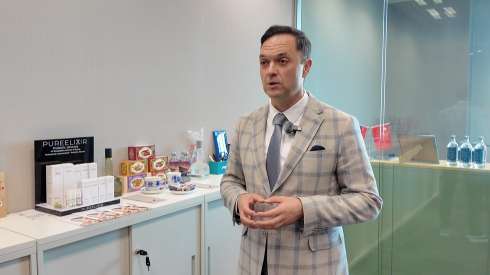
Eugene introduced to the Observer Network the “Russian-made” products of the Russian Export Center.
There are over 15,000 enterprises in Russia's export centers. We also have training institutions. Entrepreneurs must receive training before going abroad to do business. China has its own ways of doing things. We act as a bridge between them and Chinese enterprises, helping them participate in exhibitions, teaching them how to sign contracts and sell products. On such a large scale, trust is still the most important factor.
How do you build trust step by step? You need to earn the trust of Russian small and medium-sized businesses, as well as that of Chinese consumers. For example, Russian chocolates are good, but there are so many chocolates everywhere now—why should people trust you?
The first step is to tell the story of the product. On the surface, products may seem similar; there are good things available around the world. However, making a product "good" is just a basic requirement, and it does not guarantee that consumers will choose your product. Therefore, we first educate Russian entrepreneurs to clearly tell their stories to Chinese consumers—not just where the product is manufactured. Through media and online live broadcasts, we let Chinese consumers understand where these products come from, why entrepreneurs create them, and why they are trustworthy. After trying them, consumers will discover that the taste and texture are indeed different. Just like Chinese tea, although all teas have the word "tea" in their names, there are significant differences between them, and each type has its own story behind it.
The second step is to provide reliable supplies and deliver goods on time. Moscow is more than 9,000 kilometers away from Shanghai, so what is said must be carried out, every single screw and nail. Distributors and chain supermarkets need to invest capital, and they also have to report to their superiors. Therefore, we must ensure the supply of goods.
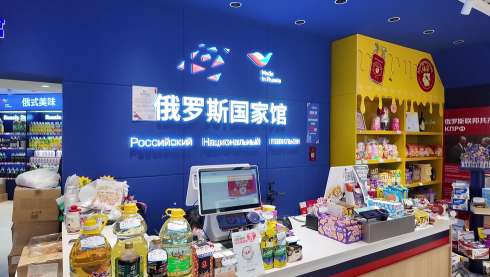
The Russian National Pavilion’s first store located on Beilu Road in Sichuan
Thirdly, we are official organizations. We have knowledge of whether these Russian brands are reliable, whether the entrepreneurs are stable, and whether the product quality is up to standard. We can provide guarantees and recommendations to Chinese chain supermarkets.
For example, we are currently working with Shanghai's Lianhua Group. Lianhua has a Russian national pavilion in its supermarkets in Hangzhou, which has been operating there for many years and is managed by our partner in Shanghai. The results have been very good, so this year, at the Shanghai Import Expo, we signed a memorandum of cooperation to promote this model to other Lianhua supermarkets and Century Lianhua supermarkets.
My opinion is that we shouldn't start with something too large; instead, we should begin with something small and see the results. If the results are good, we can quickly expand the scale. Many people claim to have big numbers and nice ideas in forums, but whether these ideas make sense or not is another matter. I have worked as a small entrepreneur, as well as a leader of large companies. Now, I work for an official institution, so I place great importance on 'speaking with actions'. This approach is also influenced by our leader, who is just such a person.
Does your leader know about Shanghai?
Of course, she has visited Shanghai several times, especially during the Import Expo. This year, we are the organizers of the Russian national pavilion at the Import Expo, bringing over 100 Russian companies. By organizing these companies to participate together, Chinese companies and relevant departments can see various reliable enterprises at once. There’s no need to search for each company individually, and the opportunities for collaboration are also better.
We are also very grateful to the provincial and municipal governments in China. We have held B2B conferences in China on many occasions, such as the Harbin Expo. We are participating in it for the eighth time, bringing a large number of companies and having large exhibition spaces. Many provincial and municipal governments have also visited us to discuss future developments together.
But the exhibition is B2B-related, and has nothing to do with ordinary people. We also want to introduce Russian culture to everyone, so we organized the “Russian Made Culture Festival”, which has been held for its eighth edition. This year, it took place in Tianjin in August, and it was a huge success with over 100,000 people participating. There were B2C trials of food, song and dance performances, and the stage had a specific theme—this time it was about Russian rural villas, aiming to introduce the lives of ordinary Russians to Chinese people. There were also B2B negotiations. We made arrangements in advance with the Tianjin Commerce Bureau, who gave us great support. We first learned about the needs of Chinese chain supermarkets, state-owned enterprises, and central enterprises, then helped Russian companies make connections, and it was soon possible to establish cooperation models and terms.
Each country's market has its own unique characteristics. Is there any example where, after introducing something to the Chinese market that you thought Russians would definitely like, it turned out not to be the case? This experience helped you gain a deeper understanding of the Chinese market.
There are many such stories. For example, Russians prefer sweet foods. When Russian chocolate is offered to Chinese people, they will say, "Oh, it's too sweet!" The way of eating chocolate also differs: in northern Russia, people drink tea while eating chocolate and candies, so the chocolate needs to be a bit sweeter. Chinese people, on the other hand, drink tea by themselves and eat desserts separately. Differences in eating habits must be understood in order to do business smoothly in China.